



 Chat with AI
Exam 17: The Trade Off between Inflation and Unemployment

Exam 1: What Is Economics?227 Questions
Exam 2: The Economy: Myth and Reality150 Questions
Exam 3: The Fundamental Economic Problem: Scarcity and Choice250 Questions
Exam 4: Supply and Demand: An Initial Look308 Questions
Exam 5: An Introduction to Macroeconomics211 Questions
Exam 6: The Goals of Macroeconomic Policy207 Questions
Exam 7: Economic Growth: Theory and Policy223 Questions
Exam 8: Aggregate Demand and the Powerful Consumer214 Questions
Exam 9: Demand-Side Equilibrium: Unemployment or Inflation?211 Questions
Exam 10: Bringing in the Supply Side: Unemployment and Inflation?223 Questions
Exam 11: Managing Aggregate Demand: Fiscal Policy205 Questions
Exam 12: Money and the Banking System219 Questions
Exam 13: Monetary Policy: Conventional and Unconventional205 Questions
Exam 14: The Financial Crisis and the Great Recession61 Questions
Exam 15: The Debate over Monetary and Fiscal Policy214 Questions
Exam 16: Budget Deficits in the Short and Long Run210 Questions
Exam 17: The Trade Off between Inflation and Unemployment214 Questions
Exam 18: International Trade and Comparative Advantage226 Questions
Exam 19: The International Monetary System: Order or Disorder?213 Questions
Exam 20: Exchange Rates and the Macroeconomy214 Questions
Select questions type


The unemployment rate for the U.S.economy in 2010 averaged about
(Multiple Choice)
4.7/5  (84)
(84) Figure 17-3
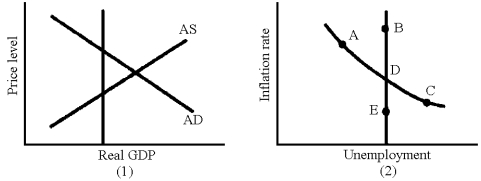 -Given the situation in graph (1)in Figure 17-3,what movement would be expected in graph (2)from the economy's self-correcting mechanism?
 (Multiple Choice)
4.7/5 (84)
(84) Most economists think that the economy's self-correcting mechanism is
(Multiple Choice)
4.8/5 (66)
(66) European governments accepted prolonged periods of unemployment in the 1990s in order to reduce inflation.
(True/False)
4.9/5 (72)
(72) Figure 17-6
 -If Figure 17-6 (a)illustrates the elimination of a recessionary gap,then the economy should move to what point on the curves shown in Figure 17-6 (b)?
 (Multiple Choice)
4.9/5 (77)
(77) Inflation targeting requires monetary policy makers to rely heavily on the Phillips curve.
(True/False)
4.8/5 (80)
(80) The suggestion that the Fed concentrate only on reducing inflation is an attempt to
(Multiple Choice)
4.8/5 (70)
(70) If strong fiscal policy stimulus is used to combat a recessionary gap,what will happen?
(Multiple Choice)
5.0/5 (77)
(77) Which of the following could trigger supply-side inflation?
(Multiple Choice)
4.8/5 (77)
(77) An increase in AD will trigger more inflation under which of the following conditions?
(Multiple Choice)
4.8/5 (79)
(79) One of the reasons why the Phillips curve is no longer viewed as a "menu" of possible choices available to policy makers is that
(Multiple Choice)
4.9/5 (83)
(83) In the 1960s and early 1970s,many economists and policy makers thought the Phillips curve was
(Multiple Choice)
4.9/5 (86)
(86) Inflation can come from the demand side or from the supply side of the economy.
(True/False)
4.9/5 (87)
(87) If aggregate demand had grown faster than it did from 2009 to 2010,then the U.S.economy would have experienced
(Multiple Choice)
4.9/5 (73)
(73) Policy makers who believe that the costs of unemployment are very high will tend to favor which of the following during a recessionary gap?
(Multiple Choice)
5.0/5 (78)
(78) If actual inflation differs from expected inflation,what is the slope of the aggregate supply curve?
(Multiple Choice)
4.8/5 (79)
(79) Most economists and policy makers decided in 2007-2010 that reducing unemployment was the main national priority.
(True/False)
4.8/5 (104)
(104) What will tend to happen to wages if workers and employers foresee inflation?
(Multiple Choice)
4.8/5 (86)
(86) Empirical research suggests that the steepness of the aggregate supply curve depends on the
(Multiple Choice)
4.8/5 (85)
(85) 
Filters
- Essay(0)
- Multiple Choice(0)
- Short Answer(0)
- True False(0)
- Matching(0)