



 Chat with AI
Exam 17: The Trade Off between Inflation and Unemployment

Exam 1: What Is Economics?227 Questions
Exam 2: The Economy: Myth and Reality150 Questions
Exam 3: The Fundamental Economic Problem: Scarcity and Choice250 Questions
Exam 4: Supply and Demand: An Initial Look308 Questions
Exam 5: An Introduction to Macroeconomics211 Questions
Exam 6: The Goals of Macroeconomic Policy207 Questions
Exam 7: Economic Growth: Theory and Policy223 Questions
Exam 8: Aggregate Demand and the Powerful Consumer214 Questions
Exam 9: Demand-Side Equilibrium: Unemployment or Inflation?211 Questions
Exam 10: Bringing in the Supply Side: Unemployment and Inflation?223 Questions
Exam 11: Managing Aggregate Demand: Fiscal Policy205 Questions
Exam 12: Money and the Banking System219 Questions
Exam 13: Monetary Policy: Conventional and Unconventional205 Questions
Exam 14: The Financial Crisis and the Great Recession61 Questions
Exam 15: The Debate over Monetary and Fiscal Policy214 Questions
Exam 16: Budget Deficits in the Short and Long Run210 Questions
Exam 17: The Trade Off between Inflation and Unemployment214 Questions
Exam 18: International Trade and Comparative Advantage226 Questions
Exam 19: The International Monetary System: Order or Disorder?213 Questions
Exam 20: Exchange Rates and the Macroeconomy214 Questions
Select questions type


A decrease in AS will trigger more inflation under which of the following conditions?
(Multiple Choice)
4.7/5  (82)
(82) When the aggregate supply curve shifts adversely,what happens to the relationship shown in the Phillips curve?
(Multiple Choice)
4.8/5 (71)
(71) Figure 17-6
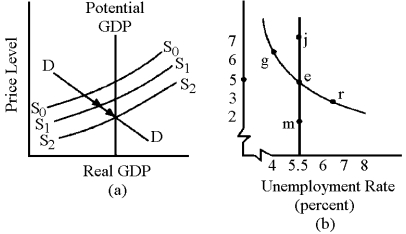 -If the economy in 34-6 (b)is experiencing an inflationary gap (point g),the economy's self-correcting process will move unemployment to ____ and inflation to ____.
 (Multiple Choice)
4.8/5 (73)
(73) The origin of the Phillips curve is the idea that an increase in
(Multiple Choice)
4.9/5 (65)
(65) The Phillips curve is built on the assumption that business fluctuations are
(Multiple Choice)
4.9/5 (80)
(80) Supply-side inflation will increase the price level and reduce real GDP.
(True/False)
4.9/5 (76)
(76) At the natural rate of unemployment,the long-run Phillips curve has a(n)
(Multiple Choice)
4.8/5 (80)
(80) If AS increases at a faster rate than AD,the result will be
(Multiple Choice)
4.7/5 (95)
(95) In the short run,fiscal and monetary policy cause unemployment and inflation to move in opposite directions because
(Multiple Choice)
4.8/5 (74)
(74) Some economists argue that there is no such thing as a short-run Phillips curve.Who are these economists and what is their argument?
(Essay)
4.9/5 (84)
(84) If the fluctuations in the economy's real growth rate from year to year are caused primarily by variations in the rate at which aggregate demand increases,then data would show
(Multiple Choice)
4.8/5 (70)
(70) Figure 17-8
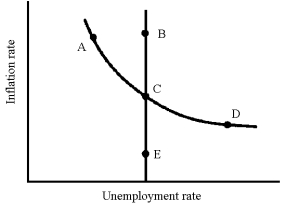 -In Figure 17-8,which of the following movements illustrates the response of the economy to an increase in aggregate demand when expectations are "rational"?
 (Multiple Choice)
4.9/5 (85)
(85) Politicians and economists who are generally conservative tend to believe that
(Multiple Choice)
4.9/5 (86)
(86) Which of the following observations concerning the Phillips curve is not t?
(Multiple Choice)
5.0/5 (79)
(79) If the fluctuations in the economy's real growth rate from year to year are caused primarily by variations in the rate at which aggregate demand increases,then data would show the
(Multiple Choice)
4.9/5 (91)
(91) Demand-side inflation is usually accompanied by increasing real GDP,while supply-side inflation is usually accompanied by falling real GDP.
(True/False)
4.8/5 (91)
(91) Figure 17-8
-In Figure 17-8,the aggregate supply curve is shifting inward as we move from
-In Figure 17-8,the aggregate supply curve is shifting inward as we move from (Multiple Choice)
4.9/5 (79)
(79) The natural rate of unemployment corresponds to what is sometimes called the full employment unemployment rate.
(True/False)
4.7/5 (74)
(74) 
Filters
- Essay(0)
- Multiple Choice(0)
- Short Answer(0)
- True False(0)
- Matching(0)