



 Chat with AI
Exam 17: The Trade Off between Inflation and Unemployment

Exam 1: What Is Economics?227 Questions
Exam 2: The Economy: Myth and Reality150 Questions
Exam 3: The Fundamental Economic Problem: Scarcity and Choice250 Questions
Exam 4: Supply and Demand: An Initial Look308 Questions
Exam 5: An Introduction to Macroeconomics211 Questions
Exam 6: The Goals of Macroeconomic Policy207 Questions
Exam 7: Economic Growth: Theory and Policy223 Questions
Exam 8: Aggregate Demand and the Powerful Consumer214 Questions
Exam 9: Demand-Side Equilibrium: Unemployment or Inflation?211 Questions
Exam 10: Bringing in the Supply Side: Unemployment and Inflation?223 Questions
Exam 11: Managing Aggregate Demand: Fiscal Policy205 Questions
Exam 12: Money and the Banking System219 Questions
Exam 13: Monetary Policy: Conventional and Unconventional205 Questions
Exam 14: The Financial Crisis and the Great Recession61 Questions
Exam 15: The Debate over Monetary and Fiscal Policy214 Questions
Exam 16: Budget Deficits in the Short and Long Run210 Questions
Exam 17: The Trade Off between Inflation and Unemployment214 Questions
Exam 18: International Trade and Comparative Advantage226 Questions
Exam 19: The International Monetary System: Order or Disorder?213 Questions
Exam 20: Exchange Rates and the Macroeconomy214 Questions
Select questions type


If the fluctuations in the economy's real growth rate from year to year are caused primarily by variations in the rate at which aggregate supply increases,then data would show
(Multiple Choice)
4.9/5  (72)
(72) An economy eliminates a recessionary gap by reducing wages and prices.
(True/False)
4.8/5 (91)
(91) Expansionary fiscal and monetary policy from 2008 to 2010,took the risk of being inflationary for the sake of avoiding additional unemployment.
(True/False)
4.9/5 (81)
(81) If the aggregate supply curve shifts outward,then unemployment
(Multiple Choice)
4.8/5 (77)
(77) If workers always see inflation coming,and if they demand wage increases in advance so that inflation does not erode real wages,then the economy's aggregate supply curve on the AD-AS diagram will
(Multiple Choice)
5.0/5 (77)
(77) The Phillips curve assumes that shocks to the economy come from the demand side.
(True/False)
4.8/5 (87)
(87) The proposition that the Fed should concentrate on price stability rather than reducing unemployment is
(Multiple Choice)
4.9/5 (77)
(77) If unemployment and inflation always move in the same direction,then we can infer that business fluctuations are
(Multiple Choice)
4.8/5 (78)
(78) Based on the evidence,most economists believe that the self-correcting mechanism operates
(Multiple Choice)
4.8/5 (72)
(72) According to the theory of rational expectations,the government can influence output
(Multiple Choice)
4.9/5 (82)
(82) If aggregate demand in the U.S.had grown more slowly than it actually did in 2010,the
(Multiple Choice)
4.9/5 (77)
(77) A non-policy reason for the reduction in the natural rate of unemployment is the
(Multiple Choice)
4.8/5 (86)
(86) Figure 17-7
 -In Figure 17-7,the case for restrictive monetary and fiscal policy is strongest at point
 (Multiple Choice)
4.9/5 (91)
(91) Figure 17-8
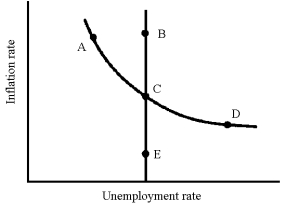 -In Figure 17-8,which of the following movements would you associate with a "negative supply shock"?
 (Multiple Choice)
4.9/5 (85)
(85) According to the theory of rational expectations,errors in predicting inflation will
(Multiple Choice)
4.8/5 (55)
(55) The aggregate supply curve slopes upward when the real wage falls initially as the price level rises.
(True/False)
4.9/5 (87)
(87) Adverse shocks such as the crop failures of 1972-1973 and the oil price increases of 1974 and 1979 pushed the economy's
(Multiple Choice)
4.8/5 (85)
(85) If nominal wages increase at the same rate as inflation,then the aggregate supply curve will be a horizontal line.
(True/False)
4.9/5 (83)
(83) 
Filters
- Essay(0)
- Multiple Choice(0)
- Short Answer(0)
- True False(0)
- Matching(0)