



 Chat with AI
Exam 9: Hearing: Physiology and Psychoacoustics

Exam 1: Introduction69 Questions
Exam 2: The First Steps in Vision: From Light to Neural Signals69 Questions
Exam 3: Spatial Vision: From Spots to Stripes63 Questions
Exam 4: Perceiving and Recognizing Objects57 Questions
Exam 5: The Perception of Color62 Questions
Exam 6: Space Perception and Binocular Vision60 Questions
Exam 7: Attention and Scene Perception64 Questions
Exam 8: Visual Motion Perception56 Questions
Exam 9: Hearing: Physiology and Psychoacoustics79 Questions
Exam 10: Hearing in the Environment49 Questions
Exam 11: Music and Speech Perception50 Questions
Exam 12: Vestibular Sensation63 Questions
Exam 13: Touch71 Questions
Exam 14: Olfaction68 Questions
Exam 15: Taste53 Questions
Select questions type


Which instrument can create a noise with the lowest fundamental frequency?
(Multiple Choice)
4.8/5  (75)
(75) The _______ refers to a graph that plots the firing rate of an auditory nerve fiber in response to a sound of a constant frequency at increasing intensities.
(Multiple Choice)
4.8/5 (77)
(77) Refer to the figure.
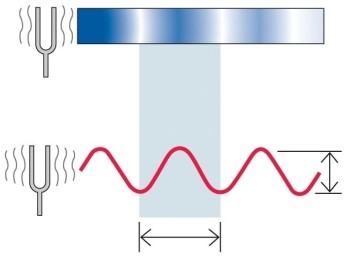 The bottom portion of the figure depicts the simplest kind of sound, known as a
 (Multiple Choice)
4.8/5 (89)
(89) A(n) _______ is a map plotting the responses of a neuron or fiber to sine waves with varying frequencies at the lowest intensity that will give rise to a response.
(Multiple Choice)
4.7/5 (79)
(79) How is the harmonic spectrum of sound analogous to the color spectrum of light?
(Multiple Choice)
4.8/5 (82)
(82) The primary auditory cortex (A1) is organized in a _______ manner.
(Multiple Choice)
4.9/5 (82)
(82) Refer to the graph.
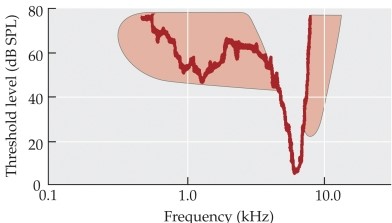 Which frequency and volume combination would be most likely to suppress the firing of the 8000-Hz auditory nerve fiber?
 (Multiple Choice)
4.8/5 (84)
(84) What would happen if you did not have the stapedius and tensor tympani muscles?
(Multiple Choice)
4.7/5 (79)
(79) How are sound waves described, and what psychological aspects do they correspond to?
(Essay)
4.7/5 (66)
(66) Refer to the graph.
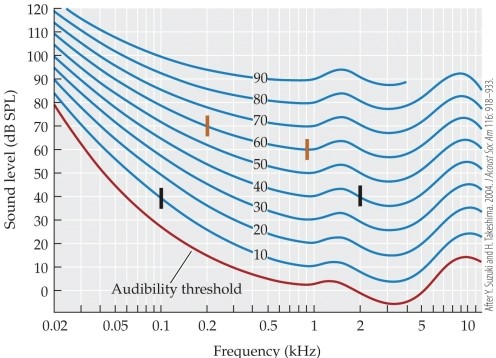 When you play piano, why might you have to hit the keys harder with your left hand (lower notes) than your right hand (higher notes) to make them sound the same volume?
 (Multiple Choice)
4.9/5 (79)
(79) The first area within the temporal lobes that is responsible for processing acoustic information is called the
(Multiple Choice)
4.7/5 (84)
(84) The tympanic, vestibular, and middle canals are filled with which substance?
(Multiple Choice)
4.9/5 (73)
(73) Hearing loss that is caused by problems with bones of the middle ear is called
(Multiple Choice)
4.8/5 (87)
(87) Describe the pathway of auditory nerve signals from the auditory nerve to primary auditory cortex.
(Essay)
4.9/5 (74)
(74) 
Filters
- Essay(0)
- Multiple Choice(0)
- Short Answer(0)
- True False(0)
- Matching(0)