



 Chat with AI
Exam 10: Hearing in the Environment

Exam 1: Introduction69 Questions
Exam 2: The First Steps in Vision: From Light to Neural Signals69 Questions
Exam 3: Spatial Vision: From Spots to Stripes63 Questions
Exam 4: Perceiving and Recognizing Objects57 Questions
Exam 5: The Perception of Color62 Questions
Exam 6: Space Perception and Binocular Vision60 Questions
Exam 7: Attention and Scene Perception64 Questions
Exam 8: Visual Motion Perception56 Questions
Exam 9: Hearing: Physiology and Psychoacoustics79 Questions
Exam 10: Hearing in the Environment49 Questions
Exam 11: Music and Speech Perception50 Questions
Exam 12: Vestibular Sensation63 Questions
Exam 13: Touch71 Questions
Exam 14: Olfaction68 Questions
Exam 15: Taste53 Questions
Select questions type


Damage to which structure would specifically impair computations of interaural time differences?

Free
(Multiple Choice)
4.9/5  (65)
(65) Correct Answer: Verified
C
If someone's medial superior olive structures are destroyed, they are most likely to experience difficulty using
Free
(Multiple Choice)
4.7/5 (83)
(83) Correct Answer:Verified
VerifiedA
Which of the following describes the phenomenon of, for example, being able to identify the different instruments in a composition based on their distinctive sound characteristics?
Free
(Multiple Choice)
4.8/5 (92)
(92) Correct Answer:Verified
VerifiedB
Describe the two major cues that our brain uses to localize sound waves.
(Essay)
4.8/5 (77)
(77) The part of a sound during which amplitude decreases is known as
(Multiple Choice)
4.8/5 (79)
(79) The _______ is the relay station in the brain stem where inputs from both ears contribute to the detection of interaural time differences.
(Multiple Choice)
5.0/5 (81)
(81) The part of a sound during which amplitude increases is known as
(Multiple Choice)
4.9/5 (75)
(75) Refer to the figure.
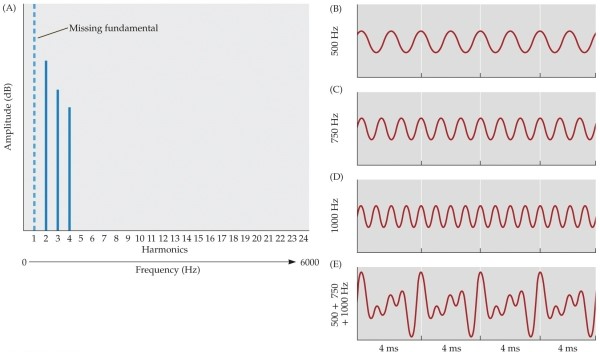 This figure demonstrates that when only three harmonics of the same fundamental frequency are presented (B-D), listeners still hear the pitch of the fundamental frequency because the harmonics all
 (Multiple Choice)
5.0/5 (88)
(88) Refer to the figure.
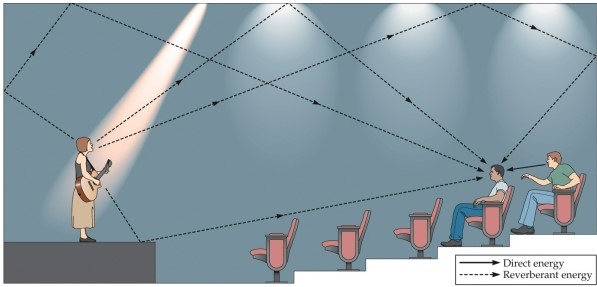 This figure demonstrates that the relative amounts of direct and reverberant energy coming from the listener's neighbor and the singer will inform him of the
 (Multiple Choice)
4.8/5 (71)
(71) When you pluck the string on a violin rather than use a bow to play the same note, which sound aspect is the most different?
(Multiple Choice)
4.8/5 (77)
(77) Refer to the figure.
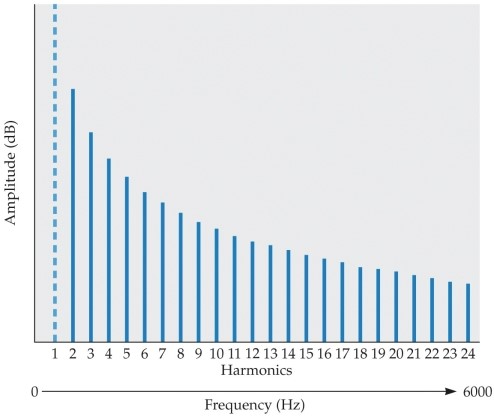 Even if the lowest frequency of a harmonic sound is removed (as in the figure), listeners still hear the pitch of this
 (Multiple Choice)
4.7/5 (75)
(75) _______ refers to the region of positions in space where all the sounds produce the same time and level (intensity) differences.
(Multiple Choice)
4.8/5 (73)
(73) 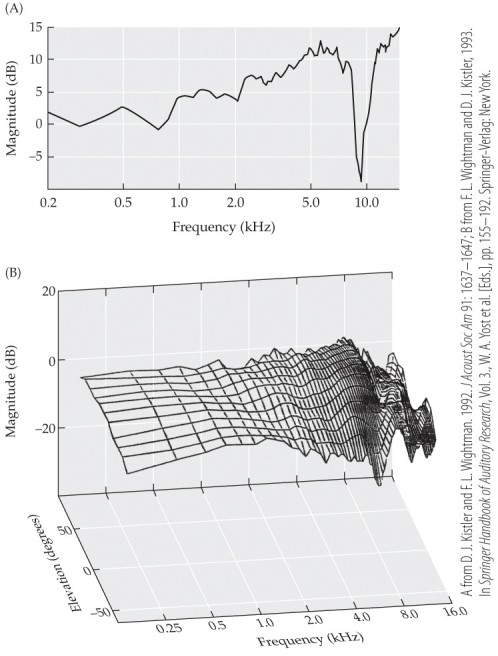 These graphs illustrate the
Suppose you get a new ear piercing that dramatically changes the shape of your pinna and causes you to have trouble localizing sounds. From which direction will you have the hardest time localizing sounds, and why?
(Multiple Choice)
4.8/5 (78)
(78) _______ is the psychological sensation by which a listener can judge that two sounds with the same loudness and pitch are dissimilar.
(Multiple Choice)
4.9/5 (73)
(73) _______ is a process by which missing or degraded acoustic signals are perceptually replaced.
(Multiple Choice)
4.8/5 (76)
(76) Suppose you are in the woods and hear a high-pitched screech (above 1000 Hz). Which auditory localization cue will help you determine where the sound came from?
(Multiple Choice)
4.9/5 (88)
(88) If someone's lateral superior olive structures are destroyed, they are most likely to experience difficulty using
(Multiple Choice)
4.7/5 (85)
(85) 
Filters
- Essay(0)
- Multiple Choice(0)
- Short Answer(0)
- True False(0)
- Matching(0)