



 Chat with AI
Exam 10: Hearing in the Environment

Exam 1: Introduction69 Questions
Exam 2: The First Steps in Vision: From Light to Neural Signals69 Questions
Exam 3: Spatial Vision: From Spots to Stripes63 Questions
Exam 4: Perceiving and Recognizing Objects57 Questions
Exam 5: The Perception of Color62 Questions
Exam 6: Space Perception and Binocular Vision60 Questions
Exam 7: Attention and Scene Perception64 Questions
Exam 8: Visual Motion Perception56 Questions
Exam 9: Hearing: Physiology and Psychoacoustics79 Questions
Exam 10: Hearing in the Environment49 Questions
Exam 11: Music and Speech Perception50 Questions
Exam 12: Vestibular Sensation63 Questions
Exam 13: Touch71 Questions
Exam 14: Olfaction68 Questions
Exam 15: Taste53 Questions
Select questions type


What is auditory stream segregation and what cues does the brain use to achieve it?
(Essay)
4.9/5  (78)
(78) Neurons that are sensitive to intensity differences between the two ears can be found in the
(Multiple Choice)
4.9/5 (79)
(79) Which method(s) of sound localization between the two ears is/are used most often for tones of very high frequencies?
(Multiple Choice)
4.9/5 (85)
(85) Refer to the graph.
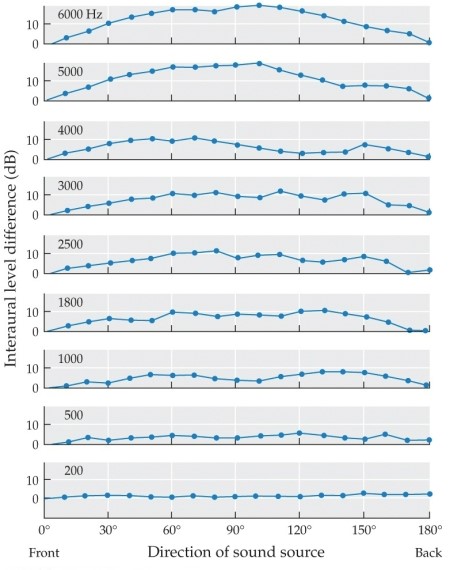 This graph shows _______ for tones of different frequencies presented at different positions around the head.
 (Multiple Choice)
4.8/5 (82)
(82) _______ is the lowest-frequency component of a complex periodic sound.
(Multiple Choice)
4.9/5 (67)
(67) The _______ is a relay station in the brain stem where inputs from both ears contribute to the detection of interaural level differences.
(Multiple Choice)
4.9/5 (75)
(75) _______ is the perceptual organization of a complex acoustic signal into separate auditory events.
(Multiple Choice)
4.8/5 (76)
(76) Which of the following do(es) not contribute to sound localization?
(Multiple Choice)
4.7/5 (89)
(89) A very simple example of auditory stream segregation involves two tones with similar frequencies that are
(Multiple Choice)
4.9/5 (73)
(73) Which of the following describes the phenomenon of grouping sounds that begin at the same time?
(Multiple Choice)
4.9/5 (87)
(87) _______ effects have been demonstrated in the laboratory with a wide variety of target sounds and interrupting sounds. The simplest version of such an experiment is to delete portions of a pure tone and replace them with noise.
(Multiple Choice)
4.8/5 (81)
(81) _______ is the complex quality of sound that lets us distinguish a note played on the piano from the same note played on a trumpet.
(Multiple Choice)
4.9/5 (80)
(80) According to the inverse-square law, as distance from a source _______, intensity _______ faster such that the _______ in intensity is the distance squared.
(Multiple Choice)
4.8/5 (84)
(84) Which of the following does not contribute to auditory stream segregation?
(Multiple Choice)
4.8/5 (78)
(78) Refer to the figure.
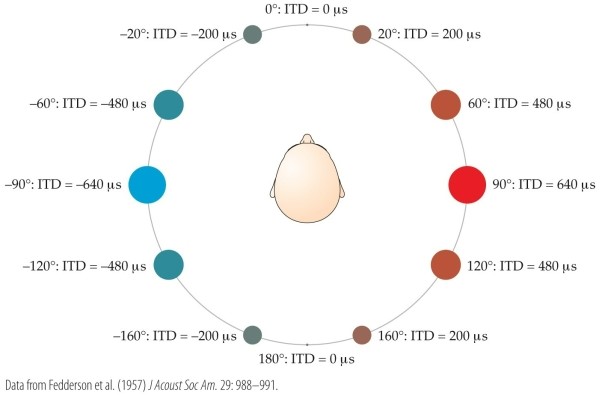 The blue circles in this interaural time difference diagram refer to locations from which sound reaches the _______ first.
 (Multiple Choice)
4.9/5 (88)
(88) Which direction on the azimuth would have the largest interaural time difference?
(Multiple Choice)
4.8/5 (88)
(88) The _______ is the difference in time between a sound arriving at one ear versus the other and helps us localize sound.
(Multiple Choice)
4.8/5 (87)
(87) Which method(s) of sound localization between the two ears is/are used most often for tones of very low frequencies?
(Multiple Choice)
4.8/5 (69)
(69) 
Filters
- Essay(0)
- Multiple Choice(0)
- Short Answer(0)
- True False(0)
- Matching(0)