



 Chat with AI
Exam 16: Psychopathology: Biological Basis of Behavioral Disorders

Exam 1: Behavioral Neuroscience Scope and Outlook99 Questions
Exam 2: Functional Neuroanatomy: The Cells and Structures of the Nervous System143 Questions
Exam 3: Neurophysiology: The Generation, Transmission, and Integration of Neural Signals136 Questions
Exam 4: The Chemistry of Behavior: Neurotransmitters and Neuropharmacology130 Questions
Exam 5: Hormones and the Brain130 Questions
Exam 6: Evolution of the Brain and Behavior125 Questions
Exam 7: Life-Span Development of the Brain and Behavior127 Questions
Exam 8: General Principles of Sensory Processing, Touch, and Pain127 Questions
Exam 9: Hearing, Balance, Taste, and Smell125 Questions
Exam 10: Vision: From Eye to Brain124 Questions
Exam 11: Motor Control and Plasticity132 Questions
Exam 12: Sex: Evolutionary, Hormonal, and Neural Bases139 Questions
Exam 13: Homeostasis: Active Regulation of the Internal Environment126 Questions
Exam 14: Biological Rhythms, Sleep, and Dreaming138 Questions
Exam 15: Emotions, Aggression, and Stress136 Questions
Exam 16: Psychopathology: Biological Basis of Behavioral Disorders127 Questions
Exam 17: Learning and Memory129 Questions
Exam 18: Attention and Higher Cognition127 Questions
Exam 19: Language and Lateralization127 Questions
Select questions type


Which drug has been shown to markedly reduce the symptoms of anxiety?
(Multiple Choice)
4.9/5  (75)
(75) In addition to showing changes in serotonin levels, suicide victims show high levels of circulating
(Multiple Choice)
4.9/5 (82)
(82) According to epidemiological studies, at least _______ of Americans experience symptoms of at least one major psychiatric illness during their lifetime.
(Short Answer)
4.9/5 (91)
(91) Survey the ways in which sex, endocrinology, and biological rhythms have all been implicated in depression. How do animal models aid in our understanding of this problem?
(Essay)
4.8/5 (65)
(65) PET scans of people with Tourette's syndrome have revealed a higher density of dopamine D2 receptors in the _______.
(Short Answer)
4.8/5 (78)
(78) Benzodiazepines, in the presence of GABA, increase the permeability of neurons to _______.
(Short Answer)
4.7/5 (77)
(77) According to the monoamine hypothesis, depression is caused by
(Multiple Choice)
4.9/5 (81)
(81) Summarize the different treatments that have been used to treat depression. Which are prevalent today and how do they work?
(Essay)
4.8/5 (76)
(76) Refer to the figure showing PET scans of patients with Tourette's syndrome.
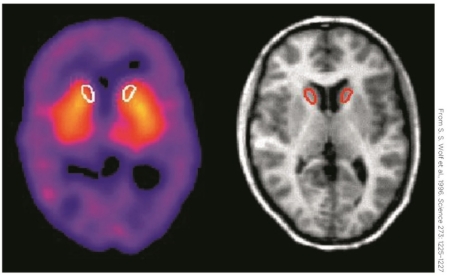 These scans show greater density of dopamine receptors in the
 (Multiple Choice)
4.9/5 (75)
(75) Refer to the figure showing PET scans of twins in which one is affected with schizophrenia and one is not.
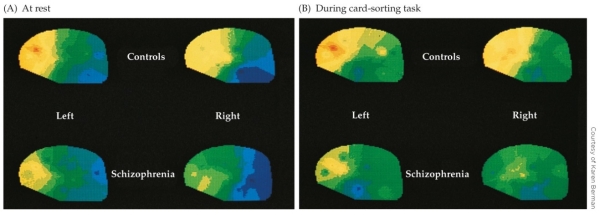 The activation patterns suggest _______ activation in the frontal cortex of the affected twin, both at rest and during the Wisconsin Cart Sorting Test.
 (Multiple Choice)
4.9/5 (79)
(79) Compare and contrast unipolar depression with bipolar disorder and discuss their treatments.
(Essay)
4.7/5 (77)
(77) Based on studies of phencyclidine, a _______ hypothesis of schizophrenia has been proposed.
(Multiple Choice)
4.8/5 (67)
(67) Provide a history of the use of lobotomy to alleviate severe psychiatric distress and describe one other type of psychosurgery that is used today to treat symptoms of anxiety.
(Essay)
4.9/5 (83)
(83) The dopamine hypothesis of schizophrenia is challenged by data showing that
(Multiple Choice)
4.7/5 (82)
(82) In a patient who has recovered from depression, dexamethasone _______ cortisol release.
(Short Answer)
4.8/5 (89)
(89) The gene that encodes _______ has been implicated in bipolar disorder.
(Multiple Choice)
4.7/5 (83)
(83) The drug clomipramine has been shown to bring about significant improvement in many people diagnosed with
(Multiple Choice)
4.7/5 (83)
(83) 
Filters
- Essay(0)
- Multiple Choice(0)
- Short Answer(0)
- True False(0)
- Matching(0)