



 Chat with AI
Exam 18: Attention and Higher Cognition

Exam 1: Behavioral Neuroscience Scope and Outlook99 Questions
Exam 2: Functional Neuroanatomy: The Cells and Structures of the Nervous System143 Questions
Exam 3: Neurophysiology: The Generation, Transmission, and Integration of Neural Signals136 Questions
Exam 4: The Chemistry of Behavior: Neurotransmitters and Neuropharmacology130 Questions
Exam 5: Hormones and the Brain130 Questions
Exam 6: Evolution of the Brain and Behavior125 Questions
Exam 7: Life-Span Development of the Brain and Behavior127 Questions
Exam 8: General Principles of Sensory Processing, Touch, and Pain127 Questions
Exam 9: Hearing, Balance, Taste, and Smell125 Questions
Exam 10: Vision: From Eye to Brain124 Questions
Exam 11: Motor Control and Plasticity132 Questions
Exam 12: Sex: Evolutionary, Hormonal, and Neural Bases139 Questions
Exam 13: Homeostasis: Active Regulation of the Internal Environment126 Questions
Exam 14: Biological Rhythms, Sleep, and Dreaming138 Questions
Exam 15: Emotions, Aggression, and Stress136 Questions
Exam 16: Psychopathology: Biological Basis of Behavioral Disorders127 Questions
Exam 17: Learning and Memory129 Questions
Exam 18: Attention and Higher Cognition127 Questions
Exam 19: Language and Lateralization127 Questions
Select questions type


Refer to the figure.
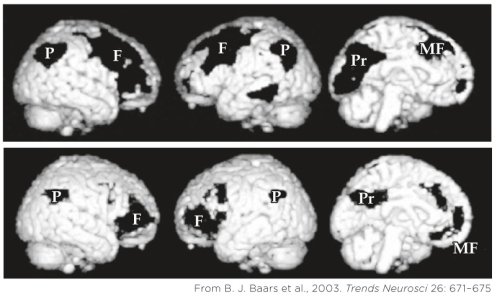 What do the similarities between the scans in the figure indicate?
 (Multiple Choice)
4.8/5  (75)
(75) Which of the following is a component of an averaged ERP waveform?
(Multiple Choice)
4.8/5 (79)
(79) One symptom of Bálint's syndrome is a spatial disorientation known as _______, which causes difficulty using vision to reach and manipulate objects.
(Multiple Choice)
4.8/5 (71)
(71) Damage to the right inferior parietal cortex often produces _______, in which the patient disregards the left side of the world.
(Short Answer)
4.9/5 (92)
(92) Currently, the model of attentional selection that is generally considered to have the most robust experimental support is
(Multiple Choice)
5.0/5 (68)
(68) A person who has trouble moving her eyes to an object, is unable to reach for objects she can see, and can only pay attention to one feature at a time may have
(Multiple Choice)
4.7/5 (91)
(91) Write a coherent and informative paragraph incorporating each of the following terms or concepts: attentional bottleneck; early-selection models; late-selection models.
(Essay)
4.8/5 (90)
(90) The experience of having your attention suddenly captured by hearing your name from across the room illustrates which attentional selection model?
(Multiple Choice)
4.9/5 (83)
(83) Which regional prefrontal syndrome is correctly associated with the damage that causes it and its symptoms?
(Multiple Choice)
4.7/5 (84)
(84) The "hard problem of consciousness" refers to the difficulty of understanding
(Multiple Choice)
4.8/5 (87)
(87) One's enhanced perception of a particular conversation in a crowded room is referred to as
(Multiple Choice)
5.0/5 (94)
(94) Discuss the differences between early-selection and late-selection models of attention and how the notion of perceptual load may resolve these differences.
(Essay)
4.8/5 (87)
(87) Refer to the figure.
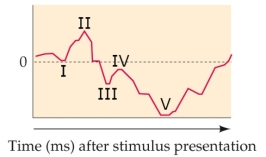 Which choice correctly labels the EEG in the figure?
 (Multiple Choice)
4.8/5 (68)
(68) In the _______ task, subjects are provided with a cue that predicts target location.
(Multiple Choice)
4.9/5 (82)
(82) In a choice reaction time test, visual information typically is processed at the level of the prefrontal cortex within _______ ms.
(Multiple Choice)
4.8/5 (77)
(77) Gallant and colleagues were able to reconstruct subjects' visual experiences by using
(Multiple Choice)
4.9/5 (88)
(88) 
Filters
- Essay(0)
- Multiple Choice(0)
- Short Answer(0)
- True False(0)
- Matching(0)