



 Chat with AI
Exam 1: Health Disparities: Entering a Strange Land at a Strange Time

Exam 1: Health Disparities: Entering a Strange Land at a Strange Time45 Questions
Exam 2: What Are Health Disparities45 Questions
Exam 3: How to Conduct Research on Health Disparities27 Questions
Exam 4: Data Sources to Study Health and Health Care Disparities24 Questions
Exam 5: Simple Statistical Tools to Assess Health and Health Care Disparities30 Questions
Exam 6: Physicians, Health Care Quality, and Health Disparities25 Questions
Exam 7: Health Care Disparities in Physician Practices24 Questions
Exam 8: Using Physicianpatient Partnerships to Reduce Health Care Disparities25 Questions
Exam 9: Disparities in Primary, Specialty, and Tertiary Health Care Markets25 Questions
Exam 10: Hospitals and Health Disparities35 Questions
Exam 11: Health Disparities in Health Insurance Markets25 Questions
Exam 12: Disparities in Long-Term Care Institutions41 Questions
Exam 13: They Protect Eagles, Dont They: Using Health Disparity Research to Tell New Stories - Case Study I35 Questions
Exam 14: Uncovering Health Disparities - A Case Study on Adverse Childhood Experiences and Intentional and Unintentional Injuries30 Questions
Exam 15: Health and Health Care Disparities Where Do We Go From Here25 Questions
Select questions type


Carefully review Table 1.7 and answer the questions below.
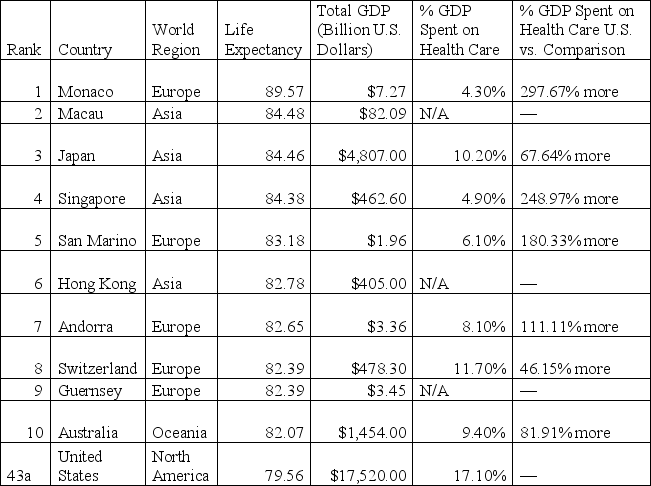 -A paradox is defined by Merriam-Webster as: 1) "…a statement that is seemingly contradictory or opposed to common sense and yet is, perhaps, true", and 2) "a self-contradictory statement that at first seems true". Does it appear that the country in table 1.7 which spends the smallest percent of GDP on health care has the greatest life expectancy in the world? Whether it does nor does not, which statement below is suggested by this relationship?
 (Multiple Choice)
4.9/5  (84)
(84) Which of the world's land masses listed below serve as home to the smallest percent (%) of the world's population?
(Multiple Choice)
5.0/5 (88)
(88) This table lists percent of GDP spent on health care and life expectancy for a group of countries that are culturally similar to the United States. Using the online Pearson correlation coefficient in the link https://www.socscistatistics.com select the correct correlation coefficient between life expectancy and the % of GDP spent on health care for these countries.
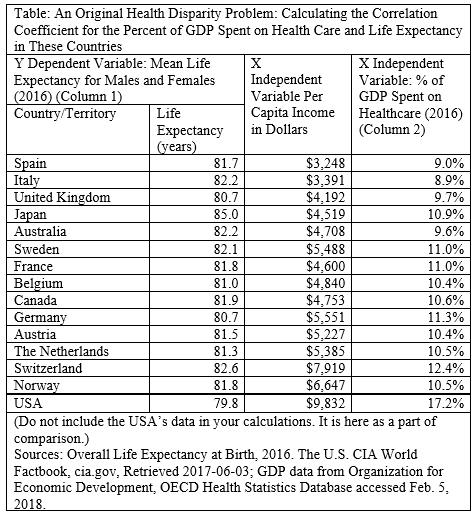 -This value suggests that the correlation between life expectancy and the percent of GDP spent on health care is:
 (Multiple Choice)
4.9/5 (75)
(75) Health care administrators are on the business side of health care. Accordingly, they need no skills in the area of health disparities.
(True/False)
4.9/5 (72)
(72) Which statement(s) below were used to confirm that the present is the "best of times" for humankind as a collective?
(Multiple Choice)
4.8/5 (78)
(78) Which of the world's land masses listed below serve as home to the largest percent (%) of the world's population?
(Multiple Choice)
4.8/5 (73)
(73) This table lists percent of GDP spent on health care and life expectancy for a group of countries that are culturally similar to the United States. Using the online Pearson correlation coefficient in the link https://www.socscistatistics.com select the correct correlation coefficient between life expectancy and the % of GDP spent on health care for these countries.
-Now recalculate the correlation coefficient based on the relationship between life expectancy and the dollar amount spent on GDP for each country. The correlation coefficient r for the calculation for was:
-Now recalculate the correlation coefficient based on the relationship between life expectancy and the dollar amount spent on GDP for each country. The correlation coefficient r for the calculation for was: (Multiple Choice)
4.9/5 (77)
(77) Based upon your own reflections, do you feel that it is true or false that health and healthcare disparities discussions generally create feelings of discomfort among America's various ethnic and/or racial groups?
(Essay)
4.8/5 (77)
(77) This table lists percent of GDP spent on health care and life expectancy for a group of countries that are culturally similar to the United States. Using the online Pearson correlation coefficient in the link https://www.socscistatistics.com select the correct correlation coefficient between life expectancy and the % of GDP spent on health care for these countries.
-The relationship is:
-The relationship is: (Multiple Choice)
4.9/5 (81)
(81) According to the authors, Contemporary Tribalism is primarily based upon:
(Multiple Choice)
4.8/5 (82)
(82) Based upon the data in the table below, the correlation of coefficient r is ____ for life expectancy and the % of GDP spent on healthcare:
________________
(Short Answer)
4.8/5 (84)
(84) According to Chapter 1, some of the differences in GDP per capita by region is due to:
(Multiple Choice)
4.7/5 (55)
(55) Carefully review Table 1.7 and answer the questions below.
-Which groups of countries listed in Table 1.7 have the second highest percent of GDP that is spent on health care in comparison with the U.S.A.?
-Which groups of countries listed in Table 1.7 have the second highest percent of GDP that is spent on health care in comparison with the U.S.A.? (Multiple Choice)
4.8/5 (88)
(88) Each of the ten definitions of "Tribe" discussed in the text emphasize that a tribe is always defined in a way that includes a common ancestor.
(True/False)
5.0/5 (77)
(77) From 2014 to 2017, the United States' ranking for life expectancy __________:
(Multiple Choice)
4.9/5 (94)
(94) The country that has the greatest life expectancy at birth in the world for its residents is:
(Multiple Choice)
4.8/5 (62)
(62) According to the authors, life expectancy has increased for:
(Multiple Choice)
4.9/5 (80)
(80) According to the authors, differences in cultural values must also be taken into consideration in interpreting the means of the higher percentage (%) of GDP spent on health care in the U.S. relative to other countries.
(True/False)
4.9/5 (70)
(70) 
Filters
- Essay(0)
- Multiple Choice(0)
- Short Answer(0)
- True False(0)
- Matching(0)