



 Chat with AI
Exam 11: Cardiovascular Clinical Assessment and Diagnostic Procedures

Exam 1: Caring for the Critically Ill Patient14 Questions
Exam 2: Ethical and Legal Issues16 Questions
Exam 3: Patient and Family Education24 Questions
Exam 4: Psychosocial and Spiritual Alterations and Management25 Questions
Exam 5: Sleep Alterations23 Questions
Exam 6: Nutritional Alterations30 Questions
Exam 7: Gerontological Alterations12 Questions
Exam 8: Pain and Pain Management14 Questions
Exam 9: Sedation, Agitation and Delirium Management20 Questions
Exam 10: End of Life Care20 Questions
Exam 11: Cardiovascular Clinical Assessment and Diagnostic Procedures88 Questions
Exam 12: Cardiovascular Disorders30 Questions
Exam 13: Cardiovascular Therapeutic Management30 Questions
Exam 14: Pulmonary Clinical Assessment and Diagnostic Procedures46 Questions
Exam 15: Pulmonary Disorders24 Questions
Exam 16: Pulmonary Therapeutic Management30 Questions
Exam 17: Neurologic Clinical Assessment and Diagnostic Procedures43 Questions
Exam 18: Neurologic Disorders and Therapeutic Management44 Questions
Exam 19: Kidney Clinical Assessment and Diagnostic Procedures19 Questions
Exam 20: Kidney Disorders and Therapeutic Management28 Questions
Exam 21: Gastrointestinal Clinical Assessment and Diagnostic Procedures21 Questions
Exam 22: Gastrointestinal Disorders and Therapeutic Management21 Questions
Exam 23: Endocrine Clinical Assessment and Diagnostic Procedures16 Questions
Exam 24: Endocrine Disorders and Therapeutic Management49 Questions
Exam 25: Trauma26 Questions
Exam 26: Shock, Sepsis, and Multiple Organ Dysfunction Syndrome28 Questions
Exam 27: Hematologic Disorders and Oncologic Emergencies20 Questions
Select questions type


The purpose of the Allen test is to

Free
(Multiple Choice)
4.9/5  (71)
(71) Correct Answer: Verified
A
Which of the following criteria are representative of the patient in normal sinus rhythm?
Free
(Multiple Choice)
4.9/5 (89)
(89) Correct Answer:Verified
VerifiedB
A patient returns from the cardiac catheterization laboratory after angioplasty and stent placement (ECG changes had indicated an inferior wall myocardial infarction in progress).Which lead would best monitor this patient?
(Multiple Choice)
4.8/5 (81)
(81) A nurse is obtaining the history of a patient who reveals that he had an MI 5 years ago.When the admission 12-lead ECG is reviewed, Q waves are noted in leads V3 and V4 only.Which of the following conclusions is most consistent with this situation?
(Multiple Choice)
4.7/5 (69)
(69) A patient with a serum potassium level of 6.8 mEq/L may exhibit electrocardiographic changes of
(Multiple Choice)
4.9/5 (86)
(86) Ventricular tachycardia has which of the following hemodynamic effects?
(Multiple Choice)
4.8/5 (81)
(81) Which of the following statements made by a patient would indicate the need for further education before an electrophysiology procedure?
(Multiple Choice)
4.8/5 (79)
(79) ST segment monitoring for ischemia has gained increasing importance with the advent of thrombolytic therapy.The most accurate method for monitoring the existence of true ischemic changes is
(Multiple Choice)
4.8/5 (76)
(76) Which serum lipid value is a significant predictor of future acute MI in persons with established coronary artery atherosclerosis?
(Multiple Choice)
4.9/5 (86)
(86) _____ are created by the turbulence of blood flow through a vessel caused by constriction of the blood pressure cuff.
(Multiple Choice)
5.0/5 (79)
(79) The physician anticipates the CVC dwelling time to be 10 to 20 days.The nurse anticipates that the CVC will be placed in the
(Multiple Choice)
4.8/5 (87)
(87) An assessment finding of pulsus alternans may indicate evidence of
(Multiple Choice)
4.8/5 (65)
(65) A 68-year-old patient is admitted to the critical care unit with reports of midchest pressure radiating into the jaw and shortness of breath when walking up stairs.The patient is admitted with a diagnosis of "rule out myocardial infarction." The history portion of the assessment should be guided by
(Multiple Choice)
4.8/5 (80)
(80) Which of the following cardiac enzymes is a highly specific biomarker for myocardial damage?
(Multiple Choice)
4.8/5 (81)
(81) 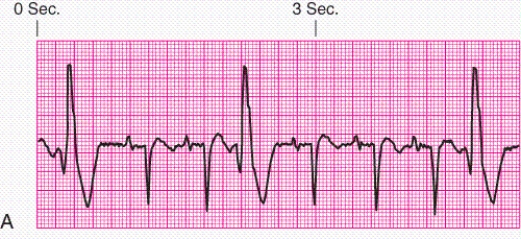
The patient's admitting 12-lead ECG shows peaked P waves.Which of the following admitting diagnoses could be responsible for this finding?
(Multiple Choice)
4.7/5 (71)
(71) Which of the following is most often found in ventricular dysrhythmias?
(Multiple Choice)
4.9/5 (69)
(69) 
Filters
- Essay(0)
- Multiple Choice(0)
- Short Answer(0)
- True False(0)
- Matching(0)