



 Chat with AI
Exam 13: Cardiovascular Therapeutic Management

Exam 1: Caring for the Critically Ill Patient14 Questions
Exam 2: Ethical and Legal Issues16 Questions
Exam 3: Patient and Family Education24 Questions
Exam 4: Psychosocial and Spiritual Alterations and Management25 Questions
Exam 5: Sleep Alterations23 Questions
Exam 6: Nutritional Alterations30 Questions
Exam 7: Gerontological Alterations12 Questions
Exam 8: Pain and Pain Management14 Questions
Exam 9: Sedation, Agitation and Delirium Management20 Questions
Exam 10: End of Life Care20 Questions
Exam 11: Cardiovascular Clinical Assessment and Diagnostic Procedures88 Questions
Exam 12: Cardiovascular Disorders30 Questions
Exam 13: Cardiovascular Therapeutic Management30 Questions
Exam 14: Pulmonary Clinical Assessment and Diagnostic Procedures46 Questions
Exam 15: Pulmonary Disorders24 Questions
Exam 16: Pulmonary Therapeutic Management30 Questions
Exam 17: Neurologic Clinical Assessment and Diagnostic Procedures43 Questions
Exam 18: Neurologic Disorders and Therapeutic Management44 Questions
Exam 19: Kidney Clinical Assessment and Diagnostic Procedures19 Questions
Exam 20: Kidney Disorders and Therapeutic Management28 Questions
Exam 21: Gastrointestinal Clinical Assessment and Diagnostic Procedures21 Questions
Exam 22: Gastrointestinal Disorders and Therapeutic Management21 Questions
Exam 23: Endocrine Clinical Assessment and Diagnostic Procedures16 Questions
Exam 24: Endocrine Disorders and Therapeutic Management49 Questions
Exam 25: Trauma26 Questions
Exam 26: Shock, Sepsis, and Multiple Organ Dysfunction Syndrome28 Questions
Exam 27: Hematologic Disorders and Oncologic Emergencies20 Questions
Select questions type


Which anticoagulant(s)enhances activity of antithrombin III and does not require aPTT or ACT monitoring?

Free
(Multiple Choice)
4.9/5  (74)
(74) Correct Answer: Verified
B
The mechanism of dilation with percutaneous transluminal coronary angioplasty (PTCA)is
Free
(Multiple Choice)
4.8/5 (84)
(84) Correct Answer:Verified
VerifiedA
A patient is admitted to the ICU after a positive exercise treadmill test with a diagnosis of CAD and stable angina.Radiographic test show that the patient has blockage in the left main coronary artery and four other vessels.The nurse anticipates that the patient will be scheduled for
Free
(Multiple Choice)
4.9/5 (74)
(74) Correct Answer:Verified
VerifiedD
Which of the following patients would be a candidate for fibrinolytic therapy?
(Multiple Choice)
4.9/5 (82)
(82) 
A reliable indicator of reperfusion after fibrinolytic therapy is
(Multiple Choice)
4.9/5 (77)
(77) In caring for a postoperative cardiovascular patient, the nurse knows that the most frequent cause of a decreased cardiac output is
(Multiple Choice)
4.8/5 (71)
(71) Vasopressors are used cautiously with critical care patients because they can cause
(Multiple Choice)
4.9/5 (83)
(83) A nurse is providing care to a patient on fibrinolytic therapy.Which of the following statements from the patient warrants further assessment and intervention by the critical care nurse?
(Multiple Choice)
4.9/5 (82)
(82) Nursing interventions after angioplasty would include which of the following?
(Multiple Choice)
4.7/5 (70)
(70) Angiotensin-converting enzyme (ACE)inhibitors such as captopril (Capoten)and enalapril (Vasotec)decrease peripheral vascular resistance and decrease blood pressure by the mechanism of
(Multiple Choice)
4.8/5 (84)
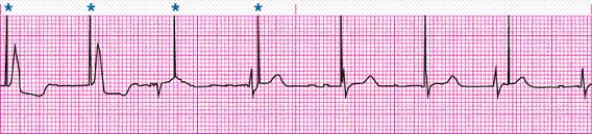
(84) In analyzing the ECG strip, the nurse notices a spike before each QRS complex.The patient's heart rate is 70 beats/min.This phenomenon is reflective of
(Multiple Choice)
4.9/5 (69)
(69) A transvenous pacemaker is inserted through the right subclavian vein and threaded into the right ventricle.The pacemaker is placed on demand at a rate of 70.The pacing mode for this pacemaker is
(Multiple Choice)
4.9/5 (65)
(65) Noninvasive emergency pacing is best achieved via the use of which type of temporary pacing?
(Multiple Choice)
4.8/5 (81)
(81) A patient has an implantable cardioverter defibrillator (ICD)for chronic ventricular tachydysrhythmias.If the patient's rhythm deteriorates to ventricular fibrillation,
(Multiple Choice)
4.8/5 (74)
(74) The predominant form of percutaneous coronary intervention (PCI)is
(Multiple Choice)
5.0/5 (91)
(91) A patient is being monitored by continuous ECG after placement of a transvenous pacemaker."Loss of capture" is seen on the ECG.Which nursing intervention may correct this situation?
(Multiple Choice)
4.9/5 (88)
(88) A patient suddenly develops a wide QRS complex tachycardia.The patient's heart rate is 220 beats/min and regular; blood pressure is 96/40 mm Hg; and respiratory rate is 22 breaths/min, and the patient is awake without complaint except for palpitations.Which of the following interventions would be best to try first?
(Multiple Choice)
4.9/5 (82)
(82) Which of the following statements regarding beta-blockers is correct?
(Multiple Choice)
4.9/5 (69)
(69) 
Filters
- Essay(0)
- Multiple Choice(0)
- Short Answer(0)
- True False(0)
- Matching(0)