



 Chat with AI
Exam 13: Social Behavior and Sociality

Exam 1: An Introduction to Animal Behavior22 Questions
Exam 2: The Integrative Study of Behavior17 Questions
Exam 3: The Developmental and Molecular Bases of Behavior15 Questions
Exam 4: The Neural Basis of Behavior22 Questions
Exam 5: The Physiological and Endocrine Basis of Behavior22 Questions
Exam 6: Avoiding Predators and Finding Food25 Questions
Exam 7: Territoriality and Movement21 Questions
Exam 8: Principles of Communication22 Questions
Exam 9: Reproductive Behavior24 Questions
Exam 10: Mating Systems26 Questions
Exam 11: Parental Care22 Questions
Exam 12: Principles of Social Evolution20 Questions
Exam 13: Social Behavior and Sociality23 Questions
Exam 14: Human Behavior18 Questions
Select questions type


Refer to the figure.
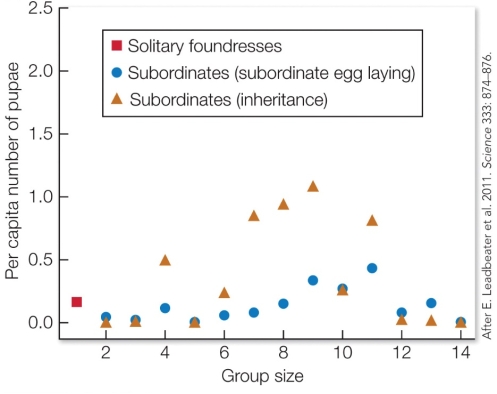 Based on the data in the figure, describe why female Polistes wasps are more likely to be helpers to a foundress rather than establish their own nest as a solitary foundress. What type of social interaction does this helping behavior illustrate, and why?
 (Essay)
5.0/5  (92)
(92) Vampire bats need to eat often, and their only food is blood. When one bat is unsuccessful at gaining a meal, it returns to a communal roost where another, often unrelated, bat is likely to give it a small amount of food. Work by Carter and Wilkinson (2015) suggests that this arrangement meets the conditions needed for
(Multiple Choice)
4.8/5 (70)
(70) There are many costs and benefits to cooperative breeding. Select two of the proposed hypotheses and explain how they apply to cooperative breeding: kin selection hypothesis, group augmentation hypothesis, ecological constraints hypothesis, life history hypothesis, benefits-of-philopatry hypothesis, temporal variability hypothesis.
(Essay)
4.8/5 (83)
(83) 
Filters
- Essay(0)
- Multiple Choice(0)
- Short Answer(0)
- True False(0)
- Matching(0)