



 Chat with AI
Exam 11: Parental Care

Exam 1: An Introduction to Animal Behavior22 Questions
Exam 2: The Integrative Study of Behavior17 Questions
Exam 3: The Developmental and Molecular Bases of Behavior15 Questions
Exam 4: The Neural Basis of Behavior22 Questions
Exam 5: The Physiological and Endocrine Basis of Behavior22 Questions
Exam 6: Avoiding Predators and Finding Food25 Questions
Exam 7: Territoriality and Movement21 Questions
Exam 8: Principles of Communication22 Questions
Exam 9: Reproductive Behavior24 Questions
Exam 10: Mating Systems26 Questions
Exam 11: Parental Care22 Questions
Exam 12: Principles of Social Evolution20 Questions
Exam 13: Social Behavior and Sociality23 Questions
Exam 14: Human Behavior18 Questions
Select questions type


Refer to the figure, which shows the provisioning efficiency of female red mason bees. 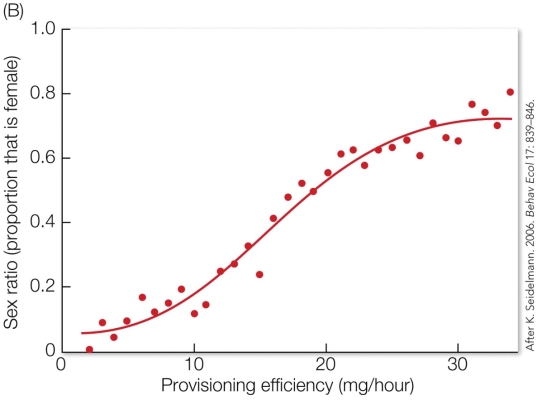 These findings indicate that
Free
(Multiple Choice)
4.8/5  (66)
(66) Correct Answer: Verified
C
Bright red inner mouths in chicks indicate the level of carotenoid pigments in the chicks' diets. How does the signal of quality hypothesis explain why parents might feed these chicks more than their paler-mouthed siblings?
Free
(Essay)
4.9/5 (82)
(82) Correct Answer:Verified
VerifiedCarotenoids are associated with strong immune system function, and chicks with brighter red coloring suggest an individual with a healthier body and higher survival potential.
In what sense is the male hangingfly's gift of a fly to his mate rather like parental investment, even if the female does not use the fly to help her produce larger or better eggs?
Free
(Multiple Choice)
4.9/5 (91)
(91) Correct Answer:Verified
VerifiedA
Assume that the red mouth coloring in chicks is hereditary and not dietary; what might be a different ultimate explanation for why parents preferentially feed red-mouthed chicks?
(Essay)
4.9/5 (85)
(85) Describe the two hypotheses for the evolution of specialized interspecific brood parasitism, and provide one piece of evidence supporting each.
(Essay)
4.9/5 (67)
(67) Refer to the figure.
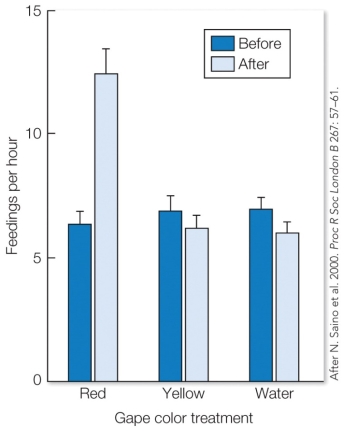 If natural gape coloring is dietary, these results support the
 (Multiple Choice)
4.9/5 (88)
(88) Why are parent birds more likely to be able to discriminate among chicks and find their own offspring (often with 80 percent or higher accuracy) in social species compared to solitary nesters?
(Essay)
4.9/5 (69)
(69) Refer to the figure, which shows the provisioning efficiency of female red mason bees.
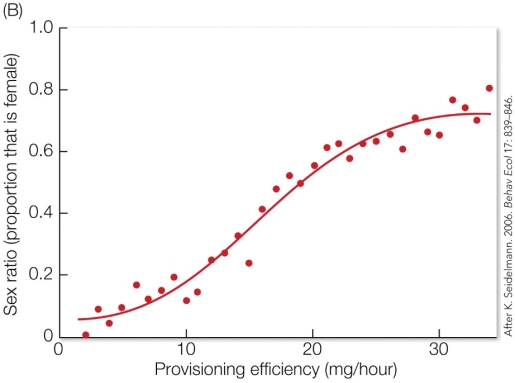 These results suggest that
 (Multiple Choice)
4.9/5 (88)
(88) Refer to the figure.
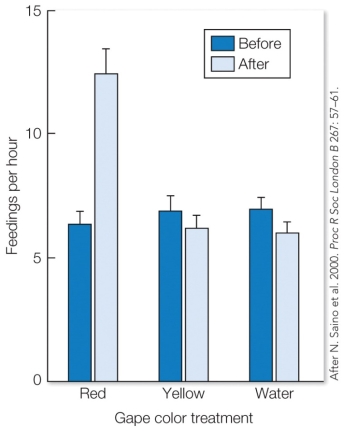 If natural gape coloring is hereditary, this experiment was most likely to test the prediction that
 (Multiple Choice)
4.8/5 (68)
(68) In some colonial, ground-nesting gulls, young birds sometimes leave their natal nests if they have been poorly fed. On occasion, these chicks move to the nests of adults that aren't their parents. Researchers found the following:
Gull chicks that abandoned their natal nests weighed much less on average for chicks their age.
If, however, gull chicks were adopted by nonrelatives, they weighed more on average than unadopted gull chicks.
Adopted chicks are more likely to survive than chicks that remained in natal nests that failed to supply enough food.
Parents that adopted nonrelative chicks lost 0.5 chicks of their own on average.
Less than 10 percent of adult gulls take in a nonrelative chick.
Explain why gull parents might be willing to adopt the offspring of other gulls?
(Essay)
4.9/5 (88)
(88) Considering the costs and benefits to both sexes, when is male parental care more likely to evolve?
(Essay)
4.7/5 (88)
(88) Refer to the figure.
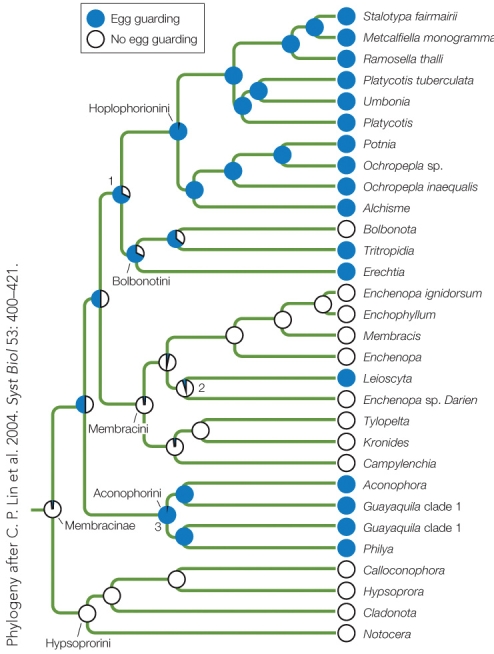 It is hypothesized that egg guarding evolved in treehoppers three times (labelled 1, 2, and 3). Imagine if the trait actually appeared in the ancestral population at the base of the tree, labelled Membracinae. What is the minimum number of trait changes that would be necessary to produce the presence of egg guarding depicted in the tree?
 (Essay)
4.8/5 (64)
(64) Refer to the figure.
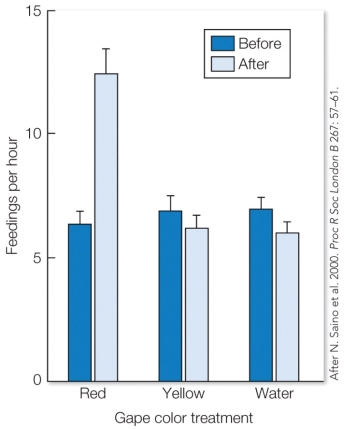 If natural gape coloring is dietary, this experiment was most likely to test the prediction that
 (Multiple Choice)
4.9/5 (64)
(64) The Trivers-Willard hypothesis primarily attempts to explain
(Multiple Choice)
4.8/5 (92)
(92) Explain the parent-offspring conflict in siblicide behavior. In species such as the Nazca booby, why do females lay a second egg if they tolerate high siblicide rates?
(Essay)
4.8/5 (78)
(78) 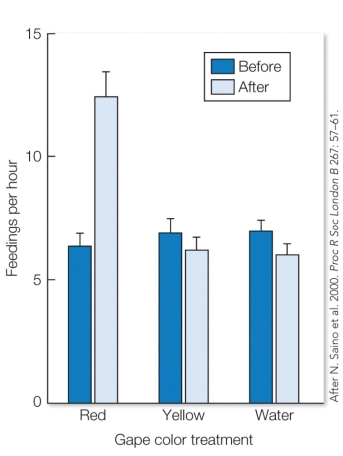 These results indicate that
Is parental care more likely in birds with high adult mortality or low adult mortality? Why is this the case, and what evidence can you provide to support your answer?
(Essay)
4.8/5 (85)
(85) Refer to the figure.
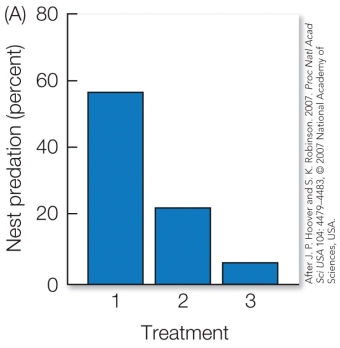 These results show the occurrence of nest predation by cowbirds on prothonotary warblers. After cowbirds laid an egg in the nest, the nests were divided into three treatments:
1) The cowbird egg was removed, and the nest opening left as is.
2) The cowbird egg and the nest entrance were left as is.
3) The cowbird egg was removed, and the nest opening was made smaller to prevent cowbirds from entering.
These results show that
These results show the occurrence of nest predation by cowbirds on prothonotary warblers. After cowbirds laid an egg in the nest, the nests were divided into three treatments:
1) The cowbird egg was removed, and the nest opening left as is.
2) The cowbird egg and the nest entrance were left as is.
3) The cowbird egg was removed, and the nest opening was made smaller to prevent cowbirds from entering.
These results show that (Multiple Choice)
4.8/5 (99)
(99) In some colonial, ground-nesting gulls, young birds sometimes leave their natal nests if they have been poorly fed. On occasion, these chicks move to the nests of adults that aren't their parents. Researchers found the following:
Gull chicks that abandoned their natal nests weighed much less on average for chicks their age.
If, however, gull chicks were adopted by nonrelatives, they weighed more on average than unadopted gull chicks.
Adopted chicks are more likely to survive than chicks that remained in natal nests that failed to supply enough food.
Parents that adopted nonrelative chicks lost 0.5 chicks of their own on average.
Less than 10 percent of adult gulls take in a nonrelative chick.
These data were collected to test a hypothesis. What is likely to have been that hypothesis? Was it proximate or ultimate?
(Essay)
4.8/5 (88)
(88) Refer to the figure.
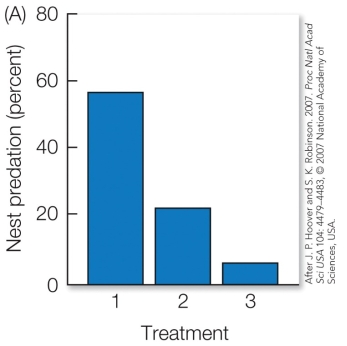 These results show the occurrence of nest predation by cowbirds on prothonotary warblers. After cowbirds laid an egg in the nest, the nests were divided into three treatments:
1) The cowbird egg was removed, and the nest opening left as is.
2) The cowbird egg and the nest entrance were left as is.
3) The cowbird egg was removed, and the nest opening was made smaller to prevent cowbirds from entering.
What hypothesis do these results support?
These results show the occurrence of nest predation by cowbirds on prothonotary warblers. After cowbirds laid an egg in the nest, the nests were divided into three treatments:
1) The cowbird egg was removed, and the nest opening left as is.
2) The cowbird egg and the nest entrance were left as is.
3) The cowbird egg was removed, and the nest opening was made smaller to prevent cowbirds from entering.
What hypothesis do these results support? (Multiple Choice)
4.8/5 (90)
(90) 
Filters
- Essay(0)
- Multiple Choice(0)
- Short Answer(0)
- True False(0)
- Matching(0)