



 Chat with AI
Exam 10: Mating Systems

Exam 1: An Introduction to Animal Behavior22 Questions
Exam 2: The Integrative Study of Behavior17 Questions
Exam 3: The Developmental and Molecular Bases of Behavior15 Questions
Exam 4: The Neural Basis of Behavior22 Questions
Exam 5: The Physiological and Endocrine Basis of Behavior22 Questions
Exam 6: Avoiding Predators and Finding Food25 Questions
Exam 7: Territoriality and Movement21 Questions
Exam 8: Principles of Communication22 Questions
Exam 9: Reproductive Behavior24 Questions
Exam 10: Mating Systems26 Questions
Exam 11: Parental Care22 Questions
Exam 12: Principles of Social Evolution20 Questions
Exam 13: Social Behavior and Sociality23 Questions
Exam 14: Human Behavior18 Questions
Select questions type


Polyandry in females might be advantageous if polyandrous females were to secure some genes from their partners that were especially compatible with the genes in their eggs. State a prediction that follows from this hypothesis.

Free
(Essay)
4.9/5  (89)
(89) Correct Answer: Verified
(Answers may vary.) In order to expand the potential gene pool, the mating partners of females will vary substantially from female to female.
According to the socio-ecological framework, resource defense polygyny should evolve when
Free
(Multiple Choice)
4.8/5 (85)
(85) Correct Answer:Verified
VerifiedA
In the dark-eyed junco, the offspring of females and their extra-pair mates are more likely to survive to reproduce, and have higher reproductive success, than the offspring of females and their pair-bonded mate. While this could be explained by the good genes hypothesis, it could also be the result of maternal effects (females invest more in eggs sired by extra-pair mates). Describe how you could test if these offspring differences are due to good genes or maternal effects.
Free
(Essay)
4.8/5 (80)
(80) Correct Answer:Verified
Verified(Answers will vary) One option is to eliminate the possibility of genetic benefits by only allowing one male to sire all the offspring of polyandrous females (by sterilizing the other males). If there is no difference in survival and reproductive success of the offspring of monogamous versus "polyandrous" females, then this supports the good gene hypothesis. If there is a difference, then this must be attributed to maternal effects. Another option is to test the hormone levels in eggs, or egg size, laid by monogamous and polyandrous females to determine if females are investing differently in eggs.
Kirk's dik-dik is a small African antelope that usually forms male-female pairs. If males are experimentally removed from pairs, the number of offspring reared by the single female falls sharply due to her inability to provide enough resources. This finding supports the
(Multiple Choice)
4.7/5 (100)
(100) Long-term storage of sperm in some species of tortoise allows a female to produce a clutch of eggs with offspring fathered by multiple males. This species exhibits
(Multiple Choice)
4.8/5 (86)
(86) Kirk's dik-dik is a small African antelope that usually forms male-female pairs. Males place their scent marks over those of the female, which hides the signals of sexual receptivity that females produce when they are fertile. This finding supports the
(Multiple Choice)
4.8/5 (83)
(83) Male Grevy's zebras set up territories near water sources where receptive females are likely to cluster. This species exhibits
(Multiple Choice)
4.8/5 (77)
(77) If you study a pair of European beavers, you will find that all of the young in their colony are genetic offspring of the pair. This species exhibits
(Multiple Choice)
4.9/5 (82)
(82) Polygyny, multiple mating by males, is in fact driven by female behavior as a result of predation pressure or food distribution. Describe two types of polygyny, and explain how female behavior and needs determine this type of mating system.
(Essay)
4.8/5 (80)
(80) Male plains zebras defend a harem of females that forms to reduce the risk of predation and avoid harassment by bachelor males. This species exhibits
(Multiple Choice)
4.9/5 (81)
(81) Refer to the figure, which shows mean area of comb produced in colonies of a polyandrous bee species. In bees, the comb in the hive is where offspring are reared and food is stored.
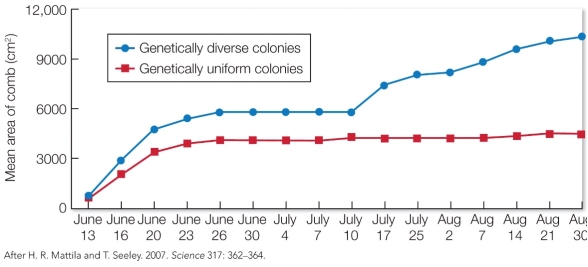 These results best support the
 (Multiple Choice)
4.8/5 (66)
(66) According to the socio-ecological framework, monogamy should evolve when
(Multiple Choice)
4.8/5 (58)
(58) According to the socio-ecological framework, female defense polygyny should evolve when
(Multiple Choice)
4.8/5 (90)
(90) In addition to indirect genetic benefits, polyandry can evolve due to direct benefits that females receive. Describe three direct benefits that polyandrous females receive.
(Essay)
4.8/5 (62)
(62) Give the primary reason that monogamy in male animals would be considered a Darwinian puzzle.
(Essay)
4.9/5 (93)
(93) Refer to the figure.
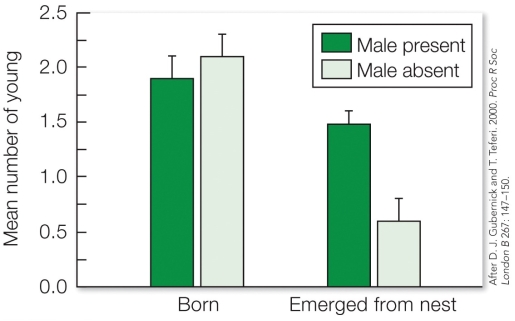 Which hypothesis for monogamy do these results best support?
 (Multiple Choice)
4.9/5 (76)
(76) Male great tinamous guard a nest into which a female lays an egg from their mating. The next day she mates with a different male; the first male also mates with a different female, which places her egg in his nest. This species exhibits
(Multiple Choice)
4.9/5 (97)
(97) Male white-bearded manakins gather in an arena, which contains no resources or practical utility, to display to females on the rainforest floor. This species exhibits
(Multiple Choice)
4.7/5 (71)
(71) Kirk's dik-dik is a small African antelope that usually forms male-female pairs. If males are experimentally removed from pairs, females wander from their territories into the territories of other males. This finding supports the
(Multiple Choice)
4.9/5 (75)
(75) Refer to the figure below, which shows the mean area of comb produced in colonies of a polyandrous bee species. In bees, the comb in the hive is where offspring are reared and food is stored.
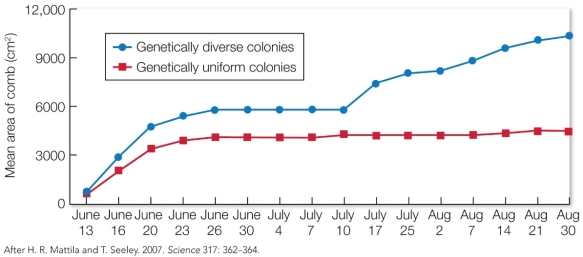 While some members of the genus Apis are highly polyandrous, most other bee species are not. These results suggest that polyandry evolved in this genus because
 (Multiple Choice)
4.9/5 (88)
(88) 
Filters
- Essay(0)
- Multiple Choice(0)
- Short Answer(0)
- True False(0)
- Matching(0)