



 Chat with AI
Exam 14: Human Behavior

Exam 1: An Introduction to Animal Behavior22 Questions
Exam 2: The Integrative Study of Behavior17 Questions
Exam 3: The Developmental and Molecular Bases of Behavior15 Questions
Exam 4: The Neural Basis of Behavior22 Questions
Exam 5: The Physiological and Endocrine Basis of Behavior22 Questions
Exam 6: Avoiding Predators and Finding Food25 Questions
Exam 7: Territoriality and Movement21 Questions
Exam 8: Principles of Communication22 Questions
Exam 9: Reproductive Behavior24 Questions
Exam 10: Mating Systems26 Questions
Exam 11: Parental Care22 Questions
Exam 12: Principles of Social Evolution20 Questions
Exam 13: Social Behavior and Sociality23 Questions
Exam 14: Human Behavior18 Questions
Select questions type


Using the comparative approach, researchers have found that

Free
(Multiple Choice)
4.8/5  (89)
(89) Correct Answer: Verified
C
Isabel Scott and colleagues conducted a study of masculinity in men's faces across 12 populations varying in degree of economic development. They found that preferences for sex-specific facial traits only occurred in highly developed urban environments. Similarly, a study by Arslan Zaidi and colleagues found that while facial masculinity is correlated with adult height and growth, it is not correlated with immune gene diversity. Together, these results
Free
(Multiple Choice)
4.7/5 (83)
(83) Correct Answer:Verified
VerifiedD
Men are predicted to place more value on "good looks" than will women. What are some of the possible adaptive values of this male preference?
Free
(Essay)
4.9/5 (88)
(88) Correct Answer:Verified
Verified(Answers will vary.) Female attractiveness may be an indicator of genetic quality and/or fertility. Feminine features favored by men in Western cultures are associated with strong immune systems, good health, high estrogen levels, and fertility. Fertility varies considerably due to age, health, and body weight. For instance, women who are younger have higher fecundity, and women with a particular body shape (narrow waist and large breasts) have higher levels of estradiol and are three times more likely to conceive a child than other women. However, cultural influences also play a role in shaping definitions of attractiveness, which can complement or counteract selection.
In a study on mate choice, men and women were able to spend "mate dollars" on traits they desired in a life partner. With a limited budget, women spent 17% of their money on yearly income, compared to only 3% spent by men on the same trait. Thus, women seem to prefer men that can provide direct, material benefits. Which hypothesis for this preference is based on the good genes model of sexual selection?
(Multiple Choice)
4.8/5 (82)
(82) In a study on mate choice, men and women were able to spend "mate dollars" on traits they desired in a life partner. With a limited budget, women spent 17% of their money on yearly income, compared to only 3% spent by men on the same trait. Thus, women seem to prefer men that can provide direct, material benefits. Which hypothesis for this preference is based on direct benefits of female mate choice?
(Multiple Choice)
4.8/5 (100)
(100) Refer to the figure below.
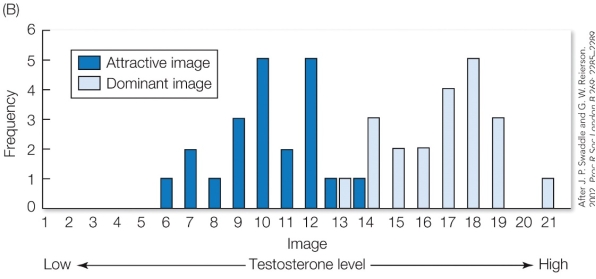 In this study, digital images of the same male's face were altered to reflect the developmental effects of testosterone. Women then judged the photographs for physical attractiveness and social dominance. The findings from this study suggest that
 (Multiple Choice)
4.9/5 (73)
(73) Which statement most accurately describes the neurophysiology of human speech?
(Multiple Choice)
4.7/5 (76)
(76) Which of the following findings supports the technical hypothesis for the evolution of language?
(Multiple Choice)
4.8/5 (79)
(79) In a study on mate choice, men and women were able to spend "mate dollars" on traits they desired in a life partner. With a limited budget, women spent 17% of their money on yearly income, compared to only 3% spent by men on the same trait. Thus, women seem to prefer men that can provide direct, material benefits. Based on this study, we can predict that
(Multiple Choice)
4.9/5 (77)
(77) When choosing between two males of the same age but different heights, a young, unmarried woman selects the taller individual. What are some of the possible adaptive values of her choice?
(Essay)
4.9/5 (80)
(80) Refer to the figure.
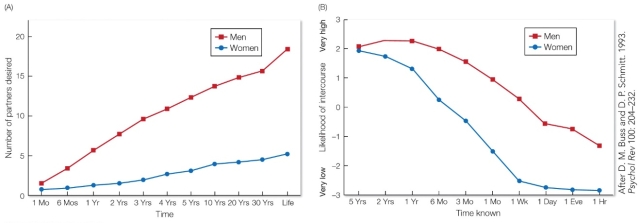 Part A shows the number of sexual partners men and women report wanting over different periods of time, and Part B shows men's and women's estimates of the likelihood of agreeing to sexual intercourse with an attractive partner they have known for varying lengths of time. These results indicate that
 (Multiple Choice)
4.8/5 (67)
(67) In a study on mate choice, men and women were able to spend "mate dollars" on traits they desired in a life partner. With a limited budget, women spent 17% of their money on yearly income, compared to only 3% spent by men on the same trait. Thus, women seem to prefer men that can provide direct, material benefits. Which hypothesis for this preference is based on group-selection theory?
(Multiple Choice)
4.9/5 (79)
(79) Refer to the figure.
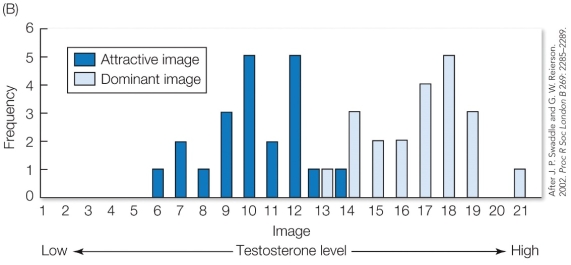 In this study, digital images of the same male's face were altered to reflect the developmental effects of testosterone. Women then judged the photographs for physical attractiveness and social dominance. These results indicate that
 (Multiple Choice)
4.9/5 (82)
(82) In a study on mate choice, men and women were able to spend "mate dollars" on traits they desired in a life partner. With a limited budget, women spent 17% of their money on yearly income, compared to only 3% spent by men on the same trait. Thus, women seem to prefer men that can provide direct, material benefits. Which hypothesis for this preference is based on kin-selection theory?
(Multiple Choice)
4.9/5 (93)
(93) Define assortative mating and provide an example illustrating it in humans.
(Essay)
4.8/5 (77)
(77) Refer to the figure.
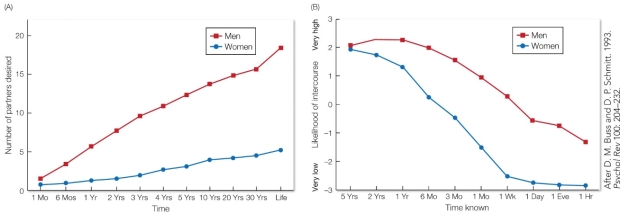 Part A shows the number of sexual partners men and women report wanting over different periods of time, and Part B shows men's and women's estimates of the likelihood of agreeing to sexual intercourse with an attractive partner they have known for varying lengths of time. Based on this study, we can conclude that men and women
 (Multiple Choice)
4.9/5 (92)
(92) 
Filters
- Essay(0)
- Multiple Choice(0)
- Short Answer(0)
- True False(0)
- Matching(0)