



 Chat with AI
Exam 12: Epidemiology of Infectious Diseases

Exam 1: History and Scope of Epidemiology24 Questions
Exam 2: Practical Applications of Epidemiology31 Questions
Exam 3: Measures of Morbidity and Mortality Used in Epidemiology29 Questions
Exam 4: Descriptive Epidemiology: Person, Place, Time45 Questions
Exam 5: Sources of Data for Use in Epidemiology19 Questions
Exam 6: Study Designs: Ecologic, Cross-Sectional, Case-Control21 Questions
Exam 7: Study Designs: Cohort Studies22 Questions
Exam 8: Experimental Study Designs33 Questions
Exam 9: Measures of Effect15 Questions
Exam 10: Data Interpretation Issues9 Questions
Exam 11: Screening for Disease in the Community24 Questions
Exam 12: Epidemiology of Infectious Diseases53 Questions
Exam 13: Epidemiologic Aspects of Work and the Environment11 Questions
Exam 14: Molecular and Genetic Epidemiology8 Questions
Exam 15: Social, Behavioral, and Psychosocial Epidemiology15 Questions
Exam 16: Epidemiology As a Profession7 Questions
Exam 17: Epidemiology and Health Policy11 Questions
Select questions type


Imagine you are the state epidemiologist. Sixty cases of salmonella were reported to you in the last two weeks. Describe how the iceberg model of disease would argue for or against whether this potential disease outbreak needs to be investigated.
(Essay)
4.9/5  (78)
(78) A secondary attack rate is used to show the spread of disease in a household.
(True/False)
4.9/5 (77)
(77) You have just finished administering a food/drink questionnaire to ill and non-ill participants in a Minnesota summer picnic party. The ill individuals developed moderate to severe diarrhea 16 to 46 hours after the picnic. Six persons experienced vomiting. The following data were collected:
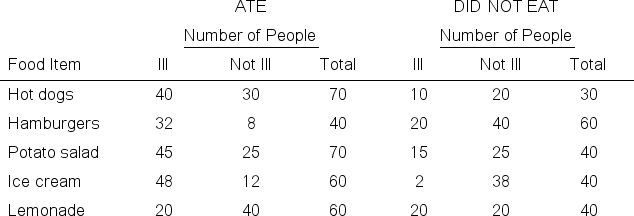 Which food item appears to be the most probable vehicle for the salmonella (agent) infection associated with the illness?
 (Multiple Choice)
4.8/5 (73)
(73) An attack rate is an alternative incidence rate that is used:
(Multiple Choice)
4.8/5 (75)
(75) Diseases that have only human reservoirs and are transmitted from person to person are the zoonoses.
(True/False)
4.8/5 (81)
(81) The following table shows the mumps experience of children in 390 families exposed to mumps by a primary case within the family:
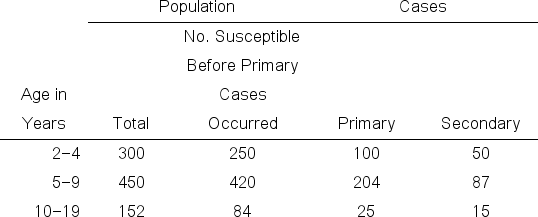 The secondary attack rate among children aged two to four years is:
 (Multiple Choice)
4.8/5 (67)
(67) An outbreak of salmonellosis occurred after an epidemiology department luncheon, which was attended by 485 faculty and staff. Assume everyone ate the same food items. Sixty-five people had fever and diarrhea; five of these people were severely affected. Subsequent laboratory tests on everyone who attended the luncheon revealed an additional 72 cases. The virulence of salmonellosis was:
(Multiple Choice)
4.7/5 (76)
(76) An enzootic disease among animals is similar to an endemic disease among humans.
(True/False)
4.9/5 (82)
(82) In 2017, the groups in the United States most affected by tuberculosis were foreign-born individuals and racial and ethnic minorities.
(True/False)
4.8/5 (86)
(86) Someone suggests immunization as a means of reducing disease, specifically the feared UJ (uderlinger jacamoodi). What part of the disease cycle is he or she trying to affect?
(Multiple Choice)
4.9/5 (93)
(93) 
Filters
- Essay(0)
- Multiple Choice(0)
- Short Answer(0)
- True False(0)
- Matching(0)