



 Chat with AI
Exam 6: Study Designs: Ecologic, Cross-Sectional, Case-Control

Exam 1: History and Scope of Epidemiology24 Questions
Exam 2: Practical Applications of Epidemiology31 Questions
Exam 3: Measures of Morbidity and Mortality Used in Epidemiology29 Questions
Exam 4: Descriptive Epidemiology: Person, Place, Time45 Questions
Exam 5: Sources of Data for Use in Epidemiology19 Questions
Exam 6: Study Designs: Ecologic, Cross-Sectional, Case-Control21 Questions
Exam 7: Study Designs: Cohort Studies22 Questions
Exam 8: Experimental Study Designs33 Questions
Exam 9: Measures of Effect15 Questions
Exam 10: Data Interpretation Issues9 Questions
Exam 11: Screening for Disease in the Community24 Questions
Exam 12: Epidemiology of Infectious Diseases53 Questions
Exam 13: Epidemiologic Aspects of Work and the Environment11 Questions
Exam 14: Molecular and Genetic Epidemiology8 Questions
Exam 15: Social, Behavioral, and Psychosocial Epidemiology15 Questions
Exam 16: Epidemiology As a Profession7 Questions
Exam 17: Epidemiology and Health Policy11 Questions
Select questions type


An epidemiologist found five cases of big toe cancer in the Yukon Territory. Because there were only a few cases, the epidemiologist decided to conduct a matched case-control study to determine whether shoe size larger than 9 is a risk factor for big toe cancer. Each case was individually matched to one control for daily activity, history of athlete's foot, and history of ingrown toenails. The following data were gathered:
Shoe size > 9
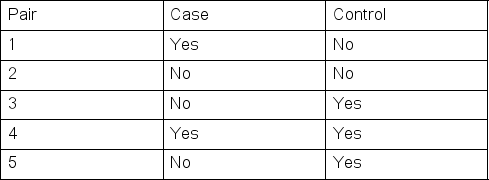 Compute the proper measure of association. Interpret your results.
Free
(Essay)
4.7/5  (89)
(89) Correct Answer: Verified
Because this situation refers to individually matched case-control pairs, the estimate of the odds ratio is b/c when the table is set up to count the number of concordant and discordant pairs. In other words, when cases and controls are concordant on exposure, they are uninformative and tossed out. The odds ratio is the number of pairs for which the case is exposed but the control is not (excessive exposure) divided by the number of pairs for which the control is exposed but the case is not (decreased exposure). In this analysis, the answer is 1/2, or 0.5. Interpretation: Large shoe size does not appear to increase risk of big toe cancer. If anything, it may actually be associated with decreased risk.
Examples of descriptive epidemiologic studies do not usually include:
Free
(Multiple Choice)
4.7/5 (66)
(66) Correct Answer:Verified
VerifiedA
Which of the following best approximates risk associated with alcohol drinking in women?
Free
(Multiple Choice)
4.9/5 (73)
(73) Correct Answer:Verified
VerifiedD
Case-control studies are among the best observational designs to study diseases of:
(Multiple Choice)
4.9/5 (68)
(68) Which of the following best approximates risk associated with tea drinking in women?
(Multiple Choice)
4.9/5 (90)
(90) Which factor has the strongest association with cancer for both men and women?
(Multiple Choice)
4.8/5 (72)
(72) Which of the following best approximates risk associated with alcohol drinking in men?
(Multiple Choice)
4.8/5 (79)
(79) Which of the following best approximates risk associated with coffee drinking in men?
(Multiple Choice)
4.7/5 (78)
(78) Which of the following best approximates risk associated with coffee drinking in women?
(Multiple Choice)
4.9/5 (77)
(77) An ecologic study is one that examines a group as a unit of analysis.
(True/False)
4.7/5 (63)
(63) In case-control studies, the odds ratio is used as an estimate of the relative risk. In order for this approximation to be reasonable, some conditions must be met. Which of the following conditions is not necessary in order to use the odds ratio to estimate the relative risk?
(Multiple Choice)
4.9/5 (79)
(79) In a case-control study, cases and controls are compared in order to determine whether they differ with respect to their exposure levels.
(True/False)
4.9/5 (87)
(87) An ecologic comparison study is sometimes called a cross-sectional ecologic study.
(True/False)
4.9/5 (81)
(81) Which of the following best approximates risk associated with tea drinking in men?
(Multiple Choice)
4.8/5 (76)
(76) Which of the following is an example of exposure data in ecologic studies?
(Multiple Choice)
4.8/5 (90)
(90) A case-control study is purely a descriptive (as opposed to analytic) study design.
(True/False)
4.8/5 (79)
(79) A cross-sectional study allows measurement of the temporal ordering of cause and effect.
(True/False)
4.9/5 (77)
(77) 
Filters
- Essay(0)
- Multiple Choice(0)
- Short Answer(0)
- True False(0)
- Matching(0)