



 Chat with AI
Exam 11: Screening for Disease in the Community

Exam 1: History and Scope of Epidemiology24 Questions
Exam 2: Practical Applications of Epidemiology31 Questions
Exam 3: Measures of Morbidity and Mortality Used in Epidemiology29 Questions
Exam 4: Descriptive Epidemiology: Person, Place, Time45 Questions
Exam 5: Sources of Data for Use in Epidemiology19 Questions
Exam 6: Study Designs: Ecologic, Cross-Sectional, Case-Control21 Questions
Exam 7: Study Designs: Cohort Studies22 Questions
Exam 8: Experimental Study Designs33 Questions
Exam 9: Measures of Effect15 Questions
Exam 10: Data Interpretation Issues9 Questions
Exam 11: Screening for Disease in the Community24 Questions
Exam 12: Epidemiology of Infectious Diseases53 Questions
Exam 13: Epidemiologic Aspects of Work and the Environment11 Questions
Exam 14: Molecular and Genetic Epidemiology8 Questions
Exam 15: Social, Behavioral, and Psychosocial Epidemiology15 Questions
Exam 16: Epidemiology As a Profession7 Questions
Exam 17: Epidemiology and Health Policy11 Questions
Select questions type


Which of the following conditions are favorable to population screening for presymptomatic diagnosis of a given disease?

Free
(Multiple Choice)
4.9/5  (69)
(69) Correct Answer: Verified
A
Drs. Poke and Jab conducted an employee health program that used five screening tests at the same time to detect several diseases among workers. Which type of program is this?
Free
(Multiple Choice)
4.8/5 (79)
(79) Correct Answer:Verified
VerifiedD
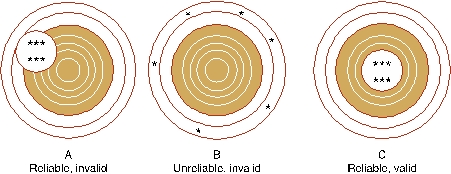
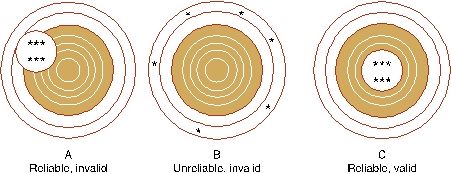
Figure 11-12 represents different combinations and qualities of validity and reliability (high vs. low). Which set of symbols represents low reliability?
Free
(Multiple Choice)
4.8/5 (74)
(74) Correct Answer:Verified
VerifiedB
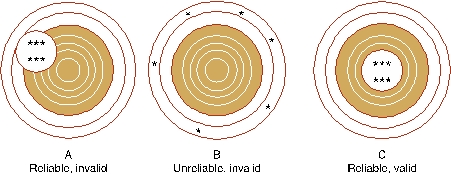
Figure 11-12 represents different combinations and qualities of validity and reliability (high vs. low). Which set of symbols represents high validity?
(Multiple Choice)
4.8/5 (80)
(80) A new blood test has been developed to screen for disease Z. Researchers establish 50 units as a cut point above which a test is considered positive and thereby indicative of disease. The test manufacturers determine that the test's sensitivity is unacceptably low. However, the manufacturers are not concerned with the specificity, and they do not want the cost of the test to rise. How can they improve the sensitivity of the test?
(Multiple Choice)
4.9/5 (76)
(76) A new antibody test detects serum antibodies against virus X (sensitivity 99%, specificity 90%). When applied in a group of hospitalized patients diagnosed as having virus X infections, the test is found to have a positive predictive value of 85%. When used to screen a group of healthy blood donors for virus X infections, the test is found to have a positive predictive value of 30%. Which of the following best explains this difference between the positive predictive values?
(Multiple Choice)
4.9/5 (78)
(78) A new screening test for Lyme disease is developed for use in the general population. The sensitivity and specificity of the new test are 60% and 70%, respectively. Three hundred people are screened at a clinic during the first year the new test is implemented. (Assume the true prevalence of Lyme disease among clinic attendees is 10%.) The number of false positives is:
(Multiple Choice)
4.9/5 (77)
(77) Sensitivity and specificity of a screening test refer to its:
(Multiple Choice)
4.8/5 (72)
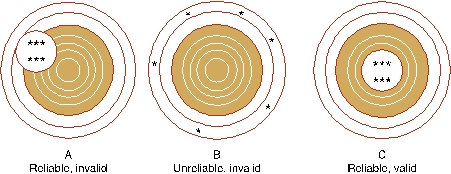
(72) Figure 11-12 represents different combinations and qualities of validity and reliability (high vs. low). Which set of symbols represents high reliability?
(Multiple Choice)
4.7/5 (83)
(83) A screening examination was performed on 250 persons for factor X, which is found in disease Y. A definitive diagnosis for disease Y among the 250 persons had been obtained previously. The results are charted here:
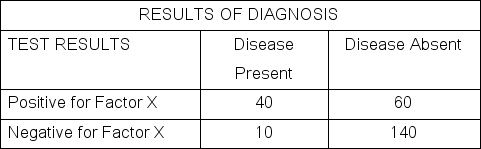 The sensitivity of this test is expressed as:
 (Multiple Choice)
5.0/5 (68)
(68) Specificity refers to the ability of a screening test to identify only nondiseased individuals who actually do not have the disease.
(True/False)
4.8/5 (91)
(91) Which of the following are the adverse consequences of using a screening test that has a low specificity?
(Multiple Choice)
4.8/5 (93)
(93) A new screening test for Lyme disease is developed for use in the general population. The sensitivity and specificity of the new test are 60% and 70%, respectively. Three hundred people are screened at a clinic during the first year the new test is implemented. (Assume the true prevalence of Lyme disease among clinic attendees is 10%.) The predictive value of a positive test is:
(Multiple Choice)
4.8/5 (81)
(81) Figure 11-12 represents different combinations and qualities of validity and reliability (high vs. low). Which set of symbols represents high validity but low reliability?
(Multiple Choice)
4.7/5 (88)
(88) Cataracts of the eye may be difficult to diagnose, especially in the early stages. In a study of the reliability of their diagnoses, two physicians each examined the same 1000 eyes, without knowing the other's diagnoses. Each physician found 100 eyes with cataracts. Does this mean that the diagnoses are reliable? Please provide a short answer explaining your position.
(Essay)
4.8/5 (88)
(88) A test that determines whether disease is actually present is a:
(Multiple Choice)
4.8/5 (74)
(74) The degree of agreement among several trained experts refers to:
(Multiple Choice)
4.9/5 (84)
(84) Reliability refers to the ability of a measuring instrument to give consistent results on repeated trials, regardless of its accuracy.
(True/False)
4.7/5 (73)
(73) Sensitivity refers to the ability of a screening test to correctly identify all screened individuals who have a disease.
(True/False)
4.9/5 (79)
(79) 
Filters
- Essay(0)
- Multiple Choice(0)
- Short Answer(0)
- True False(0)
- Matching(0)