



 Chat with AI
Exam 5: Certified Information Privacy Technologist (CIPT)

Exam 1: Certified Information Privacy Manager92 Questions
Exam 2: Certified Information Privacy Professional/Asia (CIPP/A)54 Questions
Exam 3: Certified Information Privacy Professional/Europe (CIPP/E)152 Questions
Exam 4: Certified Information Privacy Professional/United States (CIPP/US)157 Questions
Exam 5: Certified Information Privacy Technologist (CIPT)125 Questions
Select questions type


In day to day interactions with technology, consumers are presented with privacy choices. Which of the following best represents the Privacy by Design (PbD) methodology of letting the user choose a non-zero-sum choice?
(Multiple Choice)
4.8/5  (81)
(81) What would be an example of an organization transferring the risks associated with a data breach?
(Multiple Choice)
4.8/5 (55)
(55) When releasing aggregates, what must be performed to magnitude data to ensure privacy?
(Multiple Choice)
4.8/5 (85)
(85) Which of the following statements best describes the relationship between privacy and security?
(Multiple Choice)
4.8/5 (75)
(75) Which Organization for Economic Co-operation and Development (OECD) privacy protection principle encourages an organization to obtain an individual s consent before transferring personal information?
(Multiple Choice)
4.9/5 (76)
(76) Granting data subjects the right to have data corrected, amended, or deleted describes?
(Multiple Choice)
4.8/5 (85)
(85) Under the Family Educational Rights and Privacy Act (FERPA), releasing personally identifiable information from a student's educational record requires written permission from the parent or eligible student in order for information to be?
(Multiple Choice)
4.7/5 (67)
(67) What is typically NOT performed by sophisticated Access Management (AM) techniques?
(Multiple Choice)
4.8/5 (82)
(82) SCENARIO Clean-Q is a company that offers house-hold and office cleaning services. The company receives requests from consumers via their website and telephone, to book cleaning services. Based on the type and size of service, Clean-Q then contracts individuals that are registered on its resource database - currently managed in-house by Clean-Q IT Support. Because of Clean-Q's business model, resources are contracted as needed instead of permanently employed. The table below indicates some of the personal information Clean-Q requires as part of its business operations: 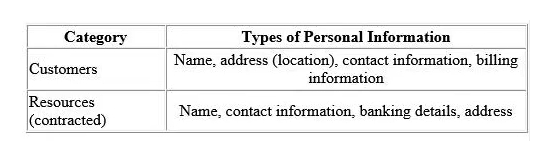 Clean-Q has an internal employee base of about 30 people. A recent privacy compliance exercise has been conducted to align employee data management and human resource functions with applicable data protection regulation. Therefore, the Clean-Q permanent employee base is not included as part of this scenario. With an increase in construction work and housing developments, Clean-Q has had an influx of requests for cleaning services. The demand has overwhelmed Clean-Q's traditional supply and demand system that has caused some overlapping bookings. Ina business strategy session held by senior management recently, Clear-Q invited vendors to present potential solutions to their current operational issues. These vendors included Application developers and Cloud-Q's solution providers, presenting their proposed solutions and platforms. The Managing Director opted to initiate the process to integrate Clean-Q's operations with a cloud solution (LeadOps) that will provide the following solution one single online platform: A web interface that Clean-Q accesses for the purposes of resource and customer management. This would entail uploading resource and customer information. A customer facing web interface that enables customers to register, manage and submit cleaning service requests online. A resource facing web interface that enables resources to apply and manage their assigned jobs. An online payment facility for customers to pay for services. What is a key consideration for assessing external service providers like LeadOps, which will conduct personal information processing operations on Clean-Q's behalf?
 (Multiple Choice)
4.8/5 (68)
(68) SCENARIO Kyle is a new security compliance manager who will be responsible for coordinating and executing controls to ensure compliance with the company's information security policy and industry standards. Kyle is also new to the company, where collaboration is a core value. On his first day of new-hire orientation, Kyle's schedule included participating in meetings and observing work in the IT and compliance departments. Kyle spent the morning in the IT department, where the CIO welcomed him and explained that her department was responsible for IT governance. The CIO and Kyle engaged in a conversation about the importance of identifying meaningful IT governance metrics. Following their conversation, the CIO introduced Kyle to Ted and Barney. Ted is implementing a plan to encrypt data at the transportation level of the organization's wireless network. Kyle would need to get up to speed on the project and suggest ways to monitor effectiveness once the implementation was complete. Barney explained that his short-term goals are to establish rules governing where data can be placed and to minimize the use of offline data storage. Kyle spent the afternoon with Jill, a compliance specialist, and learned that she was exploring an initiative for a compliance program to follow self-regulatory privacy principles. Thanks to a recent internship, Kyle had some experience in this area and knew where Jill could find some support. Jill also shared results of the company's privacy risk assessment, noting that the secondary use of personal information was considered a high risk. By the end of the day, Kyle was very excited about his new job and his new company. In fact, he learned about an open position for someone with strong qualifications and experience with access privileges, project standards board approval processes, and application-level obligations, and couldn't wait to recommend his friend Ben who would be perfect for the job. Which of the following should Kyle recommend to Jill as the best source of support for her initiative?
(Multiple Choice)
4.9/5 (88)
(88) What is the term for information provided to a social network by a member?
(Multiple Choice)
4.8/5 (68)
(68) Which is NOT a drawback to using a biometric recognition system?
(Multiple Choice)
4.8/5 (89)
(89) In order to prevent others from identifying an individual within a data set, privacy engineers use a cryptographically-secure hashing algorithm. Use of hashes in this way illustrates the privacy tactic known as what?
(Multiple Choice)
4.8/5 (73)
(73) SCENARIO Tom looked forward to starting his new position with a U.S -based automobile leasing company (New Company), now operating in 32 states. New Company was recently formed through the merger of two prominent players, one from the eastern region (East Company) and one from the western region (West Company). Tom, a Certified Information Privacy Technologist (CIPT), is New Company's first Information Privacy and Security Officer. He met today with Dick from East Company, and Harry, from West Company. Dick and Harry are veteran senior information privacy and security professionals at their respective companies, and continue to lead the east and west divisions of New Company. The purpose of the meeting was to conduct a SWOT (strengths/weaknesses/opportunities/threats) analysis for New Company. Their SWOT analysis conclusions are summarized below. Dick was enthusiastic about an opportunity for the New Company to reduce costs and increase computing power and flexibility through cloud services. East Company had been contemplating moving to the cloud, but West Company already had a vendor that was providing it with software-as-a-service (SaaS). Dick was looking forward to extending this service to the eastern region. Harry noted that this was a threat as well, because West Company had to rely on the third party to protect its data. Tom mentioned that neither of the legacy companies had sufficient data storage space to meet the projected growth of New Company, which he saw as a weakness. Tom stated that one of the team's first projects would be to construct a consolidated New Company data warehouse. Tom would personally lead this project and would be held accountable if information was modified during transmission to or during storage in the new data warehouse. Tom, Dick and Harry agreed that employee network access could be considered both a strength and a weakness. East Company and West Company had strong performance records in this regard; both had robust network access controls that were working as designed. However, during a projected year-long transition period, New Company employees would need to be able to connect to a New Company network while retaining access to the East Company and West Company networks. Which statement is correct about addressing New Company stakeholders' expectations for privacy?
(Multiple Choice)
4.9/5 (88)
(88) SCENARIO Wesley Energy has finally made its move, acquiring the venerable oil and gas exploration firm Lancelot from its long-time owner David Wilson. As a member of the transition team, you have come to realize that Wilson's quirky nature affected even Lancelot's data practices, which are maddeningly inconsistent. "The old man hired and fired IT people like he was changing his necktie," one of Wilson's seasoned lieutenants tells you, as you identify the traces of initiatives left half complete. For instance, while some proprietary data and personal information on clients and employees is encrypted, other sensitive information, including health information from surveillance testing of employees for toxic exposures, remains unencrypted, particularly when included within longer records with less-sensitive data. You also find that data is scattered across applications, servers and facilities in a manner that at first glance seems almost random. Among your preliminary findings of the condition of data at Lancelot are the following: Cloud technology is supplied by vendors around the world, including firms that you have not heard of. You are told by a former Lancelot employee that these vendors operate with divergent security requirements and protocols. The company's proprietary recovery process for shale oil is stored on servers among a variety of less-sensitive information that can be accessed not only by scientists, but by personnel of all types at most company locations. DES is the strongest encryption algorithm currently used for any file. Several company facilities lack physical security controls, beyond visitor check-in, which familiar vendors often bypass. Fixing all of this will take work, but first you need to grasp the scope of the mess and formulate a plan of action to address it. Which is true regarding the type of encryption Lancelot uses?
(Multiple Choice)
4.8/5 (78)
(78) Which of the following is considered a client-side IT risk?
(Multiple Choice)
4.8/5 (78)
(78) How can a hacker gain control of a smartphone to perform remote audio and video surveillance?
(Multiple Choice)
4.8/5 (71)
(71) SCENARIO Carol was a U.S.-based glassmaker who sold her work at art festivals. She kept things simple by only accepting cash and personal checks. As business grew, Carol couldn't keep up with demand, and traveling to festivals became burdensome. Carol opened a small boutique and hired Sam to run it while she worked in the studio. Sam was a natural salesperson, and business doubled. Carol told Sam, "I don't know what you are doing, but keep doing it!" But months later, the gift shop was in chaos. Carol realized that Sam needed help so she hired Jane, who had business expertise and could handle the back-office tasks. Sam would continue to focus on sales. Carol gave Jane a few weeks to get acquainted with the artisan craft business, and then scheduled a meeting for the three of them to discuss Jane's first impressions. At the meeting, Carol could not wait to hear Jane's thoughts, but she was unprepared for what Jane had to say. "Carol, I know that he doesn't realize it, but some of Sam's efforts to increase sales have put you in a vulnerable position. You are not protecting customers' personal information like you should." Sam said, "I am protecting our information. I keep it in the safe with our bank deposit. It's only a list of customers' names, addresses and phone numbers that I get from their checks before I deposit them. I contact them when you finish a piece that I think they would like. That's the only information I have! The only other thing I do is post photos and information about your work on the photo sharing site that I use with family and friends. I provide my email address and people send me their information if they want to see more of your work. Posting online really helps sales, Carol. In fact, the only complaint I hear is about having to come into the shop to make a purchase." Carol replied, "Jane, that doesn't sound so bad. Could you just fix things and help us to post even more online?" 'I can," said Jane. "But it's not quite that simple. I need to set up a new program to make sure that we follow the best practices in data management. And I am concerned for our customers. They should be able to manage how we use their personal information. We also should develop a social media strategy." Sam and Jane worked hard during the following year. One of the decisions they made was to contract with an outside vendor to manage online sales. At the end of the year, Carol shared some exciting news. "Sam and Jane, you have done such a great job that one of the biggest names in the glass business wants to buy us out! And Jane, they want to talk to you about merging all of our customer and vendor information with theirs beforehand." When initially collecting personal information from customers, what should Jane be guided by?
(Multiple Choice)
4.9/5 (79)
(79) 
Filters
- Essay(0)
- Multiple Choice(0)
- Short Answer(0)
- True False(0)
- Matching(0)