



 Chat with AI
Exam 1: Certified Business Analysis Professional

Exam 1: Certified Business Analysis Professional457 Questions
Exam 2: Certification of Competency in Business Analysis321 Questions
Exam 3: Entry Certificate in Business Analysis74 Questions
Exam 4: Agile Analyst68 Questions
Select questions type


An insurance company wants to increase sales by 15% and customer retention by 10% within 1 calendar year. Various strategies to achieve this were considered and a restructure to the existing pricing model is selected to help achieve these goals. A business analyst (BA) works with stakeholders such as actuaries, product specialists, sales staff, risk managers, and underwriters who agree to applying varying levels of discounts to customers based on: • Total annual premium the customer has with the company (Financial worth) • Time with the insurance company (Loyalty) Various financial models are considered but the stakeholders agree that an initial applicable discount is determined based on the customer's overall premium: 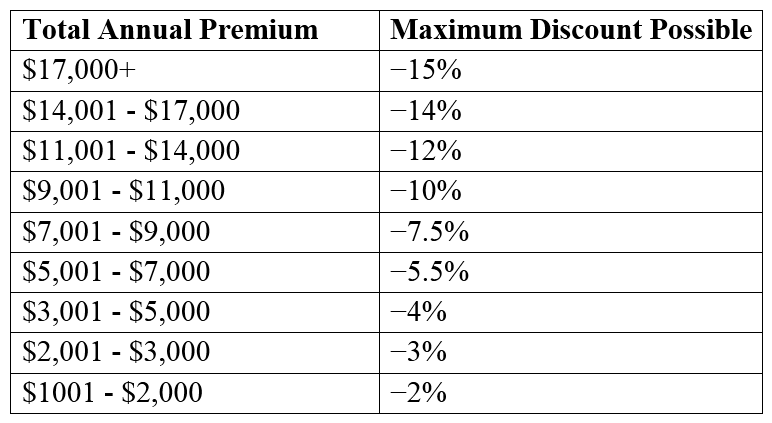 The percentage of the maximum possible discount available to the customer is adjusted based on time with the company:
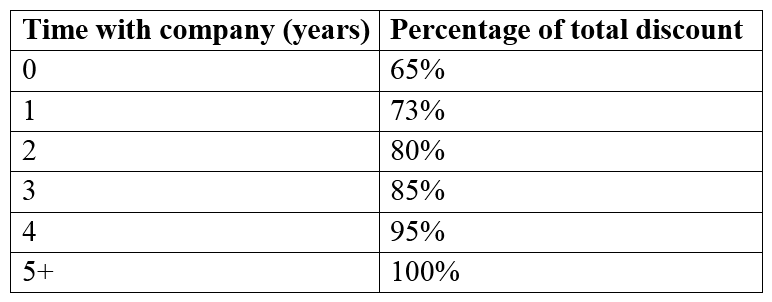 If within the first six months, customer retention increased by 5 % and sales increased by 6%, then when will the desired sales and retention goals be achieved assuming the trend continues at the same pace?
The percentage of the maximum possible discount available to the customer is adjusted based on time with the company: If within the first six months, customer retention increased by 5 % and sales increased by 6%, then when will the desired sales and retention goals be achieved assuming the trend continues at the same pace? (Multiple Choice)
4.8/5  (102)
(102) Ben is the business analyst for his organization. Ben is currently working on a solution to improve a laser printer. He has taken the laser printer apart, identified each component, and documented each component's purpose. What type of requirements organization is Ben doing in this scenario?
(Multiple Choice)
4.9/5 (67)
(67) A business analyst (BA) wants to estimate the potential value delivered by a set of requirements and design options by targeting a small group of stakeholders to understand their perceived value and expectations. The BA is going to organize a discussion during which feedback is collected. Which technique will be used?
(Multiple Choice)
4.8/5 (86)
(86) A business analyst (BA) is outlining who should participate in an upcoming requirements elicitation meeting. From whom should the BA obtain approval before selecting the participants?
(Multiple Choice)
4.9/5 (61)
(61) Which of the following process groups occurs at the beginning of the project?
(Multiple Choice)
4.9/5 (87)
(87) Your organization is using a plan-driven approach to business analysis. What characteristic must be true of changes in the approach that your organization is using?
(Multiple Choice)
4.8/5 (87)
(87) You are the business analyst for your organization. You want to use a requirements elicitation technique to produce a broad set of options for an identified problem. You want the stakeholders to help you identify options, factors that affect the solution, any possible delays in the solution implementation, and ideas for creating a solution. Which of the following requirements elicitation activities would best satisfy these requirements?
(Multiple Choice)
4.9/5 (79)
(79) A major manufacturer of popular beverages has appointed a local distributor to serve a specific territory. The demand for the beverages has a pronounced seasonal pattern. The distributor performs well overall, but is repeatedly unable to keep up with fulfilling many customer orders during peak demand periods. The distributor's current delivery capability is stretched to deliver 60 tons of merchandise per day whereas the season's peak demand periods need a daily delivery capability of up to 100 tons. The distributor is under pressure to fully meet the year-round market demand in order to stay in business. The distributor's management wants to identify and consider more cost-effective options as resorting to adding more trucks and drivers would not be economically feasible. A business analyst (BA) has spent several days observing and measuring the warehouse activities to understand the situation and to gain insights into possible solutions. The delivery workflow is a four-step process: (1) picking the orders and assembling them on trays, (2) bringing the trays to the loading bay, (3) loading the orders into trucks, and (4) delivering the orders to customers. As the following table illustrates, overall performance depends is dependent on five major resources: (1) the workers who pick the orders and load them into trucks, (2) the tallyers who check the orders, (3) the drivers, (4) the trucks, and (5) eight loading bays (LBs). 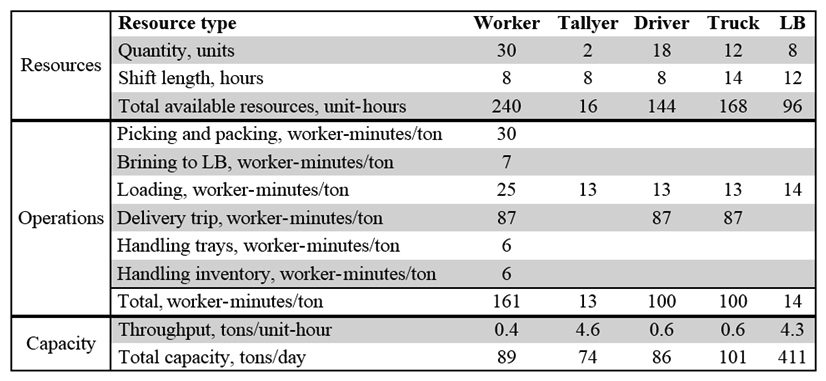 If the driver's average throughput is 0.6 tons/hour, how many hours per day would 15 drivers have to work to deliver 100 tons of merchandise?
 (Multiple Choice)
5.0/5 (63)
(63) The business analyst (BA) presented a concept model during a requirements walk through to the project sponsor, implementation subject matter expert, and operational support staff. While the presentation was clear to the project sponsor, the other stakeholders were unsure about the impacts to their respective daily tasks. What should the BA include in the next walk through, so that all stakeholders have a better understanding of the requirements?
(Multiple Choice)
4.9/5 (77)
(77) Which of the following techniques is used to test customer acceptance of the solution and to measure marketplace demand?
(Multiple Choice)
4.8/5 (75)
(75) You are the business analyst for a large project in your organization. While your company prefers face-to-face communications there are many stakeholders located in different geographical locations. How can you still effectively serve as a business analyst when the stakeholders are not collocated?
(Multiple Choice)
4.9/5 (77)
(77) You are working with Terry on the conduct stakeholder analysis task as part of the business analysis duties in your company. Terry wants to know why it's so important to identify stakeholders so early in the business analysis duties. Which one of the following statements best addresses the need to identify the stakeholders early on in the business analysis duties?
(Multiple Choice)
4.7/5 (63)
(63) You are the business analyst for your organization and you are completing the manage requirements traceability process. You are tracking the requirements to determine how the requirements are interrelated with one another and with the actual delivery of the project scope. There are actually three reasons why the business analyst should trace requirements. Which one of the following is not one of the three reasons why trace requirements is useful?
(Multiple Choice)
4.7/5 (82)
(82) You are the business analyst for your organization and you are completing the verify requirements process. There are eight characteristics each requirements should have: cohesive, complete, consistent, correct, and feasible. Which one of the following four is not a characteristic of a requirement?
(Multiple Choice)
4.8/5 (79)
(79) Which of the following statements best describes the purpose of the confirm elicitation results process?
(Multiple Choice)
4.7/5 (71)
(71) A business analyst is helping management determine which solution they should choose. As it happens that the organization can only choose one of the two solutions due to time and resource restrictions. Solution A worths $456,000 to the organization while solution B worths $565,000 to the organization. While solution A costs less, it is less risky and takes less time to complete so management elects to seize Solution A. What is the opportunity cost?
(Multiple Choice)
4.7/5 (64)
(64) Which one of the following terms is not a business analysis planning and monitoring approach?
(Multiple Choice)
4.8/5 (82)
(82) All of the following are techniques that can be used to specify or model requirements except for which one?
(Multiple Choice)
4.9/5 (84)
(84) Which of the following qualitative techniques involves a disciplined analysis of the event sequences that could transform a potential hazard into an accident?
(Multiple Choice)
4.9/5 (88)
(88) 
Filters
- Essay(0)
- Multiple Choice(0)
- Short Answer(0)
- True False(0)
- Matching(0)