



 Chat with AI
Exam 10: Differential Analysis and Product Pricing

Exam 1: Introduction to Managerial Accounting191 Questions
Exam 2: Job Order Costing178 Questions
Exam 3: Process Cost Systems182 Questions
Exam 4: Activity Based Costing110 Questions
Exam 5: Cost Volume Profit Analysis210 Questions
Exam 6: Variable Costing for Management Analysis153 Questions
Exam 7: Budgeting182 Questions
Exam 8: Evaluating Variances From Standard Costs166 Questions
Exam 9: Evaluating Decentralized Operations204 Questions
Exam 10: Differential Analysis and Product Pricing165 Questions
Exam 11: Capital Investment Analysis177 Questions
Exam 12: Lean Manufacturing and Activity Analysis123 Questions
Exam 13: Statement of Cash Flows171 Questions
Exam 14: Financial Statement Analysis183 Questions
Select questions type


Widgeon Co. manufactures three products: Bales, Tales, and Wales. The selling prices are $55, $78, and $32, respectively. The variable costs for each product are $20, $50, and $15, respectively. Each product must go through the same processing in a machine that is limited to 2,000 hours per month. Bales take 5 hours to process; Tales, 7 hours; and Wales 1 hour.
What is the contribution per machine hour for Wales?
(Multiple Choice)
4.8/5  (88)
(88) Using the variable cost concept, determine the selling price for 30,000 units using the following data:
Variable cost per unit $15.00
Total fixed costs $90,000
Desired profit $150,000
(Multiple Choice)
4.8/5 (79)
(79) Miramar Industries manufactures two products: A and B. The manufacturing operation involves three overhead activities-production setup, material handling, and general factory activities. Miramar uses activity-based costing to allocate overhead to products. An activity analysis of the overhead revealed the following estimated costs and activity bases for these activities: 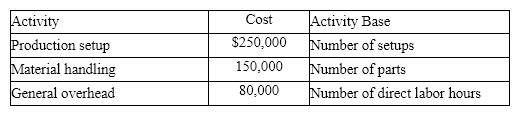
 What is the toal overhead allocated to Product B using activity-based costing?
 (Multiple Choice)
4.8/5 (74)
(74) When estimated costs are used in applying the cost-plus approach to product pricing, the estimates should be based upon normal levels of performance.
(True/False)
4.7/5 (97)
(97) Dotterel Corporation uses the variable cost concept of product pricing. Below is cost information for the production and sale of 35,000 units of its sole product. Dotterel desires a profit equal to an 11.2% rate of return on invested assets of $350,000.  The dollar amount of desired profit from the production and sale of the company's product is
 (Multiple Choice)
4.7/5 (73)
(73) The amount of income that would result from an alternative use of cash is called opportunity cost.
(True/False)
4.8/5 (78)
(78) A bottleneck begins when demand for the company's product exceeds the ability to produce the product.
(True/False)
4.9/5 (80)
(80) When a segment of a company is showing a net loss, it is always best to discontinue the segment in order not to continue with losses.
(True/False)
4.9/5 (69)
(69) Hill Co. can further process Product O to produce Product P. Product O is currently selling for $60 per pound and costs $42 per pound to produce. Product P would sell for $82 per pound and would require an additional cost of $13 per pound to produce.
The differential revenue of producing Product P is $82 per pound.
(True/False)
4.9/5 (89)
(89) Opportunity cost is the amount of increase or decrease in cost that would result from the best available alternative to the proposed use of cash or its equivalent.
(True/False)
4.8/5 (84)
(84) Falcon Co. produces a single product. Its normal selling price is $30.00 per unit. The variable costs are $19.00 per unit. Fixed costs are $25,000 for a normal production run of 5,000 units per month. Falcon received a request for a special order that would not interfere with normal sales. The order was for 1,500 units with a special price of $20.00 per unit. Falcon has the capacity to handle the special order, and for this order, a variable selling cost of $1.00 per unit would be eliminated.
Should the special order be accepted?
(Multiple Choice)
4.8/5 (77)
(77) The amount of increase or decrease in revenue that is expected from a particular course of action as compared with an alternative is
(Multiple Choice)
4.9/5 (69)
(69) Goshawks Co. produces an automotive product and incurs total manufacturing costs of $2,600,000 in the production of 80,000 units. The company desires to earn a profit equal to a 12% rate of return on assets of $960,000. Total selling and administrative expenses are $105,000.
(a) Calculate the markup percentage, using the product cost concept.
(b) Compute the selling price per unit of the automotive product.
Round your markup percentage to one decimal place, and other intermediate calculations and final answer to two decimal places.
(Short Answer)
4.8/5 (85)
(85) Gull Corp. is considering selling its old popcorn machine and replacing it with a newer one. The old machine has a book value of $5,000 and its remaining useful life is 5 years. Annual costs are $4,000. A high school is willing to buy it for $2,000. New equipment would cost $18,000 with annual operating costs of $1,500. The new machine has an estimated useful life of 5 years.
Should the machine be replaced?
(Short Answer)
4.8/5 (66)
(66) The theory of constraints is a manufacturing strategy that focuses on reducing the influence of bottlenecks on a process.
(True/False)
4.8/5 (76)
(76) What cost concept used in applying the cost-plus approach to product pricing includes only desired profit in the markup?
(Multiple Choice)
4.9/5 (70)
(70) Stryker Industries received an offer from an exporter for 15,000 units of product at $17.50 per unit. The acceptance of the offer will not affect normal production or domestic sales prices. The following data is available:  What is the differential cost from the acceptance of the offer?
 (Multiple Choice)
4.9/5 (85)
(85) Match each of the definitions that follow with the term (a-e) it defines.
Correct Answer: Verified
Premises:
Responses:
(Matching)
4.7/5 (80)
(80) Magpie Corporation uses the total cost concept of product pricing. Below is cost information for the production and sale of 60,000 units of its sole product. Magpie desires a profit equal to a 25% rate of return on invested assets of $700,000. 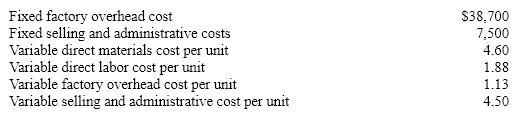 The dollar amount of desired profit from the production and sale of the company's product is
 (Multiple Choice)
4.8/5 (83)
(83) Stryker Industries received an offer from an exporter for 15,000 units of product at $17.50 per unit. The acceptance of the offer will not affect normal production or domestic sales prices. The following data is available:  What is the differential revenue from the acceptance of the offer?
 (Multiple Choice)
4.7/5 (61)
(61) 
Filters
- Essay(0)
- Multiple Choice(0)
- Short Answer(0)
- True False(0)
- Matching(0)