



 Chat with AI
Exam 10: Differential Analysis and Product Pricing

Exam 1: Introduction to Managerial Accounting191 Questions
Exam 2: Job Order Costing178 Questions
Exam 3: Process Cost Systems182 Questions
Exam 4: Activity Based Costing110 Questions
Exam 5: Cost Volume Profit Analysis210 Questions
Exam 6: Variable Costing for Management Analysis153 Questions
Exam 7: Budgeting182 Questions
Exam 8: Evaluating Variances From Standard Costs166 Questions
Exam 9: Evaluating Decentralized Operations204 Questions
Exam 10: Differential Analysis and Product Pricing165 Questions
Exam 11: Capital Investment Analysis177 Questions
Exam 12: Lean Manufacturing and Activity Analysis123 Questions
Exam 13: Statement of Cash Flows171 Questions
Exam 14: Financial Statement Analysis183 Questions
Select questions type


Falcon Inc. manufactures Product B, incurring variable costs of $15.00 per unit and fixed costs of $70,000. Falcon desires a profit equal to a 12% rate of return on assets, $785,000 of assets are devoted to producing Product B, and 100,000 units are expected to be produced and sold.
(a) Compute the markup percentage, using the total cost concept.
(b) Compute the selling price of Product b.
Round your intermediate calculations and final answer to two decimal places.
(Short Answer)
4.9/5  (70)
(70) The Swan Company produces its product at a total cost of $43 per unit. Of this amount, $8 per unit is selling and administrative costs. The total variable cost is $30 per unit and the desired profit is $20 per unit.
Determine the markup percentage on total cost.
(Multiple Choice)
4.8/5 (80)
(80) Rowan Quinn Company manufactures kitchen appliances. Currently, it is manufacturing one of its components at a variable cost of $40 and fixed costs of $15 per unit. An outside provider of this component has offered to sell Rowan Quinn the component for $45. Determine the best plan and calculate the savings assuming fixed costs are unaffected by the decision.
(Multiple Choice)
5.0/5 (83)
(83) A cost that will not be affected by later decisions is termed an opportunity cost.
(True/False)
4.7/5 (79)
(79) An employee of Morgan Corporation has found some partially completed units of Model X in a dusty corner of the warehouse. A job ticket attached to the units indicates that a total of $750 in manufacturing costs have been used to bring the materials to this point in the manufacturing process. The units can be sold in their current condition for $275 to a scrap metal dealer. If Morgan spends $250 to complete the units, they could be sold for $600.
(a) What should Morgan do? Why?
(b) Identify the sunk cost, if any.
(Short Answer)
4.9/5 (64)
(64) What cost concept used in applying the cost-plus approach to product pricing includes only total manufacturing costs in the cost amount to which the markup is added?
(Multiple Choice)
4.9/5 (84)
(84) Flyer Company sells a product in a competitive marketplace. Market analysis indicates that its product would probably sell at $48 per unit. Flyer management desires a 12.5% profit margin on sales. Their current full cost for the product is $44 per unit.
If the company cannot cut costs any lower than they already are, what would the profit margin on sales be to meet the market selling price?
(Multiple Choice)
4.7/5 (74)
(74) Flyer Company sells a product in a competitive marketplace. Market analysis indicates that its product would probably sell at $48 per unit. Flyer management desires a 12.5% profit margin on sales. Their current full cost for the product is $44 per unit.
In order to meet the new target cost, how much will the company have to cut costs per unit, if any?
(Multiple Choice)
4.9/5 (78)
(78) A bottleneck happens when a key piece of manufacturing machinery can produce 1,000 units per hour and demand for the product supports a production rate of 1,200 units per hour.
(True/False)
4.9/5 (66)
(66) Delaney Company is considering replacing equipment which originally cost $600,000 and which has $420,000 accumulated depreciation to date. A new machine will cost $790,000 and the old equipment can be sold for $8,000. What is the sunk cost in this situation?
(Multiple Choice)
4.9/5 (98)
(98) Make-or-buy options often arise when a manufacturer has excess productive capacity in the form of unused equipment, space, and labor.
(True/False)
4.7/5 (81)
(81) Contractors who sell to government agencies would be most likely to use which of the following cost concepts in pricing their products?
(Multiple Choice)
4.8/5 (80)
(80) Farris Company is considering a cash outlay of $500,000 for the purchase of land, which it could lease out for $40,000 per year. If alternative investments are available that yield a 15% return, the opportunity cost of the purchase of the land is
(Multiple Choice)
5.0/5 (72)
(72) The total cost concept includes all manufacturing costs plus selling and administrative expenses in the cost amount to which the markup is added to determine product price.
(True/False)
4.8/5 (78)
(78) The Eastwood Cake Factory sells chocolate cakes, birthday decorated cakes, and specialty cakes. The factory is experiencing a bottleneck and is trying to determine which cake is more profitable. Even though the company may have to limit the orders that it takes, Eastwood is concerned about customer service and satisfaction. 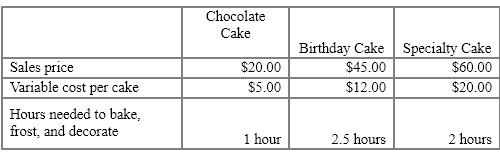 (a) Calculate the contribution margin per hour per cake.
(b) Determine which cakes the company should try to sell more of first, second, and then last.
(a) Calculate the contribution margin per hour per cake.
(b) Determine which cakes the company should try to sell more of first, second, and then last. (Short Answer)
4.8/5 (95)
(95) The amount of income that would result from an alternative use of cash is called:
(Multiple Choice)
4.9/5 (73)
(73) Which of the following reasons would cause a company to reject an offer to accept business at a special price?
(Multiple Choice)
4.8/5 (79)
(79) Cost-plus methods determine the normal selling price by estimating a cost amount per unit and adding a markup.
(True/False)
4.9/5 (76)
(76) Match the definitions that follow with the term (a-e) it defines.
Correct Answer: Verified
Premises:
Responses:
(Matching)
4.8/5 (61)
(61) When estimated costs are used in applying the cost-plus approach to product pricing, the estimates should be based upon ideal levels of performance.
(True/False)
4.7/5 (79)
(79) 
Filters
- Essay(0)
- Multiple Choice(0)
- Short Answer(0)
- True False(0)
- Matching(0)