



 Chat with AI
Exam 2: Review of the Accounting Process

Exam 1: Environment and Theoretical Structure of Financial Accounting181 Questions
Exam 2: Review of the Accounting Process 139 Questions
Exam 3: The Balance Sheet and Financial Disclosures168 Questions
Exam 4: The Income Statement, Comprehensive Income, and the Statement of Cash Flows178 Questions
Exam 5: Revenue Recognition316 Questions
Exam 6: Time Value of Money Concepts126 Questions
Exam 7: Cash and Receivables187 Questions
Exam 8: Inventories: Measurement182 Questions
Exam 9: Inventories: Additional Issues153 Questions
Exam 10: Property, Plant, and Equipment and Intangible Assets: Acquisition149 Questions
Exam 11: Property, Plant, and Equipment and Intangible Assets: Utilization and Disposition223 Questions
Exam 12: Investments183 Questions
Exam 13: Current Liabilities and Contingencies155 Questions
Exam 14: Bonds and Long-Term Notes256 Questions
Exam 15: Leases262 Questions
Exam 16: Accounting for Income Taxes176 Questions
Exam 17: Pensions and Other Postretirement Benefits246 Questions
Exam 18: Shareholders Equity179 Questions
Exam 19: Share-Based Compensation and Earnings Per Share231 Questions
Exam 20: Accounting Changes and Error Corrections152 Questions
Exam 21: The Statement of Cash Flows Revisited192 Questions
Select questions type


1100 Cash 2170 Property taxes payable 1120 Short-term investments 2180 Rent payable 1130 Notes receivable 2200 Long-term notes payable 1140 Accounts receivable 3100 Common stock 1145 Loan receivable 3200 Retained earnings 1150 Interest receivable 5000 Sales revenue 1160 Other accrued receivables 5300 Interest revenue 1200 Inventory 6000 Cost of goods sold 1250 Supplies 6200 Advertising expense 1260 Prepaid expenses 6210 Miscellaneous expense 1320 Buildings and equipment (B\&E) 6220 Depreciation expense 1325 Accumulated depreciation-B\&E 6230 Insurance expense 2110 Short-term notes payable 6240 Property tax expense 2120 Interest payable 6250 Rent expense 2130 Accounts payable 6260 Supplies expense 2140 Deferred revenue 6270 Salaries and wages expense 2150 Salaries and wages payable 6400 Interest expense 2160 Dividends payable 6999 Income summary account
Required:
Using the chart of accounts provided, indicate by account number the account or accounts that would be debited and credited in the following transactions. Also enter the number 1, 2, or 3 to indicate the type of transaction as: (1) an external transaction, (2) an internal transaction recorded as an adjusting journal entry, or (3) a closing entry. The company uses a perpetual inventory system. All prepayments are initially recorded in permanent accounts
 -Collected cash on account from customers.
 (Essay)
4.9/5  (71)
(71) 1100 Cash 2170 Property taxes payable 1120 Short-term investments 2180 Rent payable 1130 Notes receivable 2200 Long-term notes payable 1140 Accounts receivable 3100 Common stock 1145 Loan receivable 3200 Retained earnings 1150 Interest receivable 5000 Sales revenue 1160 Other accrued receivables 5300 Interest revenue 1200 Inventory 6000 Cost of goods sold 1250 Supplies 6200 Advertising expense 1260 Prepaid expenses 6210 Miscellaneous expense 1320 Buildings and equipment (B\&E) 6220 Depreciation expense 1325 Accumulated depreciation-B\&E 6230 Insurance expense 2110 Short-term notes payable 6240 Property tax expense 2120 Interest payable 6250 Rent expense 2130 Accounts payable 6260 Supplies expense 2140 Deferred revenue 6270 Salaries and wages expense 2150 Salaries and wages payable 6400 Interest expense 2160 Dividends payable 6999 Income summary account
Required:
Using the chart of accounts provided, indicate by account number the account or accounts that would be debited and credited in the following transactions. Also enter the number 1, 2, or 3 to indicate the type of transaction as: (1) an external transaction, (2) an internal transaction recorded as an adjusting journal entry, or (3) a closing entry. The company uses a perpetual inventory system. All prepayments are initially recorded in permanent accounts
-Closed the income summary account, assuming there was a net income for the period.
-Closed the income summary account, assuming there was a net income for the period. (Essay)
4.7/5 (80)
(80) Examples of external transactions include all of the following except:
(Multiple Choice)
4.8/5 (97)
(97) The account titles to be responded to are provided in no particular order. Assume that all accounts have normal balances according to whether the account is increased by a debit or increased by a credit.
Required:
In column A, indicate whether a debit will:
1. Increase the account balance, or
2. Decrease the account balance.
In column B, classify each account according to the following scheme. For contra accounts, indicate the classification of the account to which it relates.
1. A current asset in the balance sheet.
2. A noncurrent asset in the balance sheet.
3. A current liability in the balance sheet.
4. A long-term liability in the balance sheet.
5. A permanent equity account in the balance sheet.
6. A revenue account in the income statement.
7. An expense account shown in the income statement.
8. Account does not appear in either the balance sheet or the income statement.
 -Interest revenue
 (Short Answer)
4.7/5 (71)
(71) When converting an income statement from a cash basis to an accrual basis, cash received for services:
(Multiple Choice)
4.8/5 (73)
(73) When converting an income statement from a cash basis to an accrual basis, which of the following is incorrect?
(Multiple Choice)
4.9/5 (76)
(76) The accounting system of Carlton and Sons consists of a general journal (GJ), a cash receipts journal (CR), a cash disbursements journal (CD), a sales journal (SJ), and a purchases journal (PJ). For each of the following, indicate which journal should be used to record the transaction. 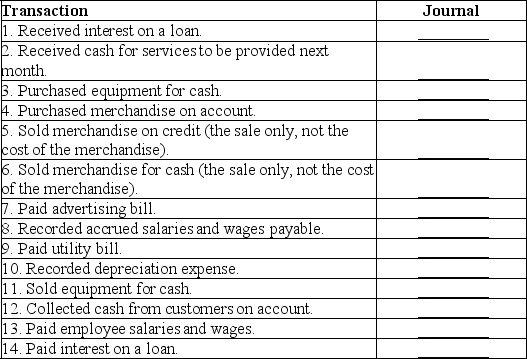
(Essay)
4.9/5 (82)
(82) Mary Parker Co. invested $15,000 in ABC Corporation and received common stock in exchange. Mary Parker Co.'s journal entry to record this transaction would include a:
(Multiple Choice)
4.9/5 (80)
(80) Incurring an expense for advertising on account would be recorded by:
(Multiple Choice)
4.7/5 (66)
(66) 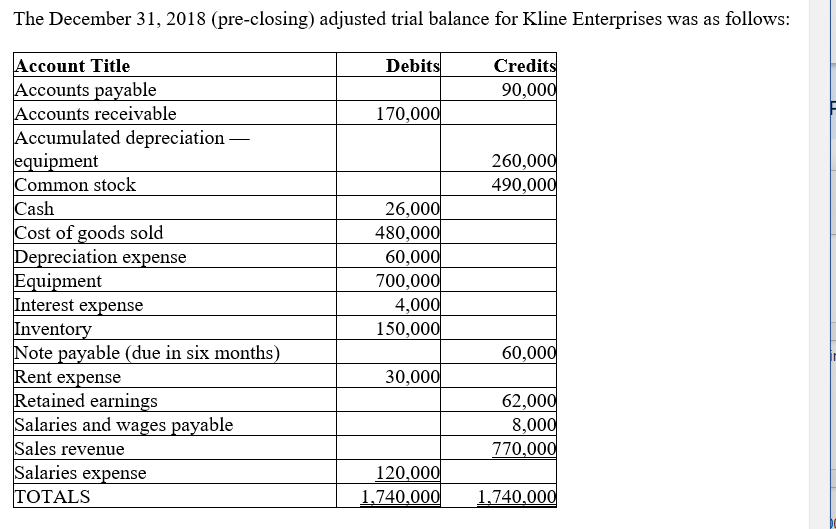 -Assuming no income taxes, compute the following, and place your answer in the space provided:
Kline's 12/31/18 total shareholders' equity.
-Assuming no income taxes, compute the following, and place your answer in the space provided:
Kline's 12/31/18 total shareholders' equity. (Essay)
4.9/5 (85)
(85) Accruals occur when the cash flow precedes either revenue or expense recognition.
(True/False)
4.8/5 (67)
(67) The account titles to be responded to are provided in no particular order. Assume that all accounts have normal balances according to whether the account is increased by a debit or increased by a credit.
Required:
In column A, indicate whether a debit will:
1. Increase the account balance, or
2. Decrease the account balance.
In column B, classify each account according to the following scheme. For contra accounts, indicate the classification of the account to which it relates.
1. A current asset in the balance sheet.
2. A noncurrent asset in the balance sheet.
3. A current liability in the balance sheet.
4. A long-term liability in the balance sheet.
5. A permanent equity account in the balance sheet.
6. A revenue account in the income statement.
7. An expense account shown in the income statement.
8. Account does not appear in either the balance sheet or the income statement.
-Buildings and equipment (B&E)
-Buildings and equipment (B&E) (Short Answer)
4.8/5 (76)
(76) When Castle Corporation pays insurance premiums, the transaction is recorded as a debit to prepaid insurance. Additional information for the year ended December 31 is as follows:  What was the total amount of cash paid by Castle for insurance premiums during the year?
 (Multiple Choice)
4.7/5 (82)
(82) On November 1, 2018, Tim's Toys borrows $30,000,000 at 9% to finance the holiday sales season. The note is for a six-month term and both principal and interest are payable at maturity. What is the balance of interest payable for the loan as of December 31, 2018?
(Multiple Choice)
4.9/5 (95)
(95) Which of the following accounts has a balance whereby debits normally exceed credits?
(Multiple Choice)
4.9/5 (83)
(83) The following information, based on the 12/31/18 Annual Report to Shareholders of Krafty Foods ($ in millions):
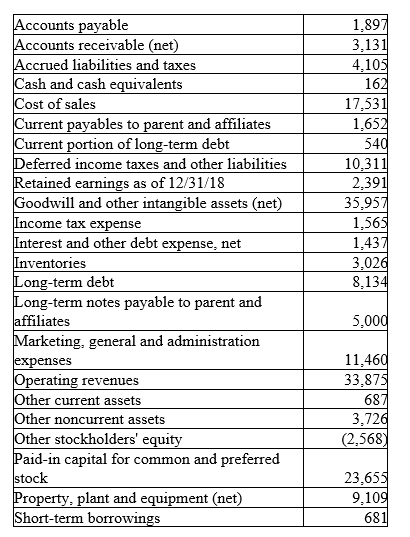 -Based on the information presented above, prepare the Income Statement for Krafty Foods for the year ended December 31, 2018.
 (Essay)
4.9/5 (76)
(76) The balance sheet can be considered a change or flow statement.
(True/False)
4.9/5 (75)
(75) Davis Hardware Company uses a perpetual inventory system. How should Davis record the sale of merchandise, costing $620, and sold on account for $960?
(Multiple Choice)
4.8/5 (85)
(85) The account titles to be responded to are provided in no particular order. Assume that all accounts have normal balances according to whether the account is increased by a debit or increased by a credit.
Required:
In column A, indicate whether a debit will:
1. Increase the account balance, or
2. Decrease the account balance.
In column B, classify each account according to the following scheme. For contra accounts, indicate the classification of the account to which it relates.
1. A current asset in the balance sheet.
2. A noncurrent asset in the balance sheet.
3. A current liability in the balance sheet.
4. A long-term liability in the balance sheet.
5. A permanent equity account in the balance sheet.
6. A revenue account in the income statement.
7. An expense account shown in the income statement.
8. Account does not appear in either the balance sheet or the income statement.
-Property taxes payable
-Property taxes payable (Short Answer)
4.9/5 (92)
(92) Raintree Corporation maintains its records on a cash basis. At the end of each year the company's accountant obtains the necessary information to prepare accrual basis financial statements. The following cash flows occurred during the year ended December 31, 2018: 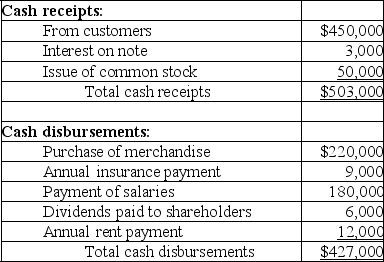 Selected balance sheet information:
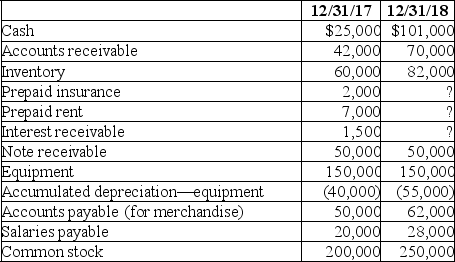 Additional information:
1. On June 30, 2017, Raintree lent a customer $50,000. Interest at 6% is payable annually on each June 30. Principal is due in 2021.
2. The annual insurance payment is made in advance on March 31.
3. Annual rent on the company's facilities is paid in advance on September 30.
Required:
1. Prepare an accrual basis income statement for 2018 (ignore income taxes).
2. Determine the following balance sheet amounts on December 31, 2018:
a. Interest receivable
b. Prepaid insurance
c. Prepaid rent
Selected balance sheet information: Additional information:
1. On June 30, 2017, Raintree lent a customer $50,000. Interest at 6% is payable annually on each June 30. Principal is due in 2021.
2. The annual insurance payment is made in advance on March 31.
3. Annual rent on the company's facilities is paid in advance on September 30.
Required:
1. Prepare an accrual basis income statement for 2018 (ignore income taxes).
2. Determine the following balance sheet amounts on December 31, 2018:
a. Interest receivable
b. Prepaid insurance
c. Prepaid rent (Essay)
4.9/5 (80)
(80) 
Filters
- Essay(0)
- Multiple Choice(0)
- Short Answer(0)
- True False(0)
- Matching(0)