



 Chat with AI
Exam 38: Freehand Vertical Lettering

Exam 1: Bases for Blueprint Reading and Sketching13 Questions
Exam 2: The Alphabet of Lines and Object Lines11 Questions
Exam 3: Hidden Lines and Center Lines9 Questions
Exam 4: Extension Lines and Dimension Lines11 Questions
Exam 5: Projection Lines, Other Lines, and Line Combinations11 Questions
Exam 6: Three-View Drawings11 Questions
Exam 7: Arrangement of Views11 Questions
Exam 8: Two-View Drawings8 Questions
Exam 9: One-View Drawings11 Questions
Exam 10: Auxiliary Views10 Questions
Exam 11: Size and Location Dimensions16 Questions
Exam 12: Dimensioning Cylinders, Circles, and Arcs12 Questions
Exam 13: Size Dimensions for Holes and Angles11 Questions
Exam 14: Location Dimensions for Points, Centers, and Holes8 Questions
Exam 15: Dimensioning Large Arcs and Base Line Dimensions13 Questions
Exam 16: Tolerances Fractional and Angular Dimensions14 Questions
Exam 17: Tolerances Unilateral and Bilateral, Decimal Dimensions11 Questions
Exam 18: Interchangeable Parts, Allowances, and Classes of Fit11 Questions
Exam 19: Representing and Dimensioning External Screw Threads11 Questions
Exam 20: Representing and Specifying Internal and Left-Hand Threads11 Questions
Exam 21: Dimensioning Tapers and Machined Surfaces11 Questions
Exam 22: Dimensioning With Shop Notes11 Questions
Exam 23: Metric System Dimensioning and Iso Symbols11 Questions
Exam 24: First-Angle Projection and Dimensioning10 Questions
Exam 25: Metric Screw Threads, Dual Dimensioning, and Tolerancing11 Questions
Exam 26: Cutting Planes, Full Sections, and Section Lining11 Questions
Exam 27: Half Sections, Partial Sections, and Full Section Assembly Drawings11 Questions
Exam 28: Datums Ordinate and Tabular Dimensioning11 Questions
Exam 29: Geometric Dimensioning, Tolerancing, and Datum Referencing11 Questions
Exam 30: Caddcamcim and Robotics11 Questions
Exam 31: Welding Symbols, Representation, and Dimensioning11 Questions
Exam 32: Surface Development and Precision Sheet Metal Drawing11 Questions
Exam 33: Detail Drawings and Assembly Drawings15 Questions
Exam 34: Sketching Horizontal, Vertical, and Slant Lines8 Questions
Exam 35: Sketching Curved Lines and Circles8 Questions
Exam 36: Sketching Irregular Shapes8 Questions
Exam 37: Sketching Fillets, Radii, Rounded Corners, Edges, and Shading12 Questions
Exam 38: Freehand Vertical Lettering15 Questions
Exam 39: Freehand Inclined Lettering9 Questions
Exam 40: Orthographic Sketching11 Questions
Exam 41: Oblique Sketching11 Questions
Exam 42: Isometric Sketching11 Questions
Exam 43: Perspective Sketching11 Questions
Exam 44: Pictorial Drawings and Dimensions8 Questions
Exam 45: Two-Dimensional and Three-Dimensional Cad Sketching11 Questions
Exam 46: Proportions and Assembly Drawings10 Questions
Select questions type


Between words, a space ____ the full width of a normal letter should be used.

Free
(Multiple Choice)
5.0/5  (76)
(76) Correct Answer: Verified
D
Discuss why proper spacing between letters, words and lines is important.
Free
(Essay)
4.8/5 (71)
(71) Correct Answer:Verified
VerifiedTo achieve good lettering, attention must be given to the proper spacing between letters, words, and lines. Words and lines that are either condensed and run together or spread out are difficult to read, cause inaccuracies, and detract from an otherwise good drawing.
The National Micrographics Association has developed an adaptation of the single-stroke Gothic characters for general use and increased legibility in drawing reproduction known as ____.
Free
(Multiple Choice)
4.9/5 (82)
(82) Correct Answer:Verified
VerifiedA
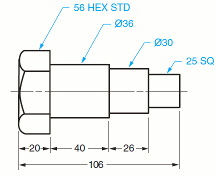 The accompanying figure represents the ____ lettering and numerals.
 (Multiple Choice)
4.9/5 (72)
(72) Explain the purpose of lettering on the drawing of a part or mechanism and how it is done.
(Essay)
4.9/5 (84)
(84) A ____ is recommended for lettering because it is possible to guide the pencil easily to form good letters.
(Multiple Choice)
4.7/5 (81)
(81) 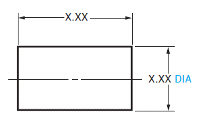 In the accompanying figure, what do the small numbers indicate?
An almost square style letter known as ____ lettering is very widely used because it is legible and the individual letters are simple enough to be made quickly and accurately.
(Multiple Choice)
4.8/5 (62)
(62) The space between letters should be about ____ the width of a regular letter.
(Multiple Choice)
4.7/5 (75)
(75) When learning to letter a drawing, ____ should be started first, as they are easiest to make.
(Multiple Choice)
4.9/5 (78)
(78) 
Filters
- Essay(0)
- Multiple Choice(0)
- Short Answer(0)
- True False(0)
- Matching(0)