



 Chat with AI
Exam 17: Tolerances Unilateral and Bilateral, Decimal Dimensions

Exam 1: Bases for Blueprint Reading and Sketching13 Questions
Exam 2: The Alphabet of Lines and Object Lines11 Questions
Exam 3: Hidden Lines and Center Lines9 Questions
Exam 4: Extension Lines and Dimension Lines11 Questions
Exam 5: Projection Lines, Other Lines, and Line Combinations11 Questions
Exam 6: Three-View Drawings11 Questions
Exam 7: Arrangement of Views11 Questions
Exam 8: Two-View Drawings8 Questions
Exam 9: One-View Drawings11 Questions
Exam 10: Auxiliary Views10 Questions
Exam 11: Size and Location Dimensions16 Questions
Exam 12: Dimensioning Cylinders, Circles, and Arcs12 Questions
Exam 13: Size Dimensions for Holes and Angles11 Questions
Exam 14: Location Dimensions for Points, Centers, and Holes8 Questions
Exam 15: Dimensioning Large Arcs and Base Line Dimensions13 Questions
Exam 16: Tolerances Fractional and Angular Dimensions14 Questions
Exam 17: Tolerances Unilateral and Bilateral, Decimal Dimensions11 Questions
Exam 18: Interchangeable Parts, Allowances, and Classes of Fit11 Questions
Exam 19: Representing and Dimensioning External Screw Threads11 Questions
Exam 20: Representing and Specifying Internal and Left-Hand Threads11 Questions
Exam 21: Dimensioning Tapers and Machined Surfaces11 Questions
Exam 22: Dimensioning With Shop Notes11 Questions
Exam 23: Metric System Dimensioning and Iso Symbols11 Questions
Exam 24: First-Angle Projection and Dimensioning10 Questions
Exam 25: Metric Screw Threads, Dual Dimensioning, and Tolerancing11 Questions
Exam 26: Cutting Planes, Full Sections, and Section Lining11 Questions
Exam 27: Half Sections, Partial Sections, and Full Section Assembly Drawings11 Questions
Exam 28: Datums Ordinate and Tabular Dimensioning11 Questions
Exam 29: Geometric Dimensioning, Tolerancing, and Datum Referencing11 Questions
Exam 30: Caddcamcim and Robotics11 Questions
Exam 31: Welding Symbols, Representation, and Dimensioning11 Questions
Exam 32: Surface Development and Precision Sheet Metal Drawing11 Questions
Exam 33: Detail Drawings and Assembly Drawings15 Questions
Exam 34: Sketching Horizontal, Vertical, and Slant Lines8 Questions
Exam 35: Sketching Curved Lines and Circles8 Questions
Exam 36: Sketching Irregular Shapes8 Questions
Exam 37: Sketching Fillets, Radii, Rounded Corners, Edges, and Shading12 Questions
Exam 38: Freehand Vertical Lettering15 Questions
Exam 39: Freehand Inclined Lettering9 Questions
Exam 40: Orthographic Sketching11 Questions
Exam 41: Oblique Sketching11 Questions
Exam 42: Isometric Sketching11 Questions
Exam 43: Perspective Sketching11 Questions
Exam 44: Pictorial Drawings and Dimensions8 Questions
Exam 45: Two-Dimensional and Three-Dimensional Cad Sketching11 Questions
Exam 46: Proportions and Assembly Drawings10 Questions
Select questions type


Briefly explain the decimal dimensioning system.

Free
(Essay)
4.7/5  (75)
(75) Correct Answer: Verified
Dimensions in the decimal system can be read quickly and accurately. Dimensions are read in thousandths, 1/1000" = (.001"); in ten thousandths, 1/10,000" = (.0001"); and in even finer divisions if necessary.
The smaller size on a tolerance is called the ____.
Free
(Multiple Choice)
4.7/5 (82)
(82) Correct Answer:Verified
VerifiedA
One of the common methods of specifying a tolerance that applies on all dimensions is to use a(n) ____.
Free
(Multiple Choice)
4.8/5 (93)
(93) Correct Answer:Verified
VerifiedC
Describe the two classifications of tolerances that the limits of accuracy to which a part is to be produced may fall.
(Essay)
4.8/5 (82)
(82) 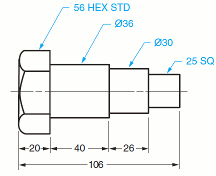 The accompanying figure is an example of a ____ tolerance.
____ tolerances applied to dimensions mean that the dimensions may vary from a larger size (+) to a smaller size (-) than the basic dimension (nominal size).
(Multiple Choice)
4.8/5 (70)
(70) 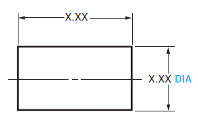 The accompanying figure is an example of a ____ tolerance.
A dimension is said to have a(n) ____ tolerance when the total tolerance is in one direction only, either (+) or (-).
(Multiple Choice)
4.8/5 (83)
(83) 
Filters
- Essay(0)
- Multiple Choice(0)
- Short Answer(0)
- True False(0)
- Matching(0)