



 Chat with AI
Exam 46: Proportions and Assembly Drawings

Exam 1: Bases for Blueprint Reading and Sketching13 Questions
Exam 2: The Alphabet of Lines and Object Lines11 Questions
Exam 3: Hidden Lines and Center Lines9 Questions
Exam 4: Extension Lines and Dimension Lines11 Questions
Exam 5: Projection Lines, Other Lines, and Line Combinations11 Questions
Exam 6: Three-View Drawings11 Questions
Exam 7: Arrangement of Views11 Questions
Exam 8: Two-View Drawings8 Questions
Exam 9: One-View Drawings11 Questions
Exam 10: Auxiliary Views10 Questions
Exam 11: Size and Location Dimensions16 Questions
Exam 12: Dimensioning Cylinders, Circles, and Arcs12 Questions
Exam 13: Size Dimensions for Holes and Angles11 Questions
Exam 14: Location Dimensions for Points, Centers, and Holes8 Questions
Exam 15: Dimensioning Large Arcs and Base Line Dimensions13 Questions
Exam 16: Tolerances Fractional and Angular Dimensions14 Questions
Exam 17: Tolerances Unilateral and Bilateral, Decimal Dimensions11 Questions
Exam 18: Interchangeable Parts, Allowances, and Classes of Fit11 Questions
Exam 19: Representing and Dimensioning External Screw Threads11 Questions
Exam 20: Representing and Specifying Internal and Left-Hand Threads11 Questions
Exam 21: Dimensioning Tapers and Machined Surfaces11 Questions
Exam 22: Dimensioning With Shop Notes11 Questions
Exam 23: Metric System Dimensioning and Iso Symbols11 Questions
Exam 24: First-Angle Projection and Dimensioning10 Questions
Exam 25: Metric Screw Threads, Dual Dimensioning, and Tolerancing11 Questions
Exam 26: Cutting Planes, Full Sections, and Section Lining11 Questions
Exam 27: Half Sections, Partial Sections, and Full Section Assembly Drawings11 Questions
Exam 28: Datums Ordinate and Tabular Dimensioning11 Questions
Exam 29: Geometric Dimensioning, Tolerancing, and Datum Referencing11 Questions
Exam 30: Caddcamcim and Robotics11 Questions
Exam 31: Welding Symbols, Representation, and Dimensioning11 Questions
Exam 32: Surface Development and Precision Sheet Metal Drawing11 Questions
Exam 33: Detail Drawings and Assembly Drawings15 Questions
Exam 34: Sketching Horizontal, Vertical, and Slant Lines8 Questions
Exam 35: Sketching Curved Lines and Circles8 Questions
Exam 36: Sketching Irregular Shapes8 Questions
Exam 37: Sketching Fillets, Radii, Rounded Corners, Edges, and Shading12 Questions
Exam 38: Freehand Vertical Lettering15 Questions
Exam 39: Freehand Inclined Lettering9 Questions
Exam 40: Orthographic Sketching11 Questions
Exam 41: Oblique Sketching11 Questions
Exam 42: Isometric Sketching11 Questions
Exam 43: Perspective Sketching11 Questions
Exam 44: Pictorial Drawings and Dimensions8 Questions
Exam 45: Two-Dimensional and Three-Dimensional Cad Sketching11 Questions
Exam 46: Proportions and Assembly Drawings10 Questions
Select questions type


Discuss how to maintain correct proportions when freehand sketching.

Free
(Essay)
4.9/5  (96)
(96) Correct Answer: Verified
Freehand sketching requires judgment about how the sizes of different features are to be correctly proportioned. With practice, the eye can adequately create and maintain proportion without the use of superfluous, time-consuming devices. Usually, an approximation by eye is adequate. If a grid paper is used, each block generally represents a definite measurement. Still more precise sketches may be made by the use of measuring instruments.
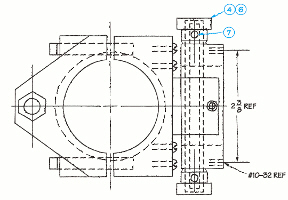 The housing clamp assembly drawing in the accompanying figure shows a sketched ____ view.
Free
(Multiple Choice)
4.9/5 (79)
(79) Correct Answer:Verified
VerifiedB
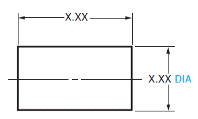 In the accompanying figure, the step identified as item A in sketching a stub nose screwdriver is to ____.
Free
(Multiple Choice)
4.8/5 (91)
(91) Correct Answer:Verified
VerifiedC
Freehand sketching requires judgment about how the sizes of different features are to be correctly ____.
(Multiple Choice)
4.9/5 (77)
(77) 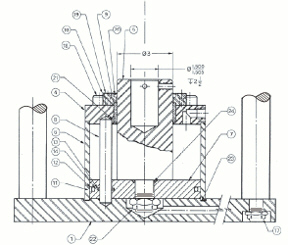 The accompanying figure shows a _____ drawing.
List the three major steps in drawing an object with accurate proportions.
(Essay)
4.9/5 (66)
(66) 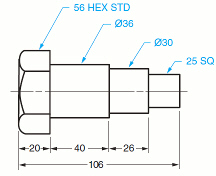 The piston system shown in the accompanying figure is an example of what type of drawing?
 (Essay)
4.8/5 (87)
(87) 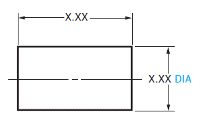 In the accompanying figure, the step identified as item B in sketching a stub nose screwdriver is to ____.
 (Multiple Choice)
4.8/5 (74)
(74) 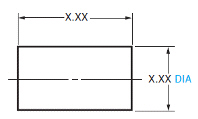 In the accompanying figure, the step identified as item C in sketching a stub nose screwdriver is to ____.
 (Multiple Choice)
4.8/5 (78)
(78) 
Filters
- Essay(0)
- Multiple Choice(0)
- Short Answer(0)
- True False(0)
- Matching(0)