



 Chat with AI
Exam 12: Fiscal Policy: Incentives, and Secondary Effects

Exam 1: The Economic Approach185 Questions
Exam 2: Some Tools of the Economist204 Questions
Exam 3: Demand, Supply, and the Market Process339 Questions
Exam 4: Supply and Demand: Applications and Extensions268 Questions
Exam 5: Difficult Cases for the Market, and the Role of Government134 Questions
Exam 6: The Economics of Political Action161 Questions
Exam 7: Taking the Nations Economic Pulse222 Questions
Exam 8: Economic Fluctuations, Unemployment, and Inflation182 Questions
Exam 9: An Introduction to Basic Macroeconomic Markets219 Questions
Exam 10: Dynamic Change, Economic Fluctuations, and the Ad--As Model193 Questions
Exam 11: Fiscal Policy: The Keynesian View and the Historical Development of Macroeconomics112 Questions
Exam 12: Fiscal Policy: Incentives, and Secondary Effects154 Questions
Exam 13: Money and the Banking System198 Questions
Exam 14: Modern Macroeconomics and Monetary Policy204 Questions
Exam 15: Stabilization Policy, Output, and Employment170 Questions
Exam 16: Creating an Environment for Growth and Prosperity125 Questions
Exam 17: Institutions, Policies, and Cross-Country Differences in Income and Growth115 Questions
Exam 18: Gaining From International Trade182 Questions
Exam 19: International Finance and the Foreign Exchange Market148 Questions
Exam 20: Special Topics274 Questions
Select questions type


Which of the following is an argument for tax cuts rather than government spending as a way to promote recovery from a recession?
(Multiple Choice)
4.8/5  (76)
(76) Which of the following most accurately indicates the political incentive to spend and/or tax?
(Multiple Choice)
4.9/5 (84)
(84) During 1960-1980, those with the highest incomes confronted federal marginal tax rates between 70 and 90 percent. Since 1986, the highest federal income tax rate has been less than 40 percent. Since 1986, the share of the personal income tax collected from the top one-half of one percent of earners has been
(Multiple Choice)
4.8/5 (76)
(76) Spending programs that substantially alter the composition of aggregate demand will tend to
(Multiple Choice)
4.9/5 (75)
(75) Within the framework of the AD-AS model, an increase in savings by households will
(Multiple Choice)
4.9/5 (90)
(90) The paradox of excessive consumption argues that when households spend all they earn,
(Multiple Choice)
4.9/5 (69)
(69) Which of the following attributes of the recession of 2008-2009 is most supportive of the Keynesian view that the crowding-out effect will be minimal during a severe recession?
(Multiple Choice)
4.9/5 (77)
(77) Which one of the following is an area of continued disagreement among modern macroeconomists with regard to the use of fiscal policy?
(Multiple Choice)
4.8/5 (82)
(82) The crowding-out effect stresses that increased government borrowing to cover a budget deficit will cause
(Multiple Choice)
4.8/5 (88)
(88) Other things being constant, countries with higher rates of saving
(Multiple Choice)
4.8/5 (69)
(69) New classical economists stress that an increase in government expenditures financed by borrowing rather than taxes will
(Multiple Choice)
4.9/5 (82)
(82) Which of the following contributes to the popularity of the argument that government spending expands employment?
(Multiple Choice)
4.9/5 (74)
(74) When government spending flows to areas where resources are already fully employed,
(Multiple Choice)
4.7/5 (81)
(81) Which of the following most clearly states the "paradox of thrift"?
(Multiple Choice)
4.9/5 (82)
(82) Use the figure below to answer the following question(s). Figure 12-2
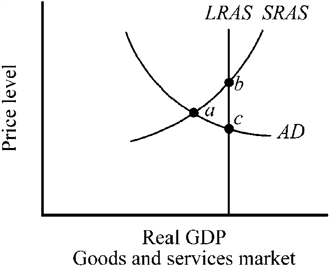 Refer to Figure 12-2. If an economy is operating in the short run at point a, Keynesian analysis indicates that expansionary fiscal policy will
 (Multiple Choice)
4.9/5 (79)
(79) If the crowding-out effect is strong, how will the potency of discretionary fiscal policy be affected?
(Multiple Choice)
4.8/5 (79)
(79) If decreased government borrowing drives down real interest rates in the United States,
(Multiple Choice)
4.8/5 (82)
(82) Use the figure below to answer the following question(s). Figure 12-1
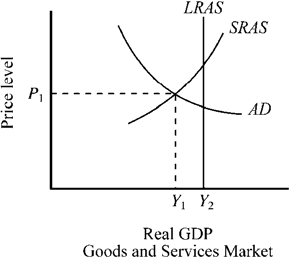 Refer to Figure 12-1. If the output of the economy is Y1, which of the following would a new classical economist be most likely to favor?
 (Multiple Choice)
4.9/5 (74)
(74) Which of the following is part of the synthesis view of fiscal policy?
(Multiple Choice)
4.9/5 (95)
(95) 
Filters
- Essay(0)
- Multiple Choice(0)
- Short Answer(0)
- True False(0)
- Matching(0)