



 Chat with AI
Exam 12: Fiscal Policy: Incentives, and Secondary Effects

Exam 1: The Economic Approach185 Questions
Exam 2: Some Tools of the Economist204 Questions
Exam 3: Demand, Supply, and the Market Process339 Questions
Exam 4: Supply and Demand: Applications and Extensions268 Questions
Exam 5: Difficult Cases for the Market, and the Role of Government134 Questions
Exam 6: The Economics of Political Action161 Questions
Exam 7: Taking the Nations Economic Pulse222 Questions
Exam 8: Economic Fluctuations, Unemployment, and Inflation182 Questions
Exam 9: An Introduction to Basic Macroeconomic Markets219 Questions
Exam 10: Dynamic Change, Economic Fluctuations, and the Ad--As Model193 Questions
Exam 11: Fiscal Policy: The Keynesian View and the Historical Development of Macroeconomics112 Questions
Exam 12: Fiscal Policy: Incentives, and Secondary Effects154 Questions
Exam 13: Money and the Banking System198 Questions
Exam 14: Modern Macroeconomics and Monetary Policy204 Questions
Exam 15: Stabilization Policy, Output, and Employment170 Questions
Exam 16: Creating an Environment for Growth and Prosperity125 Questions
Exam 17: Institutions, Policies, and Cross-Country Differences in Income and Growth115 Questions
Exam 18: Gaining From International Trade182 Questions
Exam 19: International Finance and the Foreign Exchange Market148 Questions
Exam 20: Special Topics274 Questions
Select questions type


According to the Keynesian view, the proper response to a severe recession would be
(Multiple Choice)
4.9/5  (72)
(72) During and following the recession of 2008-2009, private investment was
(Multiple Choice)
4.8/5 (82)
(82) The debt to GDP ratio in the U.S. is unlikely to cause major problems as long as which of the following scenario holds?
(Multiple Choice)
5.0/5 (79)
(79) Public choice analysis indicates that it will be politically more attractive to
(Multiple Choice)
4.8/5 (73)
(73) Use the figure below to answer the following question(s). Figure 12-2
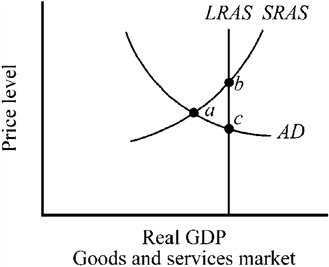 Refer to Figure 12-2. Which of the following will most likely be favored by a new classical economist if the economy is operating at point a?
 (Multiple Choice)
4.8/5 (84)
(84) Which of the following is most likely to increase the incentive to invest, produce, and employ others?
(Multiple Choice)
4.8/5 (78)
(78) Reductions in personal income tax rates that increase labor supply and work effort, can be expected to also
(Multiple Choice)
4.8/5 (81)
(81) Are jobs the key to economic progress and the achievement of high income levels?
(Multiple Choice)
4.7/5 (87)
(87) The coordination problem accompanying expansionary fiscal policy refers to
(Multiple Choice)
5.0/5 (80)
(80) Which is more likely to stimulate aggregate demand in a timely manner?
(Multiple Choice)
4.8/5 (89)
(89) When the tax rates imposed on the rich are high, a reduction in these rates
(Multiple Choice)
4.8/5 (76)
(76) An increase in subsidies and other government spending during a recession is likely to result in
(Multiple Choice)
4.8/5 (75)
(75) According to the Keynesian view, the rapid increase in government spending and large budget deficits in response to the recession of 2008-2009
(Multiple Choice)
4.9/5 (75)
(75) The new classical model implies that a shift to a more expansionary fiscal policy (the substitution of debt financing for taxes) will
(Multiple Choice)
5.0/5 (74)
(74) Suppose that increases in government expenditures and large budget deficits are projected for the next decade. If strong growth is observed during this decade, this would be most consistent with
(Multiple Choice)
4.9/5 (77)
(77) Which of the following is true with regard to the use of countercyclical fiscal policy as a stabilization tool?
(Multiple Choice)
4.9/5 (64)
(64) Use the figure below to answer the following question(s). Figure 12-1
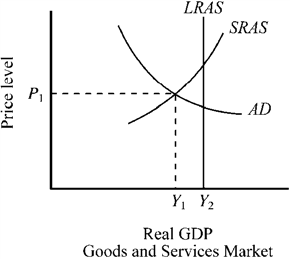 Refer to Figure 12-1. If the output of the economy is Y1, which of the following would a Keynesian economist be most likely to favor?
 (Multiple Choice)
4.9/5 (71)
(71) 
Filters
- Essay(0)
- Multiple Choice(0)
- Short Answer(0)
- True False(0)
- Matching(0)