



 Chat with AI
Exam 12: Fiscal Policy: Incentives, and Secondary Effects

Exam 1: The Economic Approach185 Questions
Exam 2: Some Tools of the Economist204 Questions
Exam 3: Demand, Supply, and the Market Process339 Questions
Exam 4: Supply and Demand: Applications and Extensions268 Questions
Exam 5: Difficult Cases for the Market, and the Role of Government134 Questions
Exam 6: The Economics of Political Action161 Questions
Exam 7: Taking the Nations Economic Pulse222 Questions
Exam 8: Economic Fluctuations, Unemployment, and Inflation182 Questions
Exam 9: An Introduction to Basic Macroeconomic Markets219 Questions
Exam 10: Dynamic Change, Economic Fluctuations, and the Ad--As Model193 Questions
Exam 11: Fiscal Policy: The Keynesian View and the Historical Development of Macroeconomics112 Questions
Exam 12: Fiscal Policy: Incentives, and Secondary Effects154 Questions
Exam 13: Money and the Banking System198 Questions
Exam 14: Modern Macroeconomics and Monetary Policy204 Questions
Exam 15: Stabilization Policy, Output, and Employment170 Questions
Exam 16: Creating an Environment for Growth and Prosperity125 Questions
Exam 17: Institutions, Policies, and Cross-Country Differences in Income and Growth115 Questions
Exam 18: Gaining From International Trade182 Questions
Exam 19: International Finance and the Foreign Exchange Market148 Questions
Exam 20: Special Topics274 Questions
Select questions type


Fiscal stimulus is most likely to direct resources into productive projects when spending decisions are left in the hands of
(Multiple Choice)
4.7/5  (98)
(98) Between 1986 and 2010, the top marginal personal income tax rate was 40 percent or less compared to 70 percent or more prior to 1981. Compared to the earlier time period, in recent years the share of personal income taxes paid by high income taxpayers
(Multiple Choice)
4.9/5 (79)
(79) A supply-side economist would stress which of the following attributes of fiscal policy?
(Multiple Choice)
4.9/5 (97)
(97) According to the Keynesian view, the large budget deficits of 2008-2015 resulted in
(Multiple Choice)
4.8/5 (81)
(81) Which of the following will be most likely to dampen the expansionary effects of an increase in government spending financed by borrowing?
(Multiple Choice)
5.0/5 (91)
(91) Use the figure below to answer the following question(s). Figure 12-2
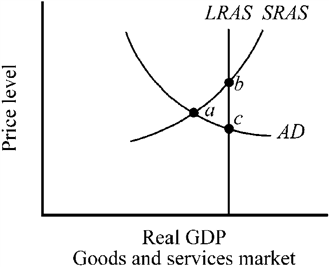 Refer to Figure 12-2. When the economy is operating at point a, reliance on the self-correcting mechanism will
 (Multiple Choice)
5.0/5 (76)
(76) Both the crowding-out effect and new classical model indicate that
(Multiple Choice)
4.8/5 (70)
(70) It will be difficult to institute fiscal policy in a stabilizing manner because politicians will find
(Multiple Choice)
4.9/5 (66)
(66) Which of the following best explains why high marginal tax rates retard output?
(Multiple Choice)
4.8/5 (88)
(88) Which one of the following is an area of agreement among modern macroeconomists with regard to the use of fiscal policy?
(Multiple Choice)
4.8/5 (93)
(93) Which of the following best describes the crowding-out effect?
(Multiple Choice)
4.9/5 (80)
(80) Which of the following tends to make the size of a shift in aggregate demand resulting from a tax change smaller than would otherwise be the case?
(Multiple Choice)
4.8/5 (63)
(63) The incentive to consume tax-deductible goods, instead of nondeductible goods, increases when
(Multiple Choice)
4.8/5 (83)
(83) If there is an increase in foreign financial investment in the United States as the result of large U.S. budget deficits and attractive interest yields,
(Multiple Choice)
4.8/5 (82)
(82) The persistence of budget deficits during the last several decades is not surprising because politicians will find
(Multiple Choice)
4.8/5 (75)
(75) Which of the following makes it more likely that a country will get caught in a vicious circle of debt financing, higher taxes, and sluggish growth?
(Multiple Choice)
5.0/5 (66)
(66) 
Filters
- Essay(0)
- Multiple Choice(0)
- Short Answer(0)
- True False(0)
- Matching(0)