



 Chat with AI
Exam 5: The Lipids: Fats and Oilsspotlight: Diet and Heart Disease

Exam 1: The Basics of Understanding Nutrition Spotlight: How Do You Tell If Its Nutrition Fact or Nutrition Fiction92 Questions
Exam 2: The Pursuit of a Healthy Dietspotlight: a Tapestry of Cultures and Cuisines90 Questions
Exam 3: Anatomy for Nutritions Sakespotlight: Gut Feelings--Common Digestive Problems92 Questions
Exam 4: The Carbohydrates: Sugar, Starch, and Fiberspotlight: Sweet Talk--Alternatives to Sugar82 Questions
Exam 5: The Lipids: Fats and Oilsspotlight: Diet and Heart Disease92 Questions
Exam 6: The Proteins and Amino Acidsspotlight: Vegetarian Eating Patterns89 Questions
Exam 7: The Vitamins: a Functional Approachspotlight: Nutrition and Cancer Prevention100 Questions
Exam 8: The Minerals and Water: a Functional Approachspotlight: Osteoporosis--The Silent Stalker of the Bones97 Questions
Exam 9: Impact of Fluids and Beverages on Nutritional Healthspotlight: Fetal Alcohol Spectrum Disorder100 Questions
Exam 10: Weight Managementspotlight: the Eating Disorders96 Questions
Exam 11: Nutrition for Fueling Fitness and Sportspotlight: Nutrition Supplements and Sport Performance--Help or Hype100 Questions
Exam 12: The Life Cycle: Conception Through the Later Yearsspotlight: Addressing Weight Problems in Children and Adolescents95 Questions
Exam 13: Food Safety and the Global Food Supplyspotlight: Global Food Insecurity87 Questions
Select questions type


Vignette #1 Jack has just returned from the hospital where his father is recovering from a heart attack. The doctors told Jack that his dad's atherosclerosis is very serious. Jack and his wife, Melanie, are worried about Jack's father and also are starting to think about Jack's risk of having heart disease in his lifetime. He sets up an appointment at his doctor's office and has his blood lipid levels evaluated for the first time. Let's see if you can answer some of the questions that Jack and Melanie have.
Because he is now better informed, Jack wants to cook healthier meals. Which recommendation should he avoid ?
(Multiple Choice)
4.9/5  (83)
(83) To lower blood cholesterol, an atherogenic diet plan advocates keeping saturated fat to less than five to six percent of daily calories.
(True/False)
4.9/5 (93)
(93) Vitamin C and vitamin E are natural antioxidants that may be added to foods to increase shelf life.
(True/False)
4.8/5 (91)
(91) ________ is a noncaloric artificial fat made from fatty acids and sucrose.
(Multiple Choice)
4.8/5 (74)
(74) Sam and Regina have a two-year old daughter, Keira. Sam wants Keira to follow the same low-fat diet like the one he and Regina follow. What advice would you give these parents?
(Multiple Choice)
4.9/5 (90)
(90) _________ make up 95 percent of the lipids in foods and in the human body.
(Multiple Choice)
4.9/5 (71)
(71) Glycerol and _____ diffuse easily into intestinal cells, which release them into capillaries without further processing.
(Multiple Choice)
4.8/5 (93)
(93) What methods are used by the food industry to prevent the spoilage of unsaturated oils in foods to increase shelf-life?
(Essay)
4.8/5 (80)
(80) Phytosterols are phytochemicals that block the absorption of dietary cholesterol from the intestine.
(True/False)
4.7/5 (70)
(70) Low concentrations of low-density lipoproteins are associated with a high risk of heart attack.
(True/False)
4.8/5 (85)
(85) Heather notices that her favorite breakfast cereal contains butylated hydroxyanisole (BHA) and butylated hydroxytoluene (BHT). Why did the manufacturer add these ingredients?
(Multiple Choice)
4.9/5 (73)
(73) The Mediterranean diet provides about 20 to 25 percent of calories from fat.
(True/False)
4.9/5 (85)
(85) You can typically judge the healthfulness of a fat by looking at ________.
(Multiple Choice)
4.7/5 (69)
(69) For each of the following ingredients, suggest a substitution that is lower in unhealthy fats:
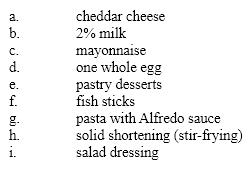
(Essay)
4.8/5 (62)
(62) 
Filters
- Essay(0)
- Multiple Choice(0)
- Short Answer(0)
- True False(0)
- Matching(0)