



 Chat with AI
Exam 10: Price-Searcher Markets With Low Entry Barriers

Exam 1: The Economic Approach210 Questions
Exam 2: Some Tools of the Economist257 Questions
Exam 3: Demand, Supply, and the Market Process585 Questions
Exam 4: Supply and Demand: Applications and Extensions331 Questions
Exam 5: Difficult Cases for the Market, and the Role of Government168 Questions
Exam 6: The Economics of Political Action360 Questions
Exam 7: Consumer Choice and Elasticity223 Questions
Exam 8: Costs and the Supply of Goods231 Questions
Exam 9: Price Takers and the Competitive Process497 Questions
Exam 10: Price-Searcher Markets With Low Entry Barriers216 Questions
Exam 11: Price-Searcher Markets With High Entry Barriers254 Questions
Exam 12: The Supply of and Demand for Productive Resources200 Questions
Exam 13: Earnings, Productivity, and the Job Market109 Questions
Exam 14: Investment, the Capital Market, and the Wealth of Nations129 Questions
Exam 15: Income Inequality and Poverty136 Questions
Exam 16: Applying the Basics: Special Topics in Economics709 Questions
Select questions type


If marginal cost exceeds marginal revenue, a profit-maximizing firm should
(Multiple Choice)
4.8/5  (80)
(80) Which of the following statements about price discrimination is correct?
(Multiple Choice)
4.8/5 (93)
(93) Which of the following conditions is most essential if a firm is going to earn long-run economic profits?
(Multiple Choice)
4.8/5 (71)
(71) When profits exist in a competitive price-searcher market,
(Multiple Choice)
4.7/5 (72)
(72) Use the figure to answer the following question(s).
Figure 10-9
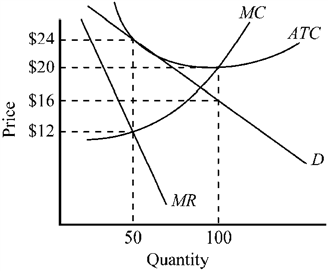 What price should a competitive price-searcher firm charge with the cost and demand conditions depicted in Figure 10-9 if it wants to maximize its profit?
 (Multiple Choice)
4.9/5 (69)
(69) Figure 10-1 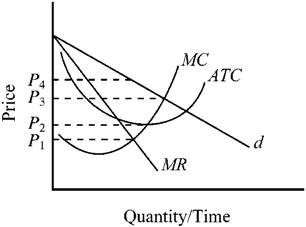 Given the cost and demand conditions in Figure 10-1, what price should this competitive price-searcher firm charge in order to maximize profits?
 (Multiple Choice)
4.7/5 (70)
(70) Only undertaking an activity when it adds more to revenue than to cost is the decision rule a profit-maximizing firm will use when deciding upon
(Multiple Choice)
4.7/5 (92)
(92) Figure 10-8 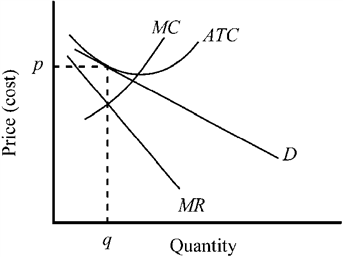 Figure 10-8 presents the demand, marginal revenue, and cost curves for a typical firm in a market. This figure illustrates
 (Multiple Choice)
4.9/5 (79)
(79) A profit-maximizing price searcher will expand output to the point where
(Multiple Choice)
4.7/5 (78)
(78) The idea that business failure is a positive force for progress in a market economy is often summarized by the term "creative destruction." Which of the following best states the central idea of this principle?
(Multiple Choice)
4.7/5 (69)
(69) Monopolistic competition is a term referring to markets characterized by
(Multiple Choice)
5.0/5 (85)
(85) A competitive price-searcher firm is currently producing 10 units of output. At this level of output the firm is charging a price equal to $10, has marginal revenue equal to $6, has marginal cost equal to $6, and has average total cost equal to $12. From this information we can conclude that
(Multiple Choice)
4.9/5 (86)
(86) In competitive price-searcher markets, short-run economic losses will lead to
(Multiple Choice)
4.9/5 (71)
(71) Long-run equilibrium in a competitive price-searcher market requires that
(Multiple Choice)
4.9/5 (81)
(81) Given the following price and output schedule, how many units should this price-searcher firm produce in order to maximize profits?

(Multiple Choice)
4.7/5 (76)
(76) Which of the following characteristics is true for a competitive price searcher but not for a price taker?
(Multiple Choice)
4.7/5 (59)
(59) 
Filters
- Essay(0)
- Multiple Choice(0)
- Short Answer(0)
- True False(0)
- Matching(0)