



 Chat with AI
Exam 10: Price-Searcher Markets With Low Entry Barriers

Exam 1: The Economic Approach210 Questions
Exam 2: Some Tools of the Economist257 Questions
Exam 3: Demand, Supply, and the Market Process585 Questions
Exam 4: Supply and Demand: Applications and Extensions331 Questions
Exam 5: Difficult Cases for the Market, and the Role of Government168 Questions
Exam 6: The Economics of Political Action360 Questions
Exam 7: Consumer Choice and Elasticity223 Questions
Exam 8: Costs and the Supply of Goods231 Questions
Exam 9: Price Takers and the Competitive Process497 Questions
Exam 10: Price-Searcher Markets With Low Entry Barriers216 Questions
Exam 11: Price-Searcher Markets With High Entry Barriers254 Questions
Exam 12: The Supply of and Demand for Productive Resources200 Questions
Exam 13: Earnings, Productivity, and the Job Market109 Questions
Exam 14: Investment, the Capital Market, and the Wealth of Nations129 Questions
Exam 15: Income Inequality and Poverty136 Questions
Exam 16: Applying the Basics: Special Topics in Economics709 Questions
Select questions type


Use the figure to answer the following question(s).
Figure 10-10
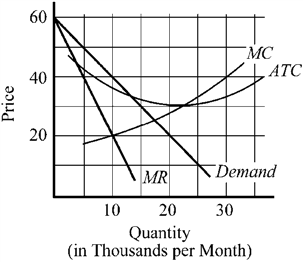 What is the approximate maximum economic profit this firm depicted in Figure 10-10 will be able to earn per month?
 (Multiple Choice)
4.8/5  (72)
(72) An important difference between the situation faced by a profit-maximizing competitive price-searcher firm in the short run and the situation faced by that same firm in the long run is that in the short run,
(Multiple Choice)
4.9/5 (66)
(66) Suppose that competitive price-searcher firms are experiencing losses. In the transition from this initial situation to a long-run equilibrium,
(Multiple Choice)
4.7/5 (80)
(80) Which of the following is a necessary condition for price discrimination to be profitable?
(Multiple Choice)
4.8/5 (79)
(79) Use the figure to answer the following question(s).
Figure 10-4
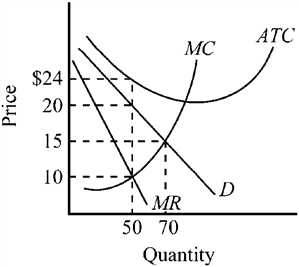 What price should a competitive price-searcher firm with the cost and demand conditions depicted in Figure 10-4 charge if it wants to maximize its profit?
 (Multiple Choice)
4.7/5 (66)
(66) Some economists have argued that competitive price-searcher industries are allocatively inefficient relative to price-taker industries because
(Multiple Choice)
4.9/5 (91)
(91) Which of the following is the best example of a firm operating in a competitive price-searcher market?
(Multiple Choice)
4.8/5 (80)
(80) As long as a market is contestable, then even if it has only a few sellers, the
(Multiple Choice)
4.9/5 (66)
(66) In competitive price-searcher markets, short-run economic profits will lead to
(Multiple Choice)
5.0/5 (77)
(77) Use the figure to answer the following question(s).
Figure 10-10
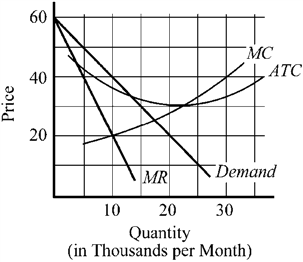 Given the cost and demand conditions depicted in Figure 10-10 for the competitive price-searcher firm, what is the price that the firm should charge if it wants to maximize its profit?
 (Multiple Choice)
4.8/5 (76)
(76) If a movie theater is going to gain by charging students a dollar less than other customers,
(Multiple Choice)
4.8/5 (67)
(67) If a government wanted to increase the prosperity of a nation, it could best serve this goal by
(Multiple Choice)
4.8/5 (71)
(71) Use the figure to answer the following question(s).
Figure 10-3
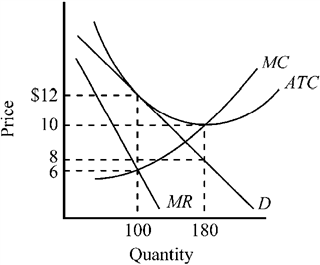 What price should a competitive price searcher firm with the cost and demand conditions depicted in Figure 10-3 charge if it wants to maximize its profit?
 (Multiple Choice)
4.8/5 (74)
(74) When entry barriers are low, firms in a competitive price-searcher market
(Multiple Choice)
4.8/5 (79)
(79) If a new entrant (or an established firm) wants to leave a contestable market,
(Multiple Choice)
4.7/5 (66)
(66) Use the figure to answer the following question(s).
Figure 10-5
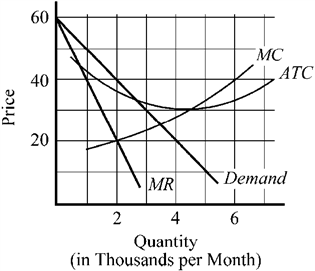 Given the cost and demand conditions shown in Figure 10-5 for the competitive price-searcher firm, what is the level of output it should produce to maximize its profit?
 (Multiple Choice)
4.8/5 (89)
(89) 
Filters
- Essay(0)
- Multiple Choice(0)
- Short Answer(0)
- True False(0)
- Matching(0)