



 Chat with AI
Exam 19: Labor and Entrepreneurship: the Human Inputs

Exam 1: What Is Economics261 Questions
Exam 2: The Economy: Myth and Reality185 Questions
Exam 3: The Fundamental Economic Problem: Scarcity and Choice290 Questions
Exam 4: Supply and Demand: an Initial Look337 Questions
Exam 5: Consumer Choice: Individual and Market Demand243 Questions
Exam 6: Demand and Elasticity254 Questions
Exam 7: Production, Inputs, and Cost: Building Blocks for Supply Analysis260 Questions
Exam 8: Output, Price, and Profit: the Importance of Marginal Analysis234 Questions
Exam 9: The Financial Markets and the Economy: the Tail That Wags the Dog227 Questions
Exam 10: The Firm and the Industry Under Perfect Competition253 Questions
Exam 11: The Case for Free Markets: the Price System259 Questions
Exam 12: Monopoly244 Questions
Exam 13: Between Competition and Monopoly254 Questions
Exam 14: Limiting Market Power: Antitrust and Regulation155 Questions
Exam 15: The Shortcomings of Free Markets219 Questions
Exam 16: Externalities, Externaliteis, the Environment, and Natural Resources222 Questions
Exam 17: Taxation and Resource Allocation221 Questions
Exam 18: Pricing the Factors of Production233 Questions
Exam 19: Labor and Entrepreneurship: the Human Inputs271 Questions
Exam 20: Poverty, Inequality, and Discrimination171 Questions
Exam 21: International Trade and Comparative Advantage226 Questions
Exam 22: Contemporary Issues in the Us Economy23 Questions
Select questions type


Which of the following would likely not be a goal of a union?
(Multiple Choice)
4.9/5  (74)
(74) The labor supply curve starts to bend backward at the point where
(Multiple Choice)
4.8/5 (91)
(91) Under what conditions is it likely that the labor supply curve may become backward bending? What roles do the income and substitution effects play?
(Essay)
4.9/5 (89)
(89) Discuss the historic increases and decreases in unionism in the United States and how it affects current labor relations today.
(Essay)
4.9/5 (79)
(79) Capitalism is an economic system in which the production process is controlled primarily by private firms operating in markets.
(True/False)
4.9/5 (79)
(79) Statistical studies in the United States have reached the conclusion that for low-income workers
(Multiple Choice)
4.9/5 (85)
(85) Recent data and analysis confirms that minimum wage laws have significantly increased teenage unemployment.
(True/False)
5.0/5 (75)
(75) Suppose the goal of a union is to maximize the total income of all workers it represents. In this case, it will probably aim for a wage at which the elasticity of demand for workers is
(Multiple Choice)
4.9/5 (95)
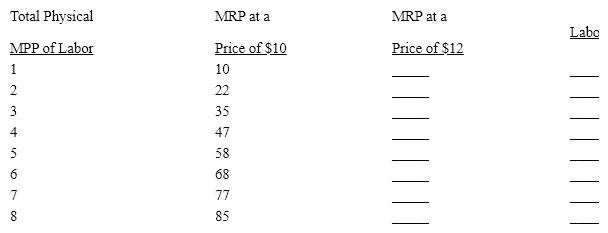
(95) The following table shows the total physical product of labor. Compute the marginal physical product (MPP)of labor and the marginal revenue product (MRP)of labor at output prices of $10 per unit and $12 per unit. If labor costs $105 per unit, how much should the firm hire at each price of output?
(Essay)
4.8/5 (78)
(78) A minimum wage law might increase wages without reducing employment if the hiring firm is
(Multiple Choice)
4.8/5 (75)
(75) The marginal revenue product is the extra revenue the firm receives by selling one additional unit of output.
(True/False)
4.8/5 (81)
(81) Evidence indicates that the average economic profits of invention are
(Multiple Choice)
4.9/5 (83)
(83) What are the major goals that unions may pursue in labor negotiations? Are these ever in conflict with one another?
(Essay)
4.8/5 (69)
(69) Historically, revolutionary inventions and innovations have come from
(Multiple Choice)
4.9/5 (84)
(84) Union membership in the United States has fallen compared to what it was in the 1950s.
(True/False)
4.8/5 (83)
(83) 
Filters
- Essay(0)
- Multiple Choice(0)
- Short Answer(0)
- True False(0)
- Matching(0)