



 Chat with AI
Exam 19: Labor and Entrepreneurship: the Human Inputs

Exam 1: What Is Economics261 Questions
Exam 2: The Economy: Myth and Reality185 Questions
Exam 3: The Fundamental Economic Problem: Scarcity and Choice290 Questions
Exam 4: Supply and Demand: an Initial Look337 Questions
Exam 5: Consumer Choice: Individual and Market Demand243 Questions
Exam 6: Demand and Elasticity254 Questions
Exam 7: Production, Inputs, and Cost: Building Blocks for Supply Analysis260 Questions
Exam 8: Output, Price, and Profit: the Importance of Marginal Analysis234 Questions
Exam 9: The Financial Markets and the Economy: the Tail That Wags the Dog227 Questions
Exam 10: The Firm and the Industry Under Perfect Competition253 Questions
Exam 11: The Case for Free Markets: the Price System259 Questions
Exam 12: Monopoly244 Questions
Exam 13: Between Competition and Monopoly254 Questions
Exam 14: Limiting Market Power: Antitrust and Regulation155 Questions
Exam 15: The Shortcomings of Free Markets219 Questions
Exam 16: Externalities, Externaliteis, the Environment, and Natural Resources222 Questions
Exam 17: Taxation and Resource Allocation221 Questions
Exam 18: Pricing the Factors of Production233 Questions
Exam 19: Labor and Entrepreneurship: the Human Inputs271 Questions
Exam 20: Poverty, Inequality, and Discrimination171 Questions
Exam 21: International Trade and Comparative Advantage226 Questions
Exam 22: Contemporary Issues in the Us Economy23 Questions
Select questions type


The Industrial Revolution refers to the stream of new technology and the resulting growth of output that began in England toward the end of the eighteenth century.
(True/False)
4.9/5  (69)
(69) A relatively high wage is predicted to be enjoyed by workers where the
(Multiple Choice)
4.7/5 (74)
(74) College graduates now earn nearly five times as much as their high school-educated peers, but the gap is falling.
(True/False)
4.9/5 (84)
(84) Figure 20-4
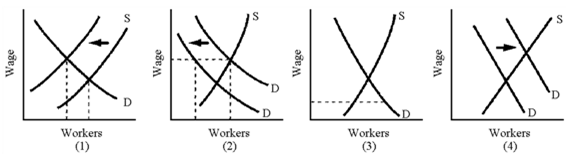 In Figure 20-4, which panel shows the impact of union efforts to have goods produced in Asia excluded from the U.S. market?
 (Multiple Choice)
4.9/5 (76)
(76) The United States has had a long history of work time lost due to worker strikes. This trend has
(Multiple Choice)
4.8/5 (79)
(79) Which of the following observations concerning labor cost patterns over the last century is true?
(Multiple Choice)
4.8/5 (84)
(84) Globalization was much more pervasive in the 1800s than it is today.
(True/False)
4.9/5 (82)
(82) The salary of an athlete like Peyton Manning is in part a reward for his unique ability-something economists call a compensating differential.
(True/False)
4.9/5 (53)
(53) The proliferation of new products that we are used to today has been occurring since the advent of the Industrial Revolution.
(True/False)
4.9/5 (77)
(77) In many high-tech industries in the economy, such as computers, medical equipment, and automobiles,
(Multiple Choice)
4.9/5 (72)
(72) Average growth rates of per capita income were close to zero, on average, prior to the Industrial Revolution.
(True/False)
4.8/5 (79)
(79) In which of the following scenarios would the income effect be most likely to be greater than the substitution effect?
(Multiple Choice)
4.9/5 (74)
(74) What are the factors that contribute to productivity growth in the market economy and which of them is considered most important?
(Essay)
5.0/5 (71)
(71) Unions often have the power to push wages above competitive levels.
(True/False)
4.8/5 (66)
(66) The real minimum wage has increased significantly over the last 40 years.
(True/False)
4.8/5 (97)
(97) Currently, college graduates are earning about ____ more than high school grads over the course of their careers.
(Multiple Choice)
4.7/5 (91)
(91) 
Filters
- Essay(0)
- Multiple Choice(0)
- Short Answer(0)
- True False(0)
- Matching(0)