



 Chat with AI
Exam 19: Labor and Entrepreneurship: the Human Inputs

Exam 1: What Is Economics261 Questions
Exam 2: The Economy: Myth and Reality185 Questions
Exam 3: The Fundamental Economic Problem: Scarcity and Choice290 Questions
Exam 4: Supply and Demand: an Initial Look337 Questions
Exam 5: Consumer Choice: Individual and Market Demand243 Questions
Exam 6: Demand and Elasticity254 Questions
Exam 7: Production, Inputs, and Cost: Building Blocks for Supply Analysis260 Questions
Exam 8: Output, Price, and Profit: the Importance of Marginal Analysis234 Questions
Exam 9: The Financial Markets and the Economy: the Tail That Wags the Dog227 Questions
Exam 10: The Firm and the Industry Under Perfect Competition253 Questions
Exam 11: The Case for Free Markets: the Price System259 Questions
Exam 12: Monopoly244 Questions
Exam 13: Between Competition and Monopoly254 Questions
Exam 14: Limiting Market Power: Antitrust and Regulation155 Questions
Exam 15: The Shortcomings of Free Markets219 Questions
Exam 16: Externalities, Externaliteis, the Environment, and Natural Resources222 Questions
Exam 17: Taxation and Resource Allocation221 Questions
Exam 18: Pricing the Factors of Production233 Questions
Exam 19: Labor and Entrepreneurship: the Human Inputs271 Questions
Exam 20: Poverty, Inequality, and Discrimination171 Questions
Exam 21: International Trade and Comparative Advantage226 Questions
Exam 22: Contemporary Issues in the Us Economy23 Questions
Select questions type


Under the U.S. patent system, a patent application must provide evidence that the invention works and that is based on another invention.
(True/False)
4.8/5  (67)
(67) Innovation refers to the introduction of new products and processes into the market.
(True/False)
4.8/5 (76)
(76) Spending on an education is considered an investment because it involves a sacrifice of current income for higher expected future income.
(True/False)
4.9/5 (77)
(77) The number of persons who could become lawyers or surgeons is potentially quite large, yet these two groups earn fairly high incomes. One of the main reasons why they do is the
(Multiple Choice)
4.9/5 (74)
(74) Small firms and entrepreneurs tend to focus on smaller, incremental improvements rather than revolutionary advances.
(True/False)
4.9/5 (68)
(68) The psychological rewards of inventing a new product generally result in ____ profits for entrepreneurs.
(Multiple Choice)
4.9/5 (66)
(66) Figure 20-4
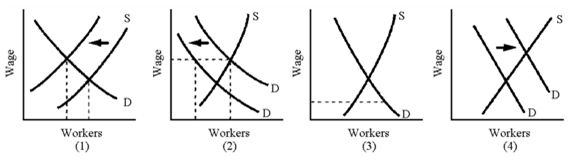 In Figure 20-4, which panel depicts a union suffering unemployment during a recession rather than allowing the wage to fall?
 (Multiple Choice)
4.7/5 (74)
(74) The income effect of higher wages leads workers to want to work more.
(True/False)
4.9/5 (68)
(68) A firm that reduces its research and development spending will expect competitor firms to reduce research and development spending as competition is reduced.
(True/False)
4.9/5 (71)
(71) Collaborative research is especially important in high-technology sectors because a single firm might not have the resources to develop a significant innovation.
(True/False)
4.8/5 (75)
(75) The percentage of work time lost due to strikes in the United States has been increasing over time.
(True/False)
4.8/5 (82)
(82) The United Automobile Workers union can select the most favorable point on the demand curve for labor and the auto manufacturing companies can do nothing in response.
(True/False)
4.8/5 (76)
(76) There is only a small difference in wages between college graduates and workers who did not attend college.
(True/False)
5.0/5 (74)
(74) The U.S. government enacted minimum wage legislation to protect skilled workers.
(True/False)
4.7/5 (87)
(87) Which of the following does not affect the marginal physical product of labor?
(Multiple Choice)
4.8/5 (76)
(76) Expenditures for attending college can be viewed as an investment in human capital.
(True/False)
4.8/5 (88)
(88) 
Filters
- Essay(0)
- Multiple Choice(0)
- Short Answer(0)
- True False(0)
- Matching(0)