



 Chat with AI
Exam 11: The Case for Free Markets: the Price System

Exam 1: What Is Economics261 Questions
Exam 2: The Economy: Myth and Reality185 Questions
Exam 3: The Fundamental Economic Problem: Scarcity and Choice290 Questions
Exam 4: Supply and Demand: an Initial Look337 Questions
Exam 5: Consumer Choice: Individual and Market Demand243 Questions
Exam 6: Demand and Elasticity254 Questions
Exam 7: Production, Inputs, and Cost: Building Blocks for Supply Analysis260 Questions
Exam 8: Output, Price, and Profit: the Importance of Marginal Analysis234 Questions
Exam 9: The Financial Markets and the Economy: the Tail That Wags the Dog227 Questions
Exam 10: The Firm and the Industry Under Perfect Competition253 Questions
Exam 11: The Case for Free Markets: the Price System259 Questions
Exam 12: Monopoly244 Questions
Exam 13: Between Competition and Monopoly254 Questions
Exam 14: Limiting Market Power: Antitrust and Regulation155 Questions
Exam 15: The Shortcomings of Free Markets219 Questions
Exam 16: Externalities, Externaliteis, the Environment, and Natural Resources222 Questions
Exam 17: Taxation and Resource Allocation221 Questions
Exam 18: Pricing the Factors of Production233 Questions
Exam 19: Labor and Entrepreneurship: the Human Inputs271 Questions
Exam 20: Poverty, Inequality, and Discrimination171 Questions
Exam 21: International Trade and Comparative Advantage226 Questions
Exam 22: Contemporary Issues in the Us Economy23 Questions
Select questions type


To equalize traffic on transportation routes, a pricing arrangement called "peak, off-peak pricing" would most likely be proposed by
(Multiple Choice)
4.7/5  (93)
(93) Marxists and leaders of communist economies actually often admire the market mechanism for its
(Multiple Choice)
4.9/5 (83)
(83) Total surplus is the sum of producer's surplus and consumer's surplus.
(True/False)
4.8/5 (72)
(72) Figure 11-4
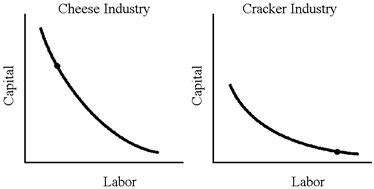 In Figure 11-4, if the cheese industry and the cracker industry have the indicated quantities of capital and labor and are on the indicated production indifference curves, is there the possibility of mutually beneficial trade in inputs? Explain.
 (Essay)
4.8/5 (78)
(78) When an economy is operating with maximum efficiency, the production of more of commodity A will entail the production of less of commodity B because
(Multiple Choice)
4.8/5 (75)
(75) An economy consists of two goods: beef and lamb. Of all the points on this economy's production possibilities frontier, which one is best in terms of efficiency?
(Essay)
4.8/5 (90)
(90) Keeping landing fees low at airports during the "peak" hours
(Multiple Choice)
4.8/5 (85)
(85) Questions of what to produce, how much to produce, and who will get the output must be faced by
(Multiple Choice)
4.8/5 (94)
(94) What does the production possibilities frontier imply about the resource allocation?
(Multiple Choice)
4.7/5 (85)
(85) Under laissez-faire, the allocation of scarce resources among the different industries
(Multiple Choice)
4.9/5 (75)
(75) Which of the following holds true in a market when the invisible hand functions properly?
(Multiple Choice)
4.9/5 (87)
(87) Politicians and citizens may often choose policies that reduce economic efficiency because they are perceived as "fairer."
(True/False)
4.8/5 (85)
(85) The "invisible hand" refers to the control that government must exercise over a market economy.
(True/False)
4.7/5 (73)
(73) There are only two people in the world (Adam and Eve)and only one good (apples). Adam has four apples and a total utility in money terms from apple consumption of $16; Eve has four apples and a total utility from apple consumption of $20. Which of the following statements must be true?
(Multiple Choice)
5.0/5 (85)
(85) Under laissez-faire, society's decisions about how much of every product to produce depend on
(Multiple Choice)
4.9/5 (87)
(87) 
Filters
- Essay(0)
- Multiple Choice(0)
- Short Answer(0)
- True False(0)
- Matching(0)