



 Chat with AI
Exam 11: The Case for Free Markets: the Price System

Exam 1: What Is Economics261 Questions
Exam 2: The Economy: Myth and Reality185 Questions
Exam 3: The Fundamental Economic Problem: Scarcity and Choice290 Questions
Exam 4: Supply and Demand: an Initial Look337 Questions
Exam 5: Consumer Choice: Individual and Market Demand243 Questions
Exam 6: Demand and Elasticity254 Questions
Exam 7: Production, Inputs, and Cost: Building Blocks for Supply Analysis260 Questions
Exam 8: Output, Price, and Profit: the Importance of Marginal Analysis234 Questions
Exam 9: The Financial Markets and the Economy: the Tail That Wags the Dog227 Questions
Exam 10: The Firm and the Industry Under Perfect Competition253 Questions
Exam 11: The Case for Free Markets: the Price System259 Questions
Exam 12: Monopoly244 Questions
Exam 13: Between Competition and Monopoly254 Questions
Exam 14: Limiting Market Power: Antitrust and Regulation155 Questions
Exam 15: The Shortcomings of Free Markets219 Questions
Exam 16: Externalities, Externaliteis, the Environment, and Natural Resources222 Questions
Exam 17: Taxation and Resource Allocation221 Questions
Exam 18: Pricing the Factors of Production233 Questions
Exam 19: Labor and Entrepreneurship: the Human Inputs271 Questions
Exam 20: Poverty, Inequality, and Discrimination171 Questions
Exam 21: International Trade and Comparative Advantage226 Questions
Exam 22: Contemporary Issues in the Us Economy23 Questions
Select questions type


Prices set too low can actually be against the public interest.
(True/False)
4.8/5  (79)
(79) A consumer who buys any amount of a good will realize a positive consumer's surplus from that good.
(True/False)
4.9/5 (69)
(69) The distribution process performed by the price system is not as efficient as the distribution process of central planners.
(True/False)
4.9/5 (66)
(66) Mutually beneficial trade is impossible when different persons have different preferences about goods and services.
(True/False)
4.8/5 (81)
(81) When box lunches are handed out at an elementary school, Jimmy (who loves chocolate and hates raisins)gets a raisin cookie and Johnny (who hates chocolate and loves raisins)gets a chocolate chip cookie. This is an example of inefficiency in
(Multiple Choice)
4.9/5 (78)
(78) It is true that the distribution process carried out by the price system
(Multiple Choice)
4.9/5 (86)
(86) The laissez-faire system relies on the price mechanism to allocate resources.
(True/False)
4.8/5 (72)
(72) In a classic administrative snafu, the Army assigns trained classical musicians to kitchen duty and places trained cooks in the military band. This is an example of inefficiency in
(Multiple Choice)
4.9/5 (89)
(89) In a competitive economy, the questions of what, how, and for whom to produce tend to be regulated by
(Multiple Choice)
4.8/5 (84)
(84) Uncoordinated decisions in perfect competition lead to mass confusion and inefficiency.
(True/False)
4.7/5 (67)
(67) Figure 11-2
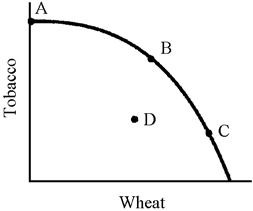 As we move down the production possibilities schedule in Figure 11-2, each successive point is
 (Multiple Choice)
4.8/5 (79)
(79) Production planning without the market mechanism is very efficiently handled by central planners.
(True/False)
4.8/5 (65)
(65) Efficiency in the choice of outputs requires that marginal cost be equal to marginal revenue and nothing else.
(True/False)
4.8/5 (91)
(91) Higher prices can discourage use\consumption, which in turn may better allocate scarce resources.
(True/False)
4.8/5 (70)
(70) The coordination task of dividing products among consumers is a problem of
(Multiple Choice)
4.8/5 (87)
(87) Prohibiting price increases in situations of true scarcity could best be described as
(Multiple Choice)
4.8/5 (87)
(87) Prohibiting price increases in situations of true scarcity
(Multiple Choice)
4.8/5 (87)
(87) 
Filters
- Essay(0)
- Multiple Choice(0)
- Short Answer(0)
- True False(0)
- Matching(0)