



 Chat with AI
Exam 11: The Case for Free Markets: the Price System

Exam 1: What Is Economics261 Questions
Exam 2: The Economy: Myth and Reality185 Questions
Exam 3: The Fundamental Economic Problem: Scarcity and Choice290 Questions
Exam 4: Supply and Demand: an Initial Look337 Questions
Exam 5: Consumer Choice: Individual and Market Demand243 Questions
Exam 6: Demand and Elasticity254 Questions
Exam 7: Production, Inputs, and Cost: Building Blocks for Supply Analysis260 Questions
Exam 8: Output, Price, and Profit: the Importance of Marginal Analysis234 Questions
Exam 9: The Financial Markets and the Economy: the Tail That Wags the Dog227 Questions
Exam 10: The Firm and the Industry Under Perfect Competition253 Questions
Exam 11: The Case for Free Markets: the Price System259 Questions
Exam 12: Monopoly244 Questions
Exam 13: Between Competition and Monopoly254 Questions
Exam 14: Limiting Market Power: Antitrust and Regulation155 Questions
Exam 15: The Shortcomings of Free Markets219 Questions
Exam 16: Externalities, Externaliteis, the Environment, and Natural Resources222 Questions
Exam 17: Taxation and Resource Allocation221 Questions
Exam 18: Pricing the Factors of Production233 Questions
Exam 19: Labor and Entrepreneurship: the Human Inputs271 Questions
Exam 20: Poverty, Inequality, and Discrimination171 Questions
Exam 21: International Trade and Comparative Advantage226 Questions
Exam 22: Contemporary Issues in the Us Economy23 Questions
Select questions type


For any combination or outputs, there is an efficient allocation of income.
(True/False)
4.9/5  (83)
(83) Input-output analysis is commonly used in production decisions.
(True/False)
4.9/5 (74)
(74) Politicians always agree with economists about the most efficient way of doing things.
(True/False)
4.8/5 (70)
(70) If the MU of half gallon of milk is $3.50 and the MU of gallon of milk is $3.25, and they both sell for the same price, we would expect consumers to
(Multiple Choice)
4.8/5 (72)
(72) The introduction of a tax in a perfectly competitive marketplace that is originally in equilibrium will lower total surplus.
(True/False)
4.7/5 (86)
(86) Any increase in efficiency increases only profits of producers, with no increase in output.
(True/False)
4.9/5 (75)
(75) The saying "the lower the price, the better" may not always be correct for an economy's public interest because
(Multiple Choice)
5.0/5 (83)
(83) Using prices to promote efficiency in the utilization of bridges,
(Multiple Choice)
4.9/5 (82)
(82) The price system takes into account consumer preferences in the distribution of goods and services.
(True/False)
4.8/5 (86)
(86) Many persons object to the results of the competitive market system because
(Multiple Choice)
4.8/5 (83)
(83) The assignment of inputs to specific industries by central planners is made difficult by
(Multiple Choice)
4.7/5 (73)
(73) Under laissez-faire, the allocation of resources among different products depends on
(Multiple Choice)
4.9/5 (81)
(81) With a monopoly, the total surplus is lower than it would be with a perfectly competitive industry.
(True/False)
4.9/5 (78)
(78) Figure 11-2
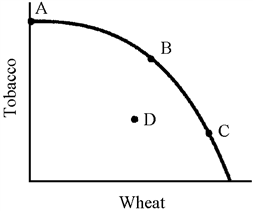 In Figure 11-2, which movement would represent an improvement for all individuals?
 (Multiple Choice)
4.9/5 (74)
(74) 
Filters
- Essay(0)
- Multiple Choice(0)
- Short Answer(0)
- True False(0)
- Matching(0)