



 Chat with AI
Exam 25: Demand-Side Equilibrium: Unemployment or Inflation

Exam 1: What Is Economics261 Questions
Exam 2: The Economy: Myth and Reality185 Questions
Exam 3: The Fundamental Economic Problem: Scarcity and Choice290 Questions
Exam 4: Supply and Demand: an Initial Look337 Questions
Exam 21: An Introduction to Macroeconomics216 Questions
Exam 22: The Goals of Macroeconomic Policy212 Questions
Exam 23: Economic Growth: Theory and Policy228 Questions
Exam 24: Aggregate Demand and the Powerful Consumer219 Questions
Exam 25: Demand-Side Equilibrium: Unemployment or Inflation216 Questions
Exam 26: Bringing in the Supply Side: Unemployment and Inflation228 Questions
Exam 27: Managing Aggregate Demand: Fiscal Policy210 Questions
Exam 28: Money and the Banking System224 Questions
Exam 29: Monetary Policy: Conventional and Unconventional210 Questions
Exam 30: The Financial Crisis and the Great Recession66 Questions
Exam 31: The Debate Over Monetary and Fiscal Policy219 Questions
Exam 32: Budget Deficits in the Short and Long Run215 Questions
Exam 33: The Trade-Off Between Inflation and Unemployment219 Questions
Exam 34: International Trade and Comparative Advantage226 Questions
Exam 35: The International Monetary System: Order or Disorder218 Questions
Exam 36: Exchange Rates and the Macroeconomy219 Questions
Exam 37: Contemporary Issues in the Us Economy23 Questions
Select questions type


If the economy is suffering a recession, inventories are probably falling.
(True/False)
5.0/5  (100)
(100) Figure 9-4
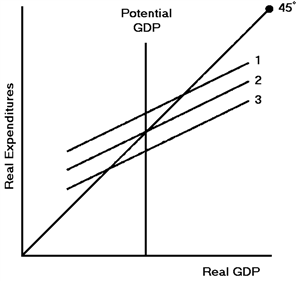 In Figure 9-4, if the economy is in a recessionary gap, what must happen to reach potential GDP?
 (Multiple Choice)
4.8/5 (79)
(79) When constructing a basic macroeconomic model, several assumptions (not realistic, but necessary to simplify the analysis) are made. Which of the following are assumed to be constant?
(Multiple Choice)
4.9/5 (66)
(66) 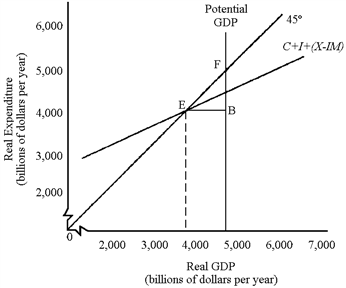 In Figure 9-1, the economy is
Table 9-1 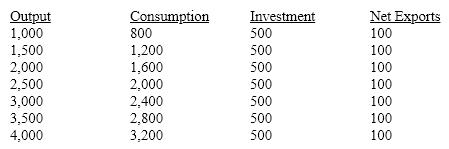 In Table 9-1, inventories will be increasing as long as output is above
 (Multiple Choice)
4.8/5 (74)
(74) Differentiate between an induced increase in consumption and an autonomous increase in consumption. How are they represented on a graph?
(Essay)
4.7/5 (90)
(90) At the equilibrium level of income, it must be true that total
(Multiple Choice)
4.9/5 (70)
(70) 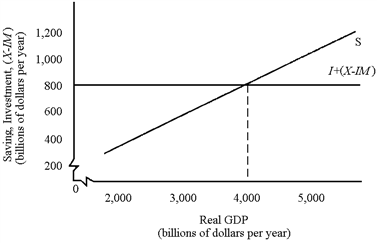 In Figure 9-3, saving at equilibrium GDP is
In the basic 45° line model, what is the effect of a decrease in the price level?
(Multiple Choice)
4.9/5 (79)
(79) 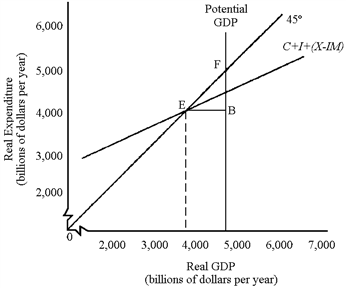 In Figure 9-1, at $3,000 billion real GDP,
A decrease in autonomous consumption would have the same effect on the expenditures schedule as a(n)
(Multiple Choice)
4.8/5 (78)
(78) A major reason for the existence of inflationary and deflationary gaps is that
(Multiple Choice)
4.8/5 (73)
(73) Describe the role of business inventory change in determining the equilibrium level of GDP and changes in the level of GDP.
(Essay)
4.9/5 (100)
(100) If we observe that every increase in income of $120 million generates an increase in consumption of $80 million, then the simple multiplier is
(Multiple Choice)
4.8/5 (75)
(75) The economic impact of a change in spending, working through the multiplier, takes effect
(Multiple Choice)
4.8/5 (74)
(74) As the multiplier process works through time, the size of the multiplier effect becomes
(Multiple Choice)
4.7/5 (90)
(90) A recessionary gap and an inflationary gap will not persist when the equilibrium level of GDP
(Multiple Choice)
4.9/5 (67)
(67) 
Filters
- Essay(0)
- Multiple Choice(0)
- Short Answer(0)
- True False(0)
- Matching(0)