



 Chat with AI
Exam 25: Demand-Side Equilibrium: Unemployment or Inflation

Exam 1: What Is Economics261 Questions
Exam 2: The Economy: Myth and Reality185 Questions
Exam 3: The Fundamental Economic Problem: Scarcity and Choice290 Questions
Exam 4: Supply and Demand: an Initial Look337 Questions
Exam 21: An Introduction to Macroeconomics216 Questions
Exam 22: The Goals of Macroeconomic Policy212 Questions
Exam 23: Economic Growth: Theory and Policy228 Questions
Exam 24: Aggregate Demand and the Powerful Consumer219 Questions
Exam 25: Demand-Side Equilibrium: Unemployment or Inflation216 Questions
Exam 26: Bringing in the Supply Side: Unemployment and Inflation228 Questions
Exam 27: Managing Aggregate Demand: Fiscal Policy210 Questions
Exam 28: Money and the Banking System224 Questions
Exam 29: Monetary Policy: Conventional and Unconventional210 Questions
Exam 30: The Financial Crisis and the Great Recession66 Questions
Exam 31: The Debate Over Monetary and Fiscal Policy219 Questions
Exam 32: Budget Deficits in the Short and Long Run215 Questions
Exam 33: The Trade-Off Between Inflation and Unemployment219 Questions
Exam 34: International Trade and Comparative Advantage226 Questions
Exam 35: The International Monetary System: Order or Disorder218 Questions
Exam 36: Exchange Rates and the Macroeconomy219 Questions
Exam 37: Contemporary Issues in the Us Economy23 Questions
Select questions type


Using the standard 45° line diagram, how does an increase in investment spending effect the expenditure schedule?
(Multiple Choice)
4.8/5  (70)
(70) Assume that the MPC is 0.75, and investment spending rises by $25 billion. How much will real GDP change?
(Multiple Choice)
4.9/5 (87)
(87) The main examples of macroeconomic coordination failures are
(Multiple Choice)
4.7/5 (86)
(86) In a market economy, the decisions about what to produce and how much of each good or service to produce are made by
(Multiple Choice)
4.9/5 (87)
(87) Assume that the MPC is 0.80 and investment rises by $50 million. How much additional saving will this generate in the second round of spending?
(Multiple Choice)
4.8/5 (86)
(86) An inflationary gap will exist when the full employment level of GDP is
(Multiple Choice)
4.9/5 (84)
(84) 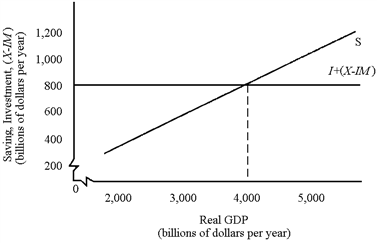 In Figure 9-3, equilibrium GDP is
The economy will reach equilibrium in a simple economy only if saving is
(Multiple Choice)
4.7/5 (71)
(71) According to Baumol and Blinder, from the demand side a decrease in the price level causes aggregate expenditures to
(Multiple Choice)
4.8/5 (79)
(79) Figure 9-4
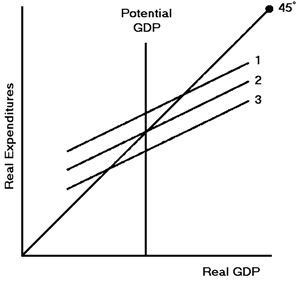 In Figure 9-4, which expenditure level will result in a recessionary gap?
 (Multiple Choice)
4.9/5 (66)
(66) If the economy automatically tends toward full employment, then government stabilization policy
(Multiple Choice)
4.7/5 (71)
(71) If the expenditure schedule must be shifted upward to reach potential GDP, then the economy is experiencing a(n)
(Multiple Choice)
4.8/5 (69)
(69) Which of the following would be associated with an inflationary gap?
(Multiple Choice)
4.9/5 (76)
(76) If inventories are being depleted, firms may respond by cutting prices.
(True/False)
4.7/5 (78)
(78) A level of GDP cannot be at equilibrium when aggregate demand exceeds output because firms will notice that
(Multiple Choice)
5.0/5 (72)
(72) High unemployment and high rates of inflation are examples of coordination successes.
(True/False)
4.9/5 (78)
(78) Equilibrium GDP will not exist where output exceeds aggregate demand because businesses will notice that
(Multiple Choice)
4.9/5 (79)
(79) A recessionary gap exists when the equilibrium level of GDP
(Multiple Choice)
4.9/5 (89)
(89) 
Filters
- Essay(0)
- Multiple Choice(0)
- Short Answer(0)
- True False(0)
- Matching(0)