



 Chat with AI
Exam 25: Demand-Side Equilibrium: Unemployment or Inflation

Exam 1: What Is Economics261 Questions
Exam 2: The Economy: Myth and Reality185 Questions
Exam 3: The Fundamental Economic Problem: Scarcity and Choice290 Questions
Exam 4: Supply and Demand: an Initial Look337 Questions
Exam 21: An Introduction to Macroeconomics216 Questions
Exam 22: The Goals of Macroeconomic Policy212 Questions
Exam 23: Economic Growth: Theory and Policy228 Questions
Exam 24: Aggregate Demand and the Powerful Consumer219 Questions
Exam 25: Demand-Side Equilibrium: Unemployment or Inflation216 Questions
Exam 26: Bringing in the Supply Side: Unemployment and Inflation228 Questions
Exam 27: Managing Aggregate Demand: Fiscal Policy210 Questions
Exam 28: Money and the Banking System224 Questions
Exam 29: Monetary Policy: Conventional and Unconventional210 Questions
Exam 30: The Financial Crisis and the Great Recession66 Questions
Exam 31: The Debate Over Monetary and Fiscal Policy219 Questions
Exam 32: Budget Deficits in the Short and Long Run215 Questions
Exam 33: The Trade-Off Between Inflation and Unemployment219 Questions
Exam 34: International Trade and Comparative Advantage226 Questions
Exam 35: The International Monetary System: Order or Disorder218 Questions
Exam 36: Exchange Rates and the Macroeconomy219 Questions
Exam 37: Contemporary Issues in the Us Economy23 Questions
Select questions type


In a simple economy (no government), the vertical distance between the consumption function and the expenditure schedule measures
(Multiple Choice)
4.8/5  (86)
(86) Figure 9-4
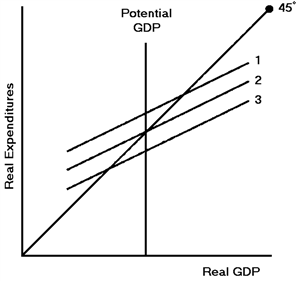 In Figure 9-4, if the economy faces an inflationary gap, what must happen to reach potential GDP?
 (Multiple Choice)
4.8/5 (85)
(85) Using the standard 45° line diagram, how does a decrease in investment spending effect the expenditure schedule?
(Multiple Choice)
4.8/5 (71)
(71) Figure 9-3
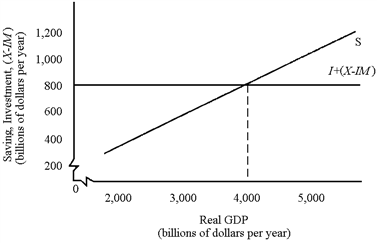 In Figure 9-3, at $5,000 billion GDP, inventories will be
 (Multiple Choice)
4.7/5 (85)
(85) Carefully define the following terms and explain their importance in the study of macroeconomics:
a. Expenditure schedule
b. Saving schedule
c. Equilibrium GDP
d. Leakages schedule
e. Injections schedule
(Essay)
4.9/5 (72)
(72) If net exports are reduced, the expenditure schedule will shift
(Multiple Choice)
4.9/5 (65)
(65) According to Baumol and Blinder, from the demand side, an increase in the price level causes aggregate expenditures to
(Multiple Choice)
4.9/5 (65)
(65) Figure 9-5
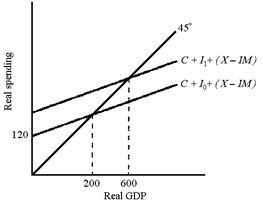 If the shift in the C + I + (X − IM) in Figure 9-5 was caused by a 80 dollar increase in investment, then the multiplier is
 (Multiple Choice)
4.9/5 (88)
(88) Why do booms and recessions tend to be transmitted across national borders?
(Essay)
4.8/5 (84)
(84) The multiplier can be expressed as the ratio of the change in Y over the change in I.
(True/False)
4.8/5 (75)
(75) According to Baumol and Blinder, the real-world multiplier will be smaller than 1/(1 − MPC) because the 1/(1 − MPC) measure is based on
(Multiple Choice)
4.9/5 (78)
(78) The aggregate demand curve is directly derived from the expenditures schedule.
(True/False)
4.8/5 (77)
(77) Savings and taxes are considered leakages in the circular flow model.
(True/False)
4.8/5 (92)
(92) Assume a simple macroeconomic model. When inventories rise unexpectedly,
(Multiple Choice)
4.7/5 (87)
(87) An economic recession in Japan will cause the aggregate demand curve in the United States to shift to the right.
(True/False)
4.9/5 (85)
(85) 
Filters
- Essay(0)
- Multiple Choice(0)
- Short Answer(0)
- True False(0)
- Matching(0)