



 Chat with AI
Exam 3: Colonial Economic Activities

Exam 1: Growth, Welfare, and the American Economy10 Questions
Exam 2: Founding the Colonies58 Questions
Exam 3: Colonial Economic Activities40 Questions
Exam 4: The Economic Relations of the Colonies47 Questions
Exam 5: Economic Progress and Wealth37 Questions
Exam 6: Three Crises and Revolt29 Questions
Exam 7: Hard Realities for a New Nation34 Questions
Exam 8: Land and the Early Westward Movements40 Questions
Exam 9: Transportation and Market Growth44 Questions
Exam 10: Market Expansion and Industry in First Transition44 Questions
Exam 11: Labor During the Early Industrial Period36 Questions
Exam 12: Money and Banking in the Developing Economy45 Questions
Exam 13: The Entrenchment of Slavery and Regional Conflict44 Questions
Exam 14: War, Recovery, and Regional Divergence41 Questions
Exam 15: Agricultures Western Advance43 Questions
Exam 16: Railroads and Economic Change44 Questions
Exam 17: Industrial Expansion and Concentration46 Questions
Exam 18: The Emergence of Americas Labor Consciousness43 Questions
Exam 19: Money, Prices, and Finance in the Postbellum Era35 Questions
Exam 20: Commerce at Home and Abroad19 Questions
Exam 21: World War I, 1914-191821 Questions
Exam 22: The Roaring Twenties37 Questions
Exam 23: The Great Depression38 Questions
Exam 24: The New Deal21 Questions
Exam 25: World War Ii29 Questions
Exam 26: The Changing Role of the Federal Government22 Questions
Exam 27: The Changing Role of the Federal Government: Consumer Safety, Agriculture, the Environment, and Housing24 Questions
Exam 28: Monetary Policy, Fiscal Policy, and the Business Cycle After World War Ii31 Questions
Exam 29: Manufacturing, Productivity, and Labor53 Questions
Exam 30: Achievements of the Past, Challenges for the Future33 Questions
Select questions type


Suppose the only input in agriculture is time and the following chart depicts the time it took for the Middle Colonies and New England to produce barley and milk. Using the principle of comparative advantage, what would be the most efficient solution?
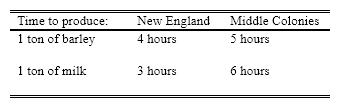
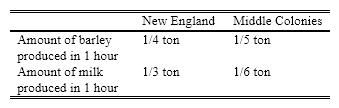 To determine comparative advantage compare the productivities of producing the two goods - one in terms of the other. To produce 1 ton of milk, New England would have to not produce 3\4 tons of barley. The Middle Colonies must give up 6\5 of a ton of barley to produce 1 ton of milk. Therefore, New England has a lower opportunity cost of producing milk and the Middle Colonies have a lower opportunity cost of producing barley. New England should produce milk and trade for barley, while the MC should produce barley and trade for milk.
Free
(Multiple Choice)
4.8/5  (78)
(78) Correct Answer: Verified
C
All of the following statements present accurate information about the 18th century New England economy except :
Free
(Multiple Choice)
4.8/5 (89)
(89) Correct Answer:Verified
VerifiedD
What was not true about the economy of the Middle Colonies?
Free
(Multiple Choice)
4.8/5 (81)
(81) Correct Answer:Verified
VerifiedA
If a product exhibits increasing returns to scale, then the average cost of making the product will ______ as a company produces more of it?
(Multiple Choice)
4.8/5 (79)
(79) Which colony was the last of the original 13 to be founded, and was designed to assist those who owed debts in the Old World?
(Multiple Choice)
4.8/5 (69)
(69) The colony of Georgia was established in 1732. During the colony's early years,
(Multiple Choice)
4.7/5 (78)
(78) Colonial production of tobacco satisfied England's mercantilist interests because
(Multiple Choice)
5.0/5 (80)
(80) The original reasons for founding the colony of Georgia do not include
(Multiple Choice)
4.9/5 (69)
(69) During the colonial period, there were no apparent economies of large-scale production in
(Multiple Choice)
4.9/5 (72)
(72) In the 18th century, Southern tobacco planters found that the use of ____________ was economical once the plantation reached a certain size.
(Multiple Choice)
4.9/5 (74)
(74) If a product exhibits decreasing returns to scale, then the average cost of making the product will ______ as a company produces more of it?
(Multiple Choice)
5.0/5 (79)
(79) During the colonial period, this region specialized in grain production, primarily using family farms:
(Multiple Choice)
5.0/5 (83)
(83) In colonial America, ____________ was\were especially scarce, while the supply of _______________ was plentiful.
(Multiple Choice)
4.8/5 (71)
(71) 
Filters
- Essay(0)
- Multiple Choice(0)
- Short Answer(0)
- True False(0)
- Matching(0)