



 Chat with AI
Exam 5: Gastrointestinal System

Exam 1: Introduction to Pathology94 Questions
Exam 2: Specialized Imaging Techniques66 Questions
Exam 3: Respiratory System81 Questions
Exam 4: Skeletal System90 Questions
Exam 5: Gastrointestinal System102 Questions
Exam 6: Urinary System58 Questions
Exam 7: Cardiovascular System81 Questions
Exam 8: Nervous System73 Questions
Exam 9: Hematopoietic System52 Questions
Exam 10: Endocrine System72 Questions
Exam 11: Reproductive System83 Questions
Exam 12: Miscellaneous Diseases61 Questions
Select questions type


What condition results from chronic cholecystitis in which the gallbladder becomes fibrotic and calcified?
(Multiple Choice)
5.0/5  (92)
(92) Which of the following is an emulsifier that aids in the breakdown of fats during digestion?
(Multiple Choice)
4.9/5 (87)
(87) Which of the following is appropriate when imaging a patient with known liver cirrhosis complicated by ascites?
(Multiple Choice)
4.9/5 (82)
(82) Telescoping of one part of the intestinal tract into another is called volvulus.
(True/False)
4.9/5 (68)
(68) A chronic inflammatory disorder of unknown cause that often affects the terminal ileum is called
(Multiple Choice)
4.8/5 (81)
(81) What is the most common cause of acute gastrointestinal bleeding?
(Multiple Choice)
4.9/5 (82)
(82) What is the most common manifestation of peptic ulcer disease?
(Multiple Choice)
4.9/5 (84)
(84) Progressive shortening and rigidity of the colon and absent haustral patterns are radiographic evidence of
(Multiple Choice)
4.9/5 (80)
(80) What is the most common abnormality found on upper GI exams?
(Multiple Choice)
4.8/5 (82)
(82) Which imaging modality is the most effective for detection of carcinoma of the pancreas?
(Multiple Choice)
4.9/5 (92)
(92) Which imaging procedure is used to demonstrate dilated veins in the walls of the esophagus?
(Multiple Choice)
4.7/5 (79)
(79) Refer to the image.This esophageal pathologic condition is described as resembling beads on a rosary.What pathologic condition is evident in this image? 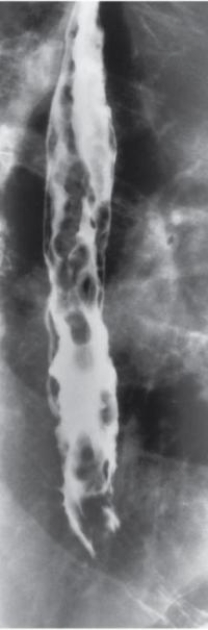
(Multiple Choice)
4.9/5 (80)
(80) Which of the following is strongly correlated with esophageal carcinoma?
(1)Excessive alcohol intake.
(2)Smoking.
(3)Portal hypertension.
(Multiple Choice)
4.8/5 (79)
(79) 
Filters
- Essay(0)
- Multiple Choice(0)
- Short Answer(0)
- True False(0)
- Matching(0)