



 Chat with AI
Exam 8: Application: The Costs of Taxation.

Exam 1: Ten Principles of Economics.349 Questions
Exam 2: Thinking Like an Economist.535 Questions
Exam 3: Interdependence and the Gains from Trade.443 Questions
Exam 4: The Market Forces of Supply and Demand.571 Questions
Exam 5: Elasticity and Its Application510 Questions
Exam 6: Supply, Demand, And Government Policies.557 Questions
Exam 7: Consumers, Producers, and the Efficiency of Markets.460 Questions
Exam 8: Application: The Costs of Taxation.424 Questions
Exam 9: Application: International Trade.410 Questions
Exam 10: Externalities.441 Questions
Exam 11: Public Goods and Common Resources.349 Questions
Exam 12: The Design of the Tax System.478 Questions
Exam 13: The Costs of Production.533 Questions
Exam 14: Firms in Competitive Markets.478 Questions
Exam 15: Monopoly.526 Questions
Exam 16: Monopolistic Competition.497 Questions
Exam 17: Oligopoly.410 Questions
Exam 18: The Market For the Factors of Production.463 Questions
Exam 19: Earnings and Discrimination.398 Questions
Exam 20: Income Inequality and Poverty.374 Questions
Exam 21: The Theory of Consumer Choice.462 Questions
Exam 22: Frontiers in Microeconomics.353 Questions
Select questions type


If a tax shifts the demand curve downward (or to the left),we can infer that the tax was levied on
(Multiple Choice)
4.9/5  (86)
(86) The benefit that government receives from a tax is measured by
(Multiple Choice)
4.8/5 (80)
(80) Figure 8-10
 -Refer to Figure 8-10.Suppose the government imposes a tax that reduces the quantity sold in the market after the tax to Q2.The deadweight loss of the tax is
 (Multiple Choice)
4.9/5 (86)
(86) Normally,both buyers and sellers of a good become worse off when the good is taxed.
(True/False)
4.8/5 (81)
(81) As the price elasticities of supply and demand increase,the deadweight loss from a tax increases.
(True/False)
4.9/5 (88)
(88) Figure 8-3
The vertical distance between points A and C represents a tax in the market.
 -Refer to Figure 8-3.Which of the following equations is valid for the tax revenue that the tax provides to the government?
 (Multiple Choice)
5.0/5 (82)
(82) When a tax is imposed on a good for which both demand and supply are very elastic,
(Multiple Choice)
4.7/5 (91)
(91) If the government imposes a $3 tax in a market,the buyers and sellers will share an equal burden of the tax.
(True/False)
4.9/5 (71)
(71) Figure 8-11
 -Refer to Figure 8-11.Suppose Q₁ = 4; Q₂ = 7; P₁ = $6; P₂ = $8; and P₃ = $10.Then the deadweight loss of the tax is
 (Multiple Choice)
4.8/5 (83)
(83) Figure 8-9
The vertical distance between points A and C represent a tax in the market.
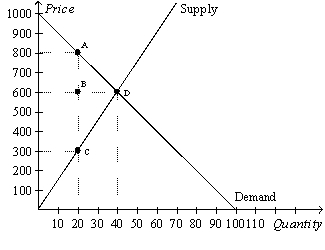 -Refer to Figure 8-9.The imposition of the tax causes the price received by sellers to decrease by
 (Multiple Choice)
4.8/5 (78)
(78) Which of the following would likely have the smallest deadweight loss relative to the tax revenue?
(Multiple Choice)
4.9/5 (76)
(76) Figure 8-5
Suppose that the government imposes a tax of P3 - P1.
 -Refer to Figure 8-5.The tax causes a reduction in consumer surplus that is represented by area
 (Multiple Choice)
4.8/5 (85)
(85) Figure 8-1
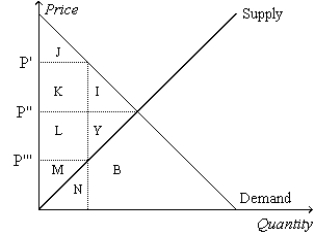 -Refer to Figure 8-1.Suppose the government imposes a tax of P' - P'''.The area measured by M represents
 (Multiple Choice)
4.9/5 (88)
(88) Figure 8-11
-Refer to Figure 8-11.The price labeled as P₁ on the vertical axis represents the price
-Refer to Figure 8-11.The price labeled as P₁ on the vertical axis represents the price (Multiple Choice)
4.8/5 (86)
(86) The Social Security tax,and to a large extent,the federal income tax,are labor taxes.
(True/False)
4.8/5 (77)
(77) Which of the following statements is correct regarding a tax on a good and the resulting deadweight loss?
(Multiple Choice)
4.8/5 (74)
(74) A $3.50 tax per gallon of paint placed on the sellers of paint will shift the supply curve
(Multiple Choice)
4.9/5 (66)
(66) For a good that is taxed,the area on the relevant supply-and-demand graph that represents government's tax revenue is a
(Multiple Choice)
4.8/5 (83)
(83) 
Filters
- Essay(0)
- Multiple Choice(0)
- Short Answer(0)
- True False(0)
- Matching(0)