



 Chat with AI
Exam 8: Application: The Costs of Taxation.

Exam 1: Ten Principles of Economics.349 Questions
Exam 2: Thinking Like an Economist.535 Questions
Exam 3: Interdependence and the Gains from Trade.443 Questions
Exam 4: The Market Forces of Supply and Demand.571 Questions
Exam 5: Elasticity and Its Application510 Questions
Exam 6: Supply, Demand, And Government Policies.557 Questions
Exam 7: Consumers, Producers, and the Efficiency of Markets.460 Questions
Exam 8: Application: The Costs of Taxation.424 Questions
Exam 9: Application: International Trade.410 Questions
Exam 10: Externalities.441 Questions
Exam 11: Public Goods and Common Resources.349 Questions
Exam 12: The Design of the Tax System.478 Questions
Exam 13: The Costs of Production.533 Questions
Exam 14: Firms in Competitive Markets.478 Questions
Exam 15: Monopoly.526 Questions
Exam 16: Monopolistic Competition.497 Questions
Exam 17: Oligopoly.410 Questions
Exam 18: The Market For the Factors of Production.463 Questions
Exam 19: Earnings and Discrimination.398 Questions
Exam 20: Income Inequality and Poverty.374 Questions
Exam 21: The Theory of Consumer Choice.462 Questions
Exam 22: Frontiers in Microeconomics.353 Questions
Select questions type


Economists use the government's tax revenue to measure the public benefit from a tax.
(True/False)
4.8/5  (67)
(67) Figure 8-12
 -Refer to Figure 8-12.Which of the following statements is not correct?
 (Multiple Choice)
4.9/5 (87)
(87) The elasticities of the supply and demand curves in the market for cigarettes affect how much a tax distorts that market.
(True/False)
4.8/5 (78)
(78) Because taxes distort incentives,they cause markets to allocate resources inefficiently.
(True/False)
5.0/5 (85)
(85) Suppose the government increases the size of a tax by 40 percent.The deadweight loss from that tax
(Multiple Choice)
4.8/5 (80)
(80) If the tax on a good is increased from $1 per unit to $3 per unit,the deadweight loss from the tax increases by a factor of
(Multiple Choice)
4.8/5 (72)
(72) The deadweight loss from a tax of $5 per unit will be smallest in a market with
(Multiple Choice)
4.8/5 (67)
(67) The benefit to buyers of participating in a market is measured by
(Multiple Choice)
4.9/5 (77)
(77) Figure 8-5
Suppose that the government imposes a tax of P3 - P1.
 -Refer to Figure 8-5.The tax is levied on
 (Multiple Choice)
4.9/5 (64)
(64) Figure 8-11
 -Refer to Figure 8-11.Suppose Q₁ = 4; Q₂ = 7; P₁ = $6; P₂ = $8; and P₃ = $10.Then,when the tax is imposed,
 (Multiple Choice)
5.0/5 (85)
(85) Figure 8-9
The vertical distance between points A and C represent a tax in the market.
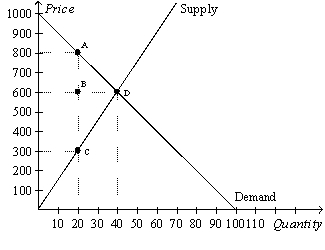 -Refer to Figure 8-9.The total surplus with the tax is
 (Multiple Choice)
4.8/5 (68)
(68) If the tax on a good is doubled,the deadweight loss of the tax
(Multiple Choice)
4.9/5 (65)
(65) Taxes on labor tend to increase the number of hours that people choose to work.
(True/False)
4.9/5 (92)
(92) Figure 8-9
The vertical distance between points A and C represent a tax in the market.
-Refer to Figure 8-9.The imposition of the tax causes the quantity sold to
-Refer to Figure 8-9.The imposition of the tax causes the quantity sold to (Multiple Choice)
5.0/5 (78)
(78) Economists generally agree that the most important tax in the U.S.economy is the
(Multiple Choice)
4.8/5 (80)
(80) Figure 8-2
The vertical distance between points A and B represents a tax in the market.
 -Refer to Figure 8-2.The imposition of the tax causes the price paid by buyers to
 (Multiple Choice)
4.9/5 (85)
(85) A decrease in the size of a tax is most likely to increase tax revenue in a market with
(Multiple Choice)
4.8/5 (67)
(67) Figure 8-5
Suppose that the government imposes a tax of P3 - P1.
-Refer to Figure 8-5.The total surplus with the tax is represented by area
-Refer to Figure 8-5.The total surplus with the tax is represented by area (Multiple Choice)
4.8/5 (80)
(80) The demand for bread is less elastic than the demand for donuts; hence,a tax on bread will create a larger deadweight loss than will the same tax on donuts,other things equal.
(True/False)
5.0/5 (74)
(74) 
Filters
- Essay(0)
- Multiple Choice(0)
- Short Answer(0)
- True False(0)
- Matching(0)