



 Chat with AI
Exam 8: Application: The Costs of Taxation.

Exam 1: Ten Principles of Economics.349 Questions
Exam 2: Thinking Like an Economist.535 Questions
Exam 3: Interdependence and the Gains from Trade.443 Questions
Exam 4: The Market Forces of Supply and Demand.571 Questions
Exam 5: Elasticity and Its Application510 Questions
Exam 6: Supply, Demand, And Government Policies.557 Questions
Exam 7: Consumers, Producers, and the Efficiency of Markets.460 Questions
Exam 8: Application: The Costs of Taxation.424 Questions
Exam 9: Application: International Trade.410 Questions
Exam 10: Externalities.441 Questions
Exam 11: Public Goods and Common Resources.349 Questions
Exam 12: The Design of the Tax System.478 Questions
Exam 13: The Costs of Production.533 Questions
Exam 14: Firms in Competitive Markets.478 Questions
Exam 15: Monopoly.526 Questions
Exam 16: Monopolistic Competition.497 Questions
Exam 17: Oligopoly.410 Questions
Exam 18: The Market For the Factors of Production.463 Questions
Exam 19: Earnings and Discrimination.398 Questions
Exam 20: Income Inequality and Poverty.374 Questions
Exam 21: The Theory of Consumer Choice.462 Questions
Exam 22: Frontiers in Microeconomics.353 Questions
Select questions type


When a tax is imposed on a good,the resulting decrease in consumer surplus is always larger than the resulting decrease in producer surplus.
(True/False)
4.8/5  (71)
(71) Economists generally agree that the most important tax in the U.S.economy is the
(Multiple Choice)
4.8/5 (89)
(89) Figure 8-2
The vertical distance between points A and B represents a tax in the market.
 -Refer to Figure 8-2.The loss of producer surplus for those sellers of the good who continue to sell it after the tax is imposed is
 (Multiple Choice)
4.8/5 (71)
(71) For the purpose of analyzing the gains and losses from a tax on a good,we use tax revenue as a direct measure of the
(Multiple Choice)
4.9/5 (73)
(73) Figure 8-10
 -Refer to Figure 8-10.Suppose the government imposes a tax that reduces the quantity sold in the market after the tax to Q2.The size of the tax is
 (Multiple Choice)
4.9/5 (79)
(79) Which of the following events is consistent with an increase in the deadweight loss of the gasoline tax from $30 million to $120 million?
(Multiple Choice)
4.9/5 (73)
(73) Scenario 8-2
Tom mows Stephanie's lawn for $25. Tom's opportunity cost of mowing Stephanie's lawn is $20, and Stephanie's willingness to pay Tom to mow her lawn is $28.
-Refer to Scenario 8-2.If Stephanie hires Tom to mow her lawn,Stephanie's consumer surplus is
(Multiple Choice)
4.9/5 (90)
(90) Figure 8-11
 -Refer to Figure 8-11.Suppose Q₁ = 4; Q₂ = 7; P₁ = $6; P₂ = $8; and P₃ = $10.Then,when the tax is imposed,
 (Multiple Choice)
4.8/5 (67)
(67) Suppose a tax of $0.10 per unit on a good creates a deadweight loss of $100.If the tax is increased to $0.25 per unit,the deadweight loss from the new tax would be
(Multiple Choice)
4.9/5 (75)
(75) Figure 8-10
-Refer to Figure 8-10.Suppose the government imposes a tax that reduces the quantity sold in the market after the tax to Q2.With the tax,the consumer surplus is
-Refer to Figure 8-10.Suppose the government imposes a tax that reduces the quantity sold in the market after the tax to Q2.With the tax,the consumer surplus is (Multiple Choice)
4.9/5 (72)
(72) The most important tax in the U.S.economy is the tax on corporations' profits.
(True/False)
4.7/5 (74)
(74) Figure 8-12
 -Refer to Figure 8-12.Which of the following combinations will minimize the deadweight loss from a tax?
 (Multiple Choice)
4.8/5 (92)
(92) For a good that is taxed,the area on the relevant supply-and-demand graph that represents government's tax revenue is
(Multiple Choice)
4.8/5 (91)
(91) Figure 8-19. The figure represents the relationship between the size of a tax and the tax revenue raised by that tax.
 -Refer to Figure 8-19.If the economy is at point A on the curve,then a small increase in the tax rate will
 (Multiple Choice)
4.8/5 (78)
(78) Figure 8-8
Suppose the government imposes a $10 per unit tax on a good.
 -Refer to Figure 8-8.The tax causes producer surplus to decrease by the area
 (Multiple Choice)
4.8/5 (78)
(78) Economists disagree on whether labor taxes cause small or large deadweight losses.This disagreement arises primarily because economists hold different views about
(Multiple Choice)
4.9/5 (77)
(77) Figure 8-16
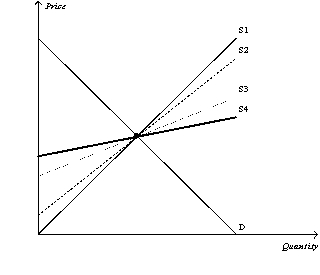 -Refer to Figure 8-16.Suppose the government imposes a $1 tax in each of the four markets represented by supply curves S1,S2,S3,and S4.The deadweight will be the largest in the market represented by
 (Multiple Choice)
4.9/5 (85)
(85) Figure 8-3
The vertical distance between points A and C represents a tax in the market.
 -Refer to Figure 8-3.The price that buyers effectively pay after the tax is imposed is
 (Multiple Choice)
4.8/5 (75)
(75) The larger the deadweight loss from taxation,the larger the cost of government programs.
(True/False)
4.9/5 (84)
(84) 
Filters
- Essay(0)
- Multiple Choice(0)
- Short Answer(0)
- True False(0)
- Matching(0)