



 Chat with AI
Exam 24: Health Care

Exam 1: Limits, Alternatives, and Choices107 Questions
Exam 2: The Market System and the Circular Flow287 Questions
Exam 3: Demand, Supply, and Market Equilibrium151 Questions
Exam 4: Market Failures Caused by Externalities Asymmetric Information229 Questions
Exam 5: Public Goods, Public Choice, and Government Failure268 Questions
Exam 6: Elasticity399 Questions
Exam 7: Utility Maximization358 Questions
Exam 8: Behavioral Economics311 Questions
Exam 9: Businesses and the Costs of Production445 Questions
Exam 10: Pure Competition in the Short Run342 Questions
Exam 11: Pure Competition in the Long Run250 Questions
Exam 12: Pure Monopoly407 Questions
Exam 13: Monopolistic Competition279 Questions
Exam 14: Oligopoly and Strategic Behavior362 Questions
Exam 15: Technology, RD, and Efficiency309 Questions
Exam 16: The Demand for Resources359 Questions
Exam 17: Wage Determination168 Questions
Exam 18: Rent, Interest, and Profit305 Questions
Exam 19: Natural Resource and Energy Economics337 Questions
Exam 20: Public Finance: Expenditures and Taxes336 Questions
Exam 21: Antitrust Policy and Regulation264 Questions
Exam 22: Agriculture: Economics and Policy265 Questions
Exam 23: Income Inequality, Poverty, and Discrimination324 Questions
Exam 24: Health Care280 Questions
Exam 25: Immigration259 Questions
Exam 26: International Trade347 Questions
Exam 27: The Balance of Payments, Exchange Rates, and Trade Deficits318 Questions
Exam 28: The Economics of Developing Countries277 Questions
Select questions type


Since 1960, health care costs in the United States have risen absolutely but remained constant as a percentage of gross domestic product.
(True/False)
4.7/5  (88)
(88) The Patient Protection and Affordable Care Act (PPACA)of 2010 is designed to address a wide-ranging set of issues including the following, except
(Multiple Choice)
4.9/5 (71)
(71) Insurance tends to drive up health care costs by encouraging greater use of health care resources. Why has this occurred in the United States but not in Canada or the United Kingdom?
(Multiple Choice)
4.8/5 (93)
(93) Which of the following would increase the supply of health care services?
(Multiple Choice)
4.8/5 (83)
(83) What are the two main types of managed-care organizations (or systems)that are used to control health care costs?
(Essay)
4.9/5 (83)
(83) 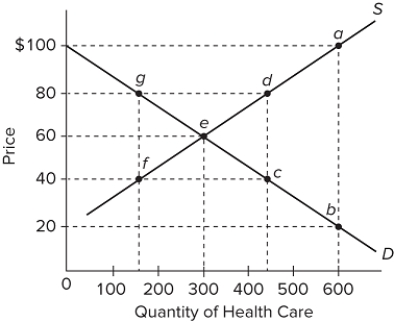 Refer to the graph of a hypothetical market for health care. If there was not health insurance, the equilibrium price and quantity of health care would be
 (Multiple Choice)
4.8/5 (72)
(72) Changes in the average age of the U.S. population over the past decade have decreased the demand for health care.
(True/False)
4.9/5 (87)
(87) Singapore encourages competition in its health care market by
(Multiple Choice)
4.9/5 (84)
(84) Approximately how many workers are employed in the U.S. health care industry?
(Multiple Choice)
4.9/5 (76)
(76) In 2007, approximately what percentage of people in the United States with private health insurance received it as an employer-provided benefit?
(Multiple Choice)
4.8/5 (84)
(84) There is a consensus among economists that the amount of resources allocated to the health care industry is optimal.
(True/False)
4.9/5 (74)
(74) Explain how unhealthy lifestyles contribute to increasing health care costs.
(Essay)
4.8/5 (76)
(76) Health insurance induces consumers to adopt less prevention and overconsumption of health care.
(True/False)
4.9/5 (88)
(88) The United States devotes about ______ percent of its gross domestic product to health care (2017).
(Multiple Choice)
4.8/5 (80)
(80)  The table gives supply and demand data for a certain elective surgical procedure. Without health insurance, the equilibrium price and quantity would be
 (Multiple Choice)
4.7/5 (92)
(92) The percentage of cost that an insured individual pays while the insurer pays the remainder would be considered
(Multiple Choice)
4.8/5 (76)
(76) The price elasticity of demand for health care is 0.2. This means that a 5 percent increase in price will induce a
(Multiple Choice)
4.9/5 (83)
(83) Which of the following is a supply factor in the health care market?
(Multiple Choice)
4.8/5 (78)
(78) 
Filters
- Essay(0)
- Multiple Choice(0)
- Short Answer(0)
- True False(0)
- Matching(0)