



 Chat with AI
Exam 24: Health Care

Exam 1: Limits, Alternatives, and Choices107 Questions
Exam 2: The Market System and the Circular Flow287 Questions
Exam 3: Demand, Supply, and Market Equilibrium151 Questions
Exam 4: Market Failures Caused by Externalities Asymmetric Information229 Questions
Exam 5: Public Goods, Public Choice, and Government Failure268 Questions
Exam 6: Elasticity399 Questions
Exam 7: Utility Maximization358 Questions
Exam 8: Behavioral Economics311 Questions
Exam 9: Businesses and the Costs of Production445 Questions
Exam 10: Pure Competition in the Short Run342 Questions
Exam 11: Pure Competition in the Long Run250 Questions
Exam 12: Pure Monopoly407 Questions
Exam 13: Monopolistic Competition279 Questions
Exam 14: Oligopoly and Strategic Behavior362 Questions
Exam 15: Technology, RD, and Efficiency309 Questions
Exam 16: The Demand for Resources359 Questions
Exam 17: Wage Determination168 Questions
Exam 18: Rent, Interest, and Profit305 Questions
Exam 19: Natural Resource and Energy Economics337 Questions
Exam 20: Public Finance: Expenditures and Taxes336 Questions
Exam 21: Antitrust Policy and Regulation264 Questions
Exam 22: Agriculture: Economics and Policy265 Questions
Exam 23: Income Inequality, Poverty, and Discrimination324 Questions
Exam 24: Health Care280 Questions
Exam 25: Immigration259 Questions
Exam 26: International Trade347 Questions
Exam 27: The Balance of Payments, Exchange Rates, and Trade Deficits318 Questions
Exam 28: The Economics of Developing Countries277 Questions
Select questions type


All of the following factors lead to overconsumption of health care, except
(Multiple Choice)
4.9/5  (71)
(71) Data on the income elasticity of demand for health care suggest that health care is a(n)
(Multiple Choice)
4.8/5 (79)
(79) The Patient Protection and Affordable Care Act (PPACA)was signed into law by
(Multiple Choice)
4.9/5 (86)
(86) The fundamental problem associated with the U.S. health care system is that
(Multiple Choice)
4.7/5 (71)
(71) 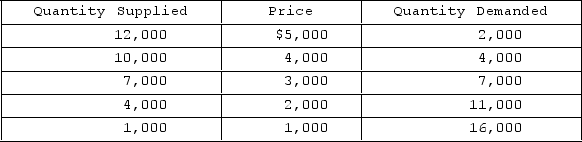 The table gives supply and demand data for a certain elective surgical procedure. Without health insurance, the equilibrium price and quantity would be
 (Multiple Choice)
4.7/5 (80)
(80) Aside from new taxes, the Patient Protection and Affordable Care Act (PPACA)aims to generate revenue by enforcing a personal mandate that requires all individuals not covered by employer- or government-provided health insurance to purchase insurance.
(True/False)
4.8/5 (80)
(80) 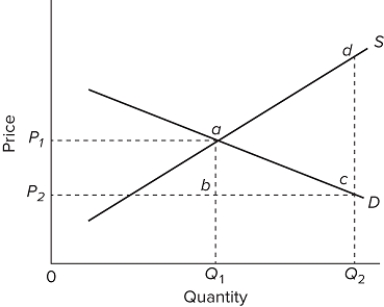 Refer to the demand and supply diagram, which relates to the health care market. Without health insurance, the equilibrium price and quantity of health care would be
 (Multiple Choice)
4.7/5 (71)
(71) Supporters of setting a cap on medical malpractice (or "pain and suffering")awards do not argue which of the following?
(Multiple Choice)
4.9/5 (62)
(62) A decrease in the demand for health care would most likely result from
(Multiple Choice)
4.8/5 (64)
(64) Proponents of the Patient Protection and Affordable Care Act (PPACA)had the primary goal to
(Multiple Choice)
4.9/5 (92)
(92) Rising health care costs have prompted workers to change jobs with greater frequency.
(True/False)
4.8/5 (81)
(81) The diagnosis-related group (DRG)system adopted by Medicare since 1983 has had the following effects, except
(Multiple Choice)
4.7/5 (84)
(84) The Patient Protection and Affordable Care Act (PPACA)attempts to provide health-insurance coverage to low-income people through the following methods, except
(Multiple Choice)
4.8/5 (85)
(85) About how many people were employed in the U.S. health care industry in 2017?
(Multiple Choice)
4.8/5 (74)
(74) Compared to younger people, those who are 65 and older tend to consume roughly
(Multiple Choice)
4.8/5 (84)
(84) 
Filters
- Essay(0)
- Multiple Choice(0)
- Short Answer(0)
- True False(0)
- Matching(0)