



 Chat with AI
Exam 26: International Trade

Exam 1: Limits, Alternatives, and Choices107 Questions
Exam 2: The Market System and the Circular Flow287 Questions
Exam 3: Demand, Supply, and Market Equilibrium151 Questions
Exam 4: Market Failures Caused by Externalities Asymmetric Information229 Questions
Exam 5: Public Goods, Public Choice, and Government Failure268 Questions
Exam 6: Elasticity399 Questions
Exam 7: Utility Maximization358 Questions
Exam 8: Behavioral Economics311 Questions
Exam 9: Businesses and the Costs of Production445 Questions
Exam 10: Pure Competition in the Short Run342 Questions
Exam 11: Pure Competition in the Long Run250 Questions
Exam 12: Pure Monopoly407 Questions
Exam 13: Monopolistic Competition279 Questions
Exam 14: Oligopoly and Strategic Behavior362 Questions
Exam 15: Technology, RD, and Efficiency309 Questions
Exam 16: The Demand for Resources359 Questions
Exam 17: Wage Determination168 Questions
Exam 18: Rent, Interest, and Profit305 Questions
Exam 19: Natural Resource and Energy Economics337 Questions
Exam 20: Public Finance: Expenditures and Taxes336 Questions
Exam 21: Antitrust Policy and Regulation264 Questions
Exam 22: Agriculture: Economics and Policy265 Questions
Exam 23: Income Inequality, Poverty, and Discrimination324 Questions
Exam 24: Health Care280 Questions
Exam 25: Immigration259 Questions
Exam 26: International Trade347 Questions
Exam 27: The Balance of Payments, Exchange Rates, and Trade Deficits318 Questions
Exam 28: The Economics of Developing Countries277 Questions
Select questions type


Tariffs and import quotas meant to increase domestic employment also eliminate domestic jobs in export industries.
(True/False)
4.7/5  (79)
(79) Which organization meets regularly to establish rules and settle disputes related to international trade?
(Multiple Choice)
4.9/5 (81)
(81) In a two-nation world, comparative advantage in the production of a particular product means that one nation can produce
(Multiple Choice)
4.8/5 (80)
(80) If country A can produce both goods X and Y more efficiently, that is, with smaller absolute amounts of resources, than can country B,
(Multiple Choice)
4.8/5 (71)
(71) Which is a valid counterargument to the infant industry argument for protective tariffs?
(Multiple Choice)
4.9/5 (83)
(83) One major factor that serves as an economic basis for world trade is the uneven distribution of resources among nations.
(True/False)
4.9/5 (84)
(84) 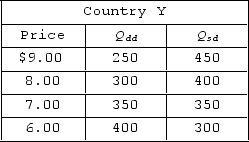 The accompanying table gives data for Country Y. Column 1 is the price of a product. Column 2 is the quantity demanded domestically (Qd), and Column 3 is the quantity supplied domestically (Qₛd). At what price will Country Y export 100 units of the product?
 (Multiple Choice)
4.9/5 (91)
(91) Frederic Bastiat's satirical argument against protectionism called for protecting domestic producers from
(Multiple Choice)
4.9/5 (86)
(86) If Nation A requires more resources to produce each bale of cloth than Nation B does, then we say that
(Multiple Choice)
5.0/5 (78)
(78) 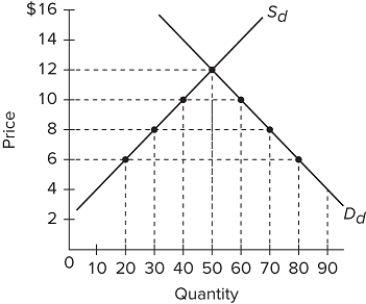 Refer to the accompanying graph, where Sd and Dd are the domestic supply and demand curves for a product. The world price of the product is $6. If this market were closed to international trade, the total revenue that would go to domestic producers would be
 (Multiple Choice)
4.9/5 (70)
(70) The following are commonly used arguments for protection against imports, except
(Multiple Choice)
4.9/5 (85)
(85) If Nations Quirk and Turk only produce aluminum or oil, the accompanying table shows the maximum output of each nation. 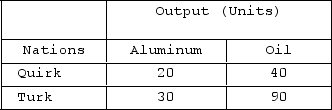 Which one of the following terms of trade is most likely to produce mutually beneficial exchange between the two nations?
 (Multiple Choice)
5.0/5 (83)
(83) 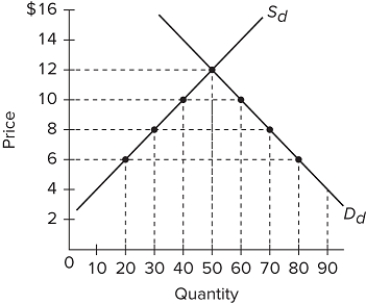 Refer to the accompanying graph, where Sd and Dd are the domestic supply and demand curves for a product. The world price of the product is $6. If the economy is open to international trade but a per unit tariff of $4 is imposed, then the total revenue going to domestic producers would be
 (Multiple Choice)
4.7/5 (88)
(88) Trade protection in most instances transfers wealth from consumers to domestic producers and government.
(True/False)
4.8/5 (84)
(84) During the Great Depression, most nations lowered tariffs and abolished import quotas to encourage the flow of trade.
(True/False)
4.8/5 (88)
(88) 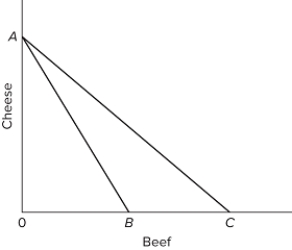 Refer to the given diagram, in which line AB is the U.S. production possibilities curve and AC is its trading possibilities curve. The international exchange ratio between beef and cheese (terms of trade)
 (Multiple Choice)
4.8/5 (99)
(99) 
Filters
- Essay(0)
- Multiple Choice(0)
- Short Answer(0)
- True False(0)
- Matching(0)