



 Chat with AI
Exam 26: International Trade

Exam 1: Limits, Alternatives, and Choices107 Questions
Exam 2: The Market System and the Circular Flow287 Questions
Exam 3: Demand, Supply, and Market Equilibrium151 Questions
Exam 4: Market Failures Caused by Externalities Asymmetric Information229 Questions
Exam 5: Public Goods, Public Choice, and Government Failure268 Questions
Exam 6: Elasticity399 Questions
Exam 7: Utility Maximization358 Questions
Exam 8: Behavioral Economics311 Questions
Exam 9: Businesses and the Costs of Production445 Questions
Exam 10: Pure Competition in the Short Run342 Questions
Exam 11: Pure Competition in the Long Run250 Questions
Exam 12: Pure Monopoly407 Questions
Exam 13: Monopolistic Competition279 Questions
Exam 14: Oligopoly and Strategic Behavior362 Questions
Exam 15: Technology, RD, and Efficiency309 Questions
Exam 16: The Demand for Resources359 Questions
Exam 17: Wage Determination168 Questions
Exam 18: Rent, Interest, and Profit305 Questions
Exam 19: Natural Resource and Energy Economics337 Questions
Exam 20: Public Finance: Expenditures and Taxes336 Questions
Exam 21: Antitrust Policy and Regulation264 Questions
Exam 22: Agriculture: Economics and Policy265 Questions
Exam 23: Income Inequality, Poverty, and Discrimination324 Questions
Exam 24: Health Care280 Questions
Exam 25: Immigration259 Questions
Exam 26: International Trade347 Questions
Exam 27: The Balance of Payments, Exchange Rates, and Trade Deficits318 Questions
Exam 28: The Economics of Developing Countries277 Questions
Select questions type


In a two-nation, two-good world, if both nations have identical production possibilities curves with constant costs, then one nation would have
(Multiple Choice)
4.8/5  (88)
(88) If a nation has a comparative advantage in the production of X, this means the nation
(Multiple Choice)
5.0/5 (83)
(83) Which of the following statements about the European Union (EU)is true?
(Multiple Choice)
4.8/5 (66)
(66) 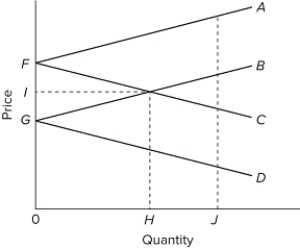 Refer to the diagram pertaining to two nations and a specific product. Lines FA and GB are
 (Multiple Choice)
4.8/5 (79)
(79) In a two-nation, two-good world, if country A has the comparative advantage in producing good X over country B, then country A
(Multiple Choice)
4.9/5 (81)
(81) The tables give production possibilities data for two countries, Alpha and Beta, which have populations of equal size. 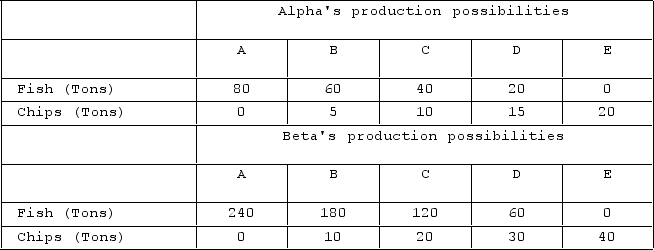 Assume the production possibilities in Beta double at alternatives A through E, while remaining as shown in the table for Alpha. As a result, Beta should
 (Multiple Choice)
4.9/5 (78)
(78) The World Trade Organization was established as a successor to
(Multiple Choice)
5.0/5 (68)
(68) In a world with two products, wheat (W)and coffee (C), nation Alpha produces wheat and nation Beta produces coffee. Nation Alpha prefers an exchange rate of 1W = 2C, and nation Beta prefers an exchange rate of 1W = 1C. The exchange rate preferred by nation
(Multiple Choice)
4.8/5 (66)
(66) Production of goods and services require different mixes of resources. Discuss the three different production resource intensities and give examples of each.
(Essay)
4.9/5 (73)
(73) Which of the following countries had the smallest share of exports as a percentage of GDP in 2018?
(Multiple Choice)
4.9/5 (80)
(80) As of 2018, how many European nations belonged to the European Union (EU)?
(Multiple Choice)
4.8/5 (75)
(75) Which of the following arguments contends that certain industries need to be protected in the interest of national security?
(Multiple Choice)
4.9/5 (77)
(77) 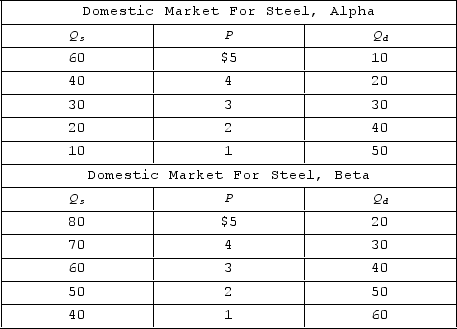 The accompanying tables show data for the hypothetical nations of Alpha and Beta. Qₛis domestic quantity supplied, and Qd is domestic quantity demanded. Alpha's export supply is represented by
 (Multiple Choice)
4.8/5 (75)
(75) Answer the question on the basis of the accompanying production possibilities tables for two countries, Latalia and Trombonia.  In Latalia the domestic real cost of 1 ton of pork
 (Multiple Choice)
4.9/5 (89)
(89) 
Filters
- Essay(0)
- Multiple Choice(0)
- Short Answer(0)
- True False(0)
- Matching(0)